

 Suche
Suche
 Mein Konto


You’ve probably heard of “Meat-Free Monday.” But now you might want to consider adding “Tofu Tuesday” to it.
According to a study, avoiding steak, bacon and sausages two days a week is enough to reduce the likelihood of developing cancer.
Researchers at the University of Oxford found that people who eat meat five times a week have a 9 percent lower risk of developing colon cancer.
The study, which tracked 470,000 Brits for more than a decade, found the risk was even lower for pescatarians, vegetarians and vegans.
Meat - especially red and processed meat - can increase the risk of colon cancer because chemicals produced during cooking can damage cells in the body.
Other chemicals in the meat itself – including nitrates – and its natural red dye can also be carcinogenic.
Around 43,000 people in the UK develop the disease, also known as bowel cancer, every year. It is Britain's second biggest cancer killer, claiming the lives of around 16,000 people every year.
It is the third leading cancer killer in the United States, with more than 50,000 people expected to die from the disease in the country this year.
The NHS recommends eating no more than 70g of red or processed meat per day - the equivalent of half a burger or two slices of bacon.
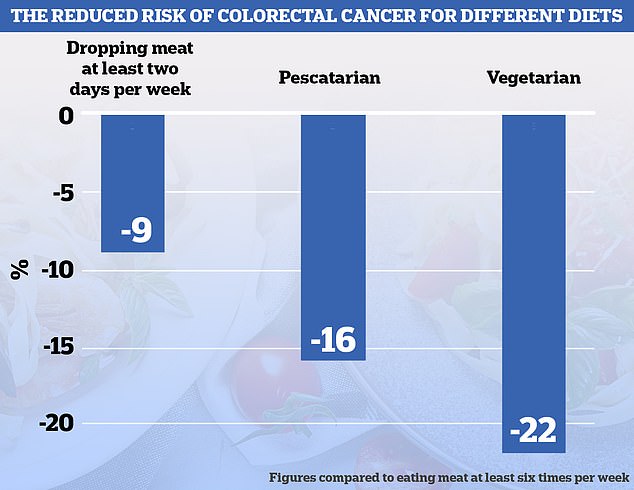
Researchers at the University of Oxford found that limiting meat intake to five or fewer days per week can reduce the risk of colon cancer by nine percent. The study of more than 470,000 Brits over 15 years found that the risk fell even further if people switched to eating fish or gave up meat altogether

Meat - especially red and processed meat - can increase the risk of colon cancer because chemicals produced during cooking can turn into cancer-causing compounds in the body
The study, published in BMC Medicine analyzed the diets of 472,377 adults aged 40 to 70 in England, Wales and Scotland.
Participants were cancer-free from 2006 to 2010, when the study began.
More than half (52 percent) were regular meat eaters – defined as at least six times a week.
44 percent fell into the “low” group, which the researchers classified as eating meat five times or less per week.
Only 2.3 percent were pescetarians - people who eat fish but not meat - and 1.8 percent were vegetarian or vegan.
Researchers then tracked the volunteers' NHS records for cancer diagnoses in the hope of identifying a trend.
They monitored whether participants were diagnosed with colon cancer, prostate cancer or breast cancer.
In total, 55,000 developed some form of cancer over the 11 years.
Nearly 11.7 people who ate meat five times a week developed some form of cancer, compared to 11.9 percent of the almost daily group.
For comparison: only 8.8 percent of pescatarians and 7.7 percent of vegetarians were diagnosed with the disease.
But the difference between the two meat-eating groups was more noticeable when looking specifically at colon cancer.
About 1.3 percent of those who ate meat at least six days a week were diagnosed, compared to 1.2 percent of those who ate meat less regularly.
After taking into account the gender and age of the patients, the scientists calculated that the group with lower meat consumption was nine percent less likely to develop colorectal cancer than those who ate it almost every day.
The risk was 16 percent lower among pescatarians and 22 percent lower among people who ate no meat or fish at all.
There was no risk difference between high and low meat consumption for prostate cancer - but it appeared to have a slight impact on breast cancer.
The risks were lower for pescatarians, vegetarians and vegans for all three types of cancer.
The team led by Cody Watling, a graduate student in cancer epidemiology at the university, wrote in the study that the increased risk of colorectal cancer is unlikely to be caused solely by higher obesity levels in the meat group, which tended to have higher BMIs.
But they admitted they couldn't prove what caused the link between eating more meat and a higher risk of colon cancer.
They wrote: “Consumption of processed meat has been classified by the World Health Organization and the World Cancer Research Fund as a definite cause of colorectal cancer and red meat as a probable cause of colorectal cancer.
“This likely explains, at least in part, the lower risk of colorectal cancer in people with low meat eating habits, and the proposed mechanisms include chemicals in meat such as nitrosamines.”
Independent experts said the study did not take into account how much meat was eaten by volunteers on each day.
Dr. Duane Mellor, a nutritionist at Aston University in Birmingham, said that while the study "could not assess whether participants ate more or less than the amount of meat recommended under healthy eating guidelines."
He added: “Perhaps more importantly, what the people in the study ate with their meat was not taken into account.
“Previous studies have looked at the interaction between meat consumption and fiber, suggesting that higher fiber intake may reduce the risk of colon cancer in particular from meat consumption.
“This could be because the fiber reduces the risk of potentially cancer-causing chemicals in meat coming into contact with our intestinal lining.
"A problem with this study (like many others that examine the connection between one type of food and cancer) is that it does not look at the entire diet - it may be just as important to look at what is eaten and what is not."