

 Suche
Suche
 Mein Konto
Why do some people attract mosquitoes more than others?

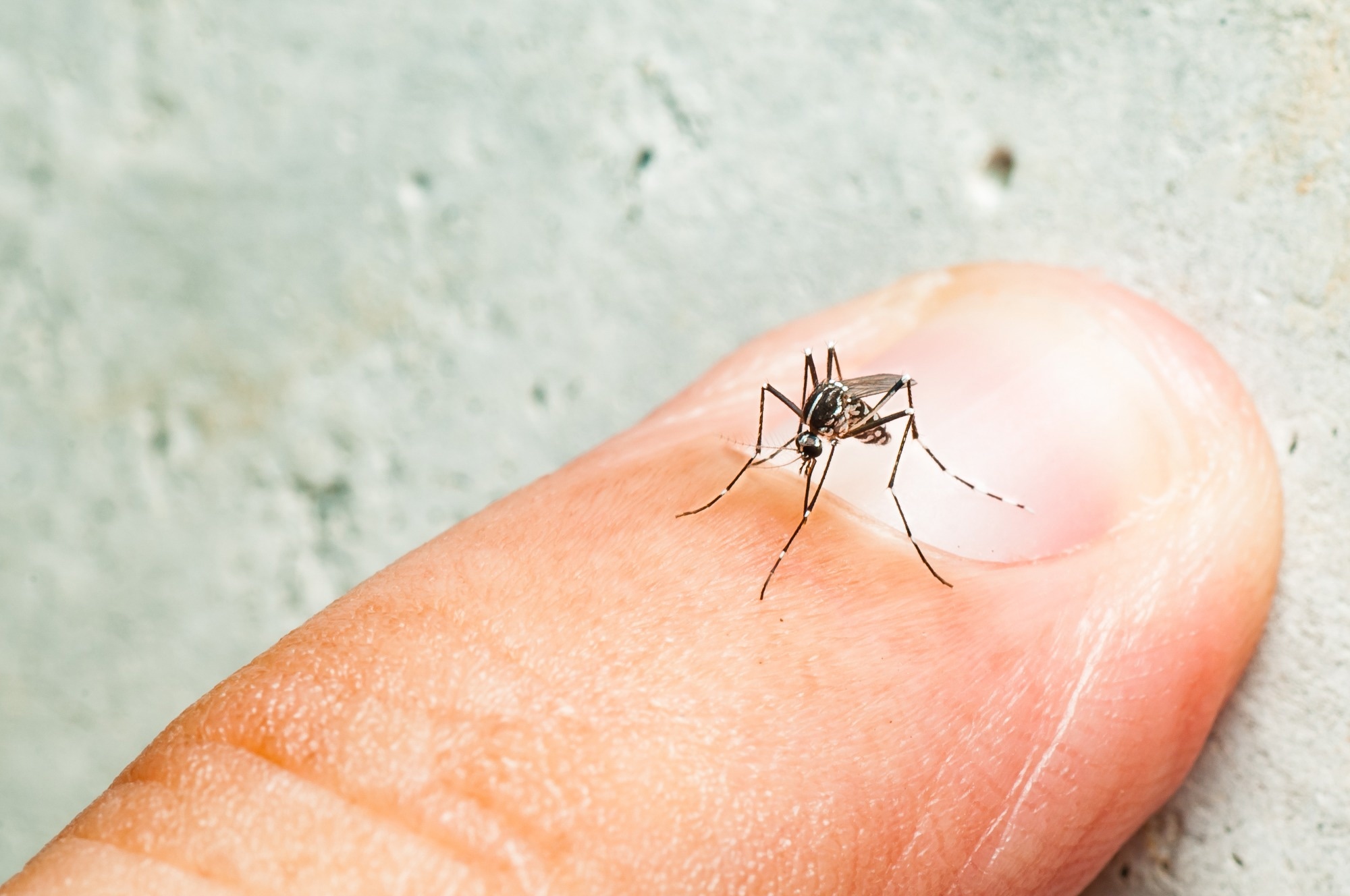
Mosquitoes (e.g. Aedes aegypti) are common vectors of many viruses that infect the human population, such as: B. Dengue fever, Zika and yellow fever. A single female mosquito can bite multiple people over the course of her three to six week lifespan. Aedes aegypti is an efficient vector because it has a strong innate drive to prey on human hosts via sensory signals such as body heat, exhaled carbon dioxide (CO2), and skin color. Learn: The different attraction of mosquitoes to humans is related to the level of carboxylic acid in the skin. Image credit: Fendizz / Shutterstock Background Although body heat and CO2 are common stimuli that affect a living, warm-blooded animal...

Why do some people attract mosquitoes more than others?
Mosquitoes (e.g. Aedes aegypti) are common vectors of many viruses that infect the human population, such as: B. Dengue fever, Zika and yellow fever. A single female mosquito can bite multiple people over the course of her three to six week lifespan. Aedes aegypti is an efficient vector because it has a strong innate drive to prey on human hosts via sensory signals such as body heat, exhaled carbon dioxide (CO2), and skin color.
background
Although body heat and CO2 are common stimuli that indicate a live, warm-blooded animal, a specific skin odor helps identify whether the target is non-human or human. Additionally, there is a wealth of research indicating that mosquitoes are more attracted to some individuals than others. However, the underlying mechanism for this behavior is not yet clear.
Some non-scientific speculations about why some people are more attracted to mosquitoes than others include differences in blood type, pregnancy, malaria infection, and beer consumption. However, the most widely accepted explanation is differences in skin odor that are due to a person's unique skin microbiota.
Human skin odor is a mixture of many organic compounds, the exact composition of which has not yet been extensively studied. Furthermore, the extent of interindividual variation in skin odor remains to be thoroughly analyzed. Therefore, it is not known which components are crucial for the attraction of mosquitoes to humans.
Depending on the exact composition and concentration of certain molecules, certain fragrance blends may be less or more attractive. For example, research has shown that the mixture of ammonia and lactic acid has a strong attraction to mosquitoes. In addition, carboxylic acids in combination with ammonia and lactic acid increase the attraction to mosquitoes.
About the study
In a new study published in the journal cell Scientists studied the skin-derived compounds that distinguish between highly and weakly attractive people. In addition, the mosquitoes' sensory pathways, which are necessary to identify these individuals, were analyzed. A two-choice behavioral test was developed to test mosquito attraction at higher throughput. This enabled frequent and repeated sampling of human subjects. Human skin odor samples were collected from nylon stockings worn on the forearms of 64 subjects. Mosquitoes were then examined to find out which nylon stockings were attractive to them.
Key results
A cohort of people were discovered who were weak and highly attractive to mosquitoes. It was also documented that the Orco (olfactory receptor co-receptor) was not required to differentiate between them. Furthermore, the differential attractiveness of individuals to mosquitoes was found to be stable over many months and to be related to the abundance of skin-associated carboxylic acids.
The extremely attractive group produced more significant amounts of three carboxylic acids, pentadecanoic acid, heptadecanoic acid and nonadecanoic acid, as well as ten other unidentified compounds of the same chemical class. However, the specific mixture of these chemicals differed in the very attractive test subjects. From this it was concluded that there could be several reasons why a person is extremely attractive to mosquitoes. It was found that no particular chemical was produced in large quantities for less attractive subjects.
An individual's attractiveness could also depend on group attitudes; The “mosquito magnet” in a group could be bitten multiple times, while the less attractive people remain more or less unaffected. It was suggested that exceptionally high or low attractiveness was a “fixed trait” that remained constant over several years. Research has also shown that identical twins are similarly more attractive to mosquitoes than fraternal twins, suggesting the presence of a genetic component.
It was observed that there was significant redundancy in human skin odor recognition. A possible mechanism of the ionotropic receptor (IR) could be that not one but three co-receptors are used for the odorant receptor (OR) system. The results documented in this study show that mosquitoes do not distinguish between weakly and highly attractive people based on a single smell.
Concluding remarks
The current study examined the connection between the attractiveness of individuals to mosquitoes and the abundance of carboxylic acid in the skin. However, a causal relationship could not be proven as this would require confirmation of the necessity and sufficiency of specific chemicals for mosquito magnetism.
As mentioned above, the smell of human skin is a complex mixture of multiple chemicals, and each requires a specific detection method. This study mainly focused on carboxylic acid groups, but did not fully document all human skin metabolites. Therefore, other types of compounds may influence mosquitoes' different levels of attraction to humans. This issue was not addressed in this study.
The authors pointed out that the carboxylic acids identified in the present study were non-volatile, raising the question of their function in the differential attraction of mosquitoes to humans over long distances. In the future, different analytical methods could be used to identify other compounds concentrated on the skin that attract mosquitoes.
Reference:
- De Obaldia, EM et al. (2022) Die unterschiedliche Anziehungskraft von Mücken auf den Menschen hängt mit dem Carbonsäurespiegel in der Haut zusammen. Zelle. https://doi.org/10.1016/j.cell.2022.09.034, https://www.sciencedirect.com/science/article/pii/S0092867422012533
.