

 Suche
Suche
 Mein Konto
Globalization and the end of smallpox vaccination influence the spread of monkeypox

In the late 1970s, smallpox was eradicated worldwide thanks to large-scale vaccination programs. Smallpox is a highly contagious and fatal disease caused by the variola virus. The currently circulating monkeypox virus (MPXV) is closely linked to the variola virus. Previously, MPXV was only endemic in sub-Saharan Africa, but has since spread worldwide. Older people who have received the smallpox vaccination should be adequately protected against smallpox viruses. A recent review by Barbara S. Schnierle of the Paul Ehrlich Institute, Germany, and published in the journal Viruses summarized the existing knowledge about MPXV, the disease it causes, and the strategies to contain its spread. …

Globalization and the end of smallpox vaccination influence the spread of monkeypox
In the late 1970s, smallpox was eradicated worldwide thanks to large-scale vaccination programs. Smallpox is a highly contagious and fatal disease caused by the variola virus. The currently circulating monkeypox virus (MPXV) is closely linked to the variola virus. Previously, MPXV was only endemic in sub-Saharan Africa, but has since spread worldwide. Older people who have received the smallpox vaccination should be adequately protected against smallpox viruses. A recent review by Barbara S. Schnierle from the Paul Ehrlich Institute, Germany, and published in the journal Viruses summarized existing knowledge about MPXV, the disease it causes, and strategies to control its spread.
background
MPXV became the most common zoonotic orthopoxvirus infection in humans following eradication of variola virus (VARV). It was first identified among macaques in Denmark in 1958, and later, in 1970, human cases were reported in the Democratic Republic of the Congo (DRC). Infections occurring primarily in children have been reported sporadically in the Democratic Republic of Congo and other central and west African countries. Unlike VARV, which only existed in primates, MPXV can infect many species.
Rodents, African squirrels and non-human primates have been described as MPXV reservoirs. There are two distinct genetic clades of MPXV, namely clade I (Central African or Congo Basin (CB) clade) and clade II (West African (WA) clade). The mortality rates for Clade I and Clade II were reported to be 10.6% and 3.6%, respectively, and a 10-kbp deletion in Clade II was also observed using genomic analysis.
The current outbreak is driven by clade II, and the World Health Organization (WHO) had confirmed 25,047 cases outside Africa as of August 2, 2022. 99% of cases were men with an average age of 36 years and 98% were men who had sex with men (MSM). The global spread of MPXV was declared a public health emergency of international concern (PHEIC) by the WHO in July 2022.
The clinical disease caused by MPXV
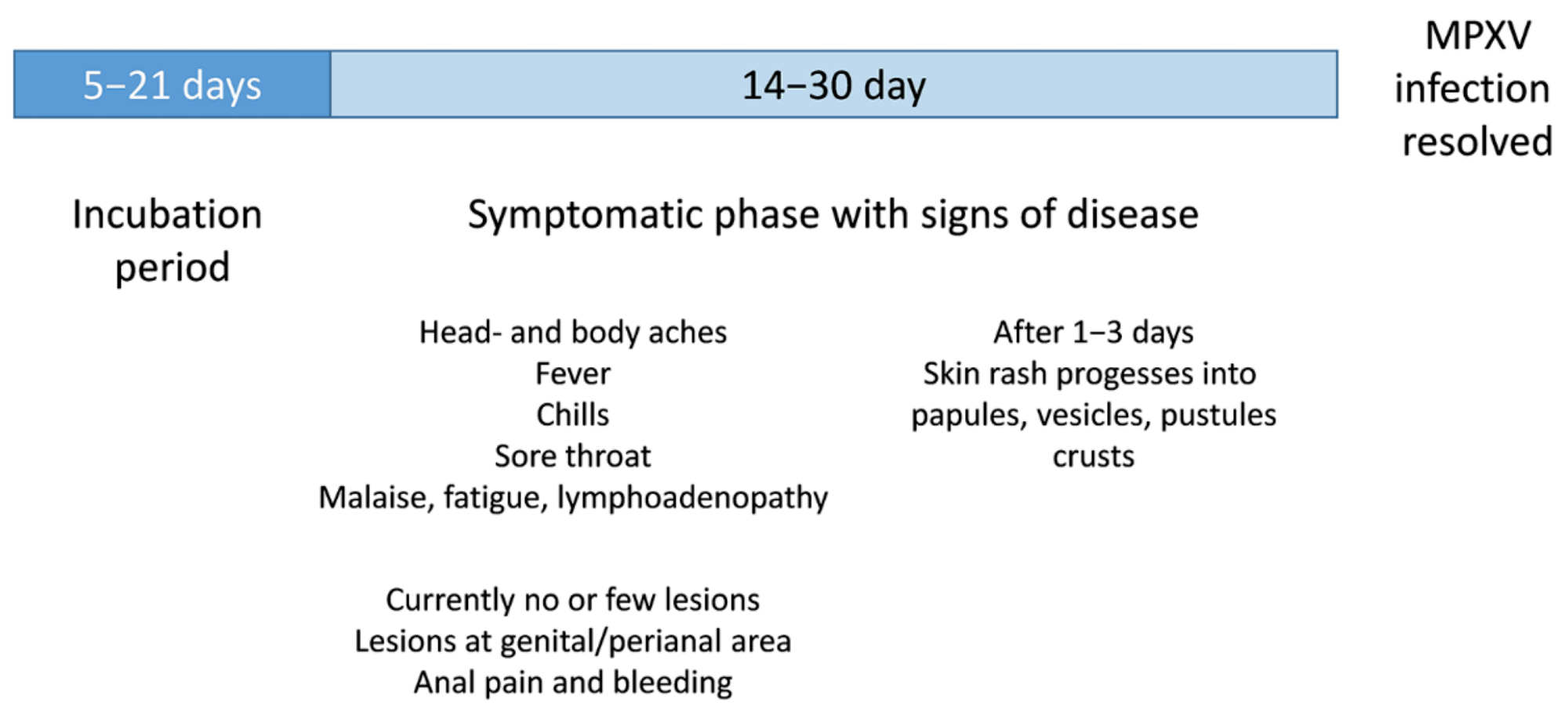
The incubation period of MPXV is typically 5-13 days but can last up to 21 days. The first signs are severe headache, fever, sore throat, nasal congestion, cough, etc. A rash may appear on the face and extremities within the first three days after the onset of fever. Loss of vision is also possible because the cornea is affected.
The initial rash eventually dries up and falls off after passing through the papule, vesicle, pustule, and crust phases. The number of lesions varies from person to person and can range from a few to several thousand. In the current outbreak, lesions occur primarily near the genitals or anus, but other locations such as the feet, face, and chest are not uncommon. Severe cases can occur in pregnant women, children and immunocompromised people.
Diagnosis and treatment
Genetics & Genomics eBook
Compilation of the top interviews, articles and news from the last year.
Download a copy today
The symptoms are very similar to those of measles or chickenpox. The skin lesion material contains a sufficient amount of MPXV for PCR testing. Additionally, detection of MPXV-specific IgM could indicate infection; However, serological testing could be affected by recent vaccination.
Vaccination is considered the most effective way to prevent orthopoxvirus infections. Smallpox vaccines are expected to be 85% effective against MPXV. The smallpox vaccine ACAM2000, approved in North America, is administered as a single dose using a forked needle. However, it cannot be used in immunocompromised people.
LC16m8 is a third-generation vaccine approved in Japan. It is derived from the Lister strain of vaccinia virus (VACV) and has shown an improved safety profile. It has the same exclusion criteria as ACAM2000 but has been shown to be effective in animal models. In addition, the Food and Drug Administration (FDA) and the European Medicine Agency (EMA) have approved a fourth-generation vaccine based on the modified vaccinia virus Ankara (MVA) for adults only.
Further, immunization with vaccinia immunoglobulin (VIG) isolated from blood samples of individuals vaccinated with the smallpox vaccine can be administered intravenously. Brincidofovir and tecovirimat (ST-246) are two oral medications that have been approved to treat smallpox but have been shown to be effective against MPXV in animals. The former is approved in the US, while the latter has been approved for emergency use by the FDA and EMA.
Future perspective
The discontinuation of smallpox vaccination in 1980 is believed to be the main reason for the current MPXV outbreak, as it made younger people susceptible to the infection. In the era of global travel, disease surveillance in endemic and non-endemic regions is essential. It is unclear whether the 2022 MPXV differs from previous isolates in transmissibility, host switching, or pathology. Future research should urgently examine this question.
Smallpox vaccines are probably effective against MPXV. Since the current outbreak is focused on the MSM community, they, close contacts and healthcare workers should be offered vaccination. Furthermore, large-scale vaccination campaigns could be organized in endemic areas to prevent potential future outbreaks.
Reference:
- Schnierle, BS (2022) Monkeypox Goes North: Fortlaufende weltweite Monkeypox-Infektionen beim Menschen. Viren, 14, 1874. https://doi.org/10.3390/v14091874, https://www.mdpi.com/1999-4915/14/9/1874/htm
.