

 Suche
Suche
 Mein Konto
Centuries-old mobility aids can be replaced with wearable exoskeletons

Exoskeletons - motorized mechanical devices attached to a person's body to aid movement - have been a popular feature in science fiction films from Robocop to Iron Man to give someone superhuman abilities. Ankle exoskeleton. Photo credit: Victoria University But researchers at Victoria University's (VU) Institute of Health and Sport are using the concept in real life to help older people or those with physical injuries or neurological diseases such as spinal cord damage, stroke or osteoarthritis improve their mobility. As one of the few organizations in the world combining gait biomechanics, robotics, computational intelligence and wearable sensors, VU has been working for nearly a decade...

Centuries-old mobility aids can be replaced with wearable exoskeletons
Exoskeletons - motorized mechanical devices attached to a person's body to aid movement - have been a popular feature in science fiction films from Robocop to Iron Man to give someone superhuman abilities.
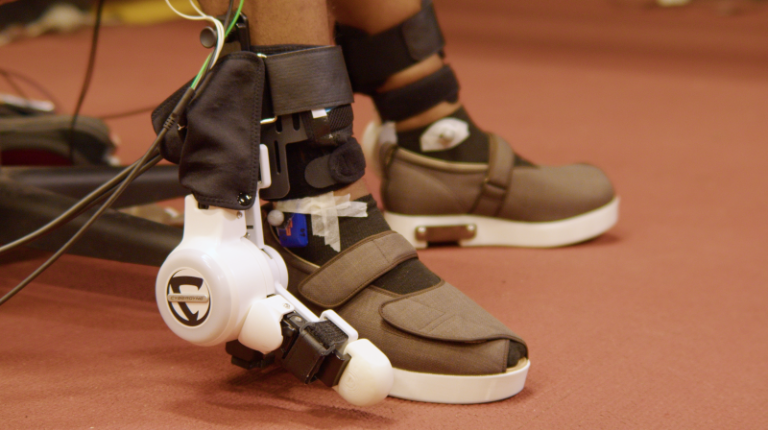
Knöchel-Exoskelett. Bildnachweis: Victoria University
But researchers at Victoria University's (VU) Institute of Health and Sport are using the concept in real life to help older people or those with physical injuries or neurological conditions such as spinal cord damage, stroke or osteoarthritis improve their mobility.
As one of the few organizations in the world combining gait biomechanics, robotics, computational intelligence and wearable sensors, VU has been working for nearly a decade on research that will enable wearable exoskeletons to replace century-old mobility aids such as wheelchairs, walkers or canes.
The researchers Professor Rezaul Begg and Dr. Hanatsu Nagano is currently conducting research with the world's leading Japanese company CYBERDYNE (which, anecdotally, is the name of a fictional robotics company in Terminator films), which has developed the world's first wearable cyborg, the Hybrid Assistive Limb (HAL). exoskeleton.
How a Hybrid Assistive Limb (HAL) exoskeleton works
HAL identifies and anticipates an impaired person's remaining muscle activation commands as "microelectricity" through a sensor attached to the wearer, which then controls an external robotic device attached to the non-functioning limb. For example, when attached to an ankle, it can use the microelectricity signal to precisely control the exoskeleton's required timing and ankle movement for walking.
In short, it understands the wearer’s intent and helps him or her reproduce the intended movement.”
Professor Rezaul Begg
With repeated training, the device could affect the neuroplasticity of a wheelchair-bound patient's brain, helping to reconnect signals between their damaged nervous system and their limbs to improve or even restore motor functions.
“The use of exoskeletons for technology-assisted rehabilitation is already happening worldwide,” said Dr. Nagano.
“VU’s research with our Japanese partners lays the foundation for clinical applications in Australia.”
Ultimately, and within the next five to ten years, Dr. Nagano is introducing a HAL research center at VU where exoskeletons will be tailored to work with Victoria's estimated 54,000 wheelchair users.
The project received a prestigious grant from the Victorian Government's Victorian Endowment for Science, Knowledge and Innovation (VESKI). The VU is also working with the University of Tsukuba in Japan on this project.
Look at this video to see a hybrid supportive limb exoskeleton (HAL) in action.
Source:
.