

 Suche
Suche
 Mein Konto
Neurodermatitis
Neurodermatitis
overview
Neurodermatitis
Neurodermatitis
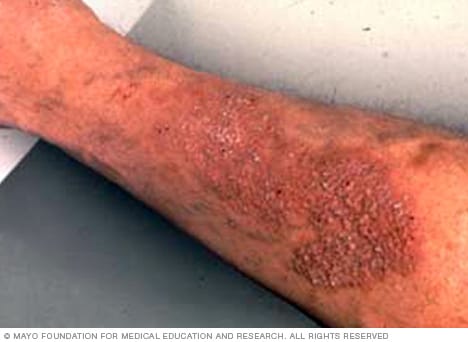
Atopic dermatitis is a skin disease characterized by chronic itching or flaking. You will notice raised, rough, itchy patches of skin - typically on the neck, wrists, forearms, legs, or anal area.
Atopic dermatitis is a skin disease that begins with an itchy patch of skin. Scratching makes it even itchier. This itch-scratch cycle causes the affected skin to become thick and leathery. You may develop multiple itchy spots, typically on the neck, wrists, forearms, legs, or anal area.
Neurodermatitis – also known as lichen simplex chronicus – is neither life-threatening nor contagious. But the itching can be so intense or recurring that it affects your sleep, sexual function, and quality of life.
Breaking the itch-scratch cycle of eczema is challenging, and eczema is usually a lifelong condition. The success of treatment depends on whether you resist the urge to rub or scratch the affected areas. Over-the-counter or prescription medications can help relieve itching. You also need to identify and eliminate factors that can make the problem worse.
Symptoms
Signs and symptoms of neurodermatitis are:
- Ein juckender Hautfleck oder Flecken
- Ledrige oder schuppige Textur an den betroffenen Stellen
- Ein erhabener, rauer Fleck oder Flecken, die rot oder dunkler als der Rest Ihrer Haut sind
The condition affects areas that can be reached for scratching – the head, neck, wrists, forearms, ankles, vulva, scrotum or anus. The itching, which can be intense, may come and go or be continuous. You may scratch yourself out of habit and in your sleep.
When to go to the doctor?
See your doctor if:
- Du erwischst dich dabei, wie du immer wieder denselben Hautfleck kratzt
- Der Juckreiz hindert Sie daran, zu schlafen oder sich auf Ihre täglichen Routinen zu konzentrieren
- Ihre Haut schmerzt oder sieht infiziert aus und Sie haben Fieber
Causes
The cause of neurodermatitis is unknown. The persistent rubbing and scratching that characterizes the condition can begin with something that simply irritates the skin, such as tight clothing or an insect bite. Rubbing or scratching the area will make it more itchy. The more you scratch, the more it itches.
In some cases, neurodermatitis is accompanied by chronic skin diseases - such as dry skin, eczema or psoriasis. Stress and anxiety can also trigger itching.
Risk factors
Certain factors can affect your risk of eczema, including:
- Ihr Geschlecht und Alter. Frauen erkranken häufiger an Neurodermitis als Männer. Die Erkrankung tritt am häufigsten im Alter zwischen 30 und 50 Jahren auf.
- Andere Hauterkrankungen. Menschen mit einer persönlichen oder familiären Vorgeschichte von Dermatitis, Ekzemen, Psoriasis oder ähnlichen Hauterkrankungen entwickeln eher Neurodermitis.
- Angststörungen. Angst und Stress können den Juckreiz der Neurodermitis auslösen.
Complications
Persistent scratching can lead to a wound, a bacterial skin infection, or permanent scarring and changes in skin color. The itching of eczema can affect your sleep, sexual function, and quality of life.
Sources:
- Fragen Sie MayoExpert. Juckreiz ohne Hautausschlag. Rochester, Minnesota: Mayo Foundation for Medical Education and Research; 2018.
- Lichen simplex chronicus (Neurodermitis). Merck Manual Professional-Version. https://www.merckmanuals.com/professional/dermatologic-disorders/dermatitis/lichen-simplex-chronicus. Abgerufen am 28. Juni 2018.
- Goldsmith LA, et al., Hrsg. Nummuläres Ekzem, Lichen simplex chronicus und Prurigo nodularis. In: Fitzpatricks Dermatologie in der Allgemeinmedizin. 8. Aufl. New York, NY: Die McGraw-Hill-Unternehmen; 2012. https://www.accessmedicine.mhmedical.com. Abgerufen am 29. Juli 2015.
- Bolognia JL, et al., Hrsg. Juckreiz und Dysästhesie. In: Dermatologie. 4. Aufl. Philadelphia, Pennsylvania: Saunders Elsevier; 2018. https://www.clinicalkey.com. Abgerufen am 29. Juni 2018.
- Fragen Sie MayoExpert. Lichen sclerosus (balanitis xerotica obliterans). Rochester, Minnesota: Mayo Foundation for Medical Education and Research; 2018.
- Fazio SB, et al. Juckreiz: Überblick über das Management. https://www.uptodate/contents/search. Abgerufen am 28. Juni 2018.
- Ferri FF. Lichen simplex chronicus. In: Ferri’s Clinical Advisor 2019. Philadelphia, Pa.: Elsevier; 2019. https://www.clinicalkey.com. Abgerufen am 28. Juni 2018.
- Neurodermitis. Amerikanische Akademie für Dermatologie. https://www.aad.org/dermatology-a-to-z/diseases-and-treatments/m—p/neurodermatitis. Abgerufen am 28. Juni 2018.
- Liao YH, et al. Erhöhtes Risiko für Lichen simplex chronicus bei Menschen mit Angststörung: Eine landesweite bevölkerungsbasierte retrospektive Kohortenstudie. Britisches Journal für Dermatologie. 2014;170:890.
- Cohen KR. Pruritus im Alter: Klinische Ansätze zur Verbesserung der Lebensqualität. P&T. 2012;37:227.
- Gibson LE (Gutachten). Mayo Clinic, Rochester, Minnesota, 10. September 2018.