

 Suche
Suche
 Mein Konto
Pneumothorax
Pneumothorax
overview
Collapsed and normal lungs
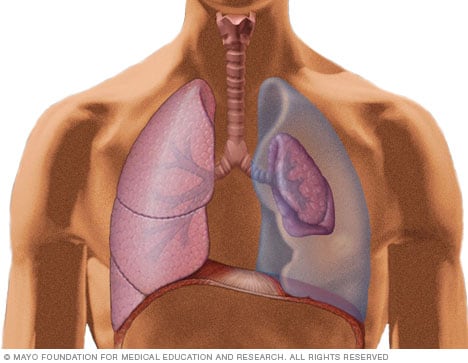
Collapsed and normal lungs
When a lung collapses, air leaks from the lungs into the chest cavity. The example shown is a complete left pneumothorax.
A pneumothorax (noo-moe-THOR-aks) is a collapsed lung. A pneumothorax occurs when air enters the space between the lungs and the chest wall. This air pushes on the outside of your lungs, causing them to collapse. A pneumothorax can be a complete lung collapse or a collapse of only part of the lung.
A pneumothorax can be caused by a blunt or penetrating chest injury, certain medical procedures, or damage from an underlying lung disease. Or it may occur for no apparent reason. Symptoms usually include sudden chest pain and shortness of breath. In some cases, a collapsed lung can be a life-threatening event.
Treatment for a pneumothorax usually involves inserting a needle or chest tube between the ribs to remove the excess air. However, a small pneumothorax can heal on its own.
Symptoms
The main symptoms of a pneumothorax are sudden chest pain and shortness of breath. The severity of symptoms may depend on how much of the lung has collapsed.
When to go to the doctor?
Symptoms of a pneumothorax can be caused by a variety of health problems, and some can be life-threatening, so seek medical attention. If your chest pain is severe or breathing becomes increasingly difficult, seek emergency care immediately.
Causes
A pneumothorax can be caused by:
- Brustverletzung. Jede stumpfe oder durchdringende Verletzung Ihrer Brust kann zu einem Lungenkollaps führen. Einige Verletzungen können bei körperlichen Übergriffen oder Autounfällen auftreten, während andere unbeabsichtigt bei medizinischen Eingriffen auftreten können, bei denen eine Nadel in die Brust eingeführt wird.
- Lungenerkrankung. Beschädigtes Lungengewebe kollabiert eher. Lungenschäden können durch viele Arten von Grunderkrankungen verursacht werden, wie zum Beispiel chronisch obstruktive Lungenerkrankung (COPD), Mukoviszidose, Lungenkrebs oder Lungenentzündung. Zystische Lungenerkrankungen wie die Lymphangioleiomyomatose und das Birt-Hogg-Dube-Syndrom verursachen runde, dünnwandige Luftsäcke im Lungengewebe, die reißen können, was zu einem Pneumothorax führt.
- Geplatzte Luftblasen. Oben auf der Lunge können sich kleine Luftbläschen (Bläschen) bilden. Diese Luftbläschen platzen manchmal und lassen Luft in den Raum um die Lunge eintreten.
- Mechanische Lüftung. Eine schwere Art von Pneumothorax kann bei Menschen auftreten, die mechanische Unterstützung zum Atmen benötigen. Das Beatmungsgerät kann ein Ungleichgewicht des Luftdrucks in der Brust erzeugen. Die Lunge kann vollständig kollabieren.
Risk factors
In general, men are much more likely to have pneumothorax than women. The type of pneumothorax caused by ruptured air bubbles is most likely to occur in people between the ages of 20 and 40, especially if the person is very tall and underweight.
Underlying lung disease or mechanical ventilation may be a cause or risk factor for pneumothorax. Other risk factors include:
- Rauchen. Das Risiko steigt mit der Dauer und der Anzahl der gerauchten Zigaretten auch ohne Lungenemphysem.
- Genetik. Bestimmte Arten von Pneumothorax scheinen in Familien zu laufen.
- Früherer Pneumothorax. Jeder, der einen Pneumothorax hatte, hat ein erhöhtes Risiko für einen weiteren.
Complications
Possible complications vary depending on the size and severity of the pneumothorax as well as the cause and treatment. Sometimes air can continue to leak if the opening in the lung does not close or a pneumothorax occurs again.
Pneumothorax care
Sources:
- Ferri FF. Pneumothorax, spontan. In: Ferri’s Clinical Advisor 2021. Elsevier; 2021. https://www.clinicalkey.com. Abgerufen am 4. Februar 2021.
- Weinberger SE, et al. Pleuraerkrankung. In: Grundlagen der Lungenheilkunde. 7. Aufl. Elsevier; 2019. https://www.clinicalkey.com. Abgerufen am 4. Februar 2021.
- Tintinalli JE, et al., Hrsg. Pneumothorax. In: Tintinalli’s Emergency Medicine: A Comprehensive Study Guide. 9. Aufl. McGraw-Hill; 2020. https://www.accessmedicine.mhmedical. Abgerufen am 4. Februar 2021.
- Fragen Sie MayoExpert. Pneumothorax. Mayo-Klinik; 2020.
- Paskaradevan J, et al. Was ist ein Spontanpneumothorax? American Journal of Respiratory and Critical Care Medicine. 2020; doi:10.1164/rccm.20212P33.
- Pneumothorax. Merck Manual Professional-Version. https://www.merckmanuals.com/professional/pulmonary-disorders/mediastinal-and-pleural-disorders/pneumothorax. Abgerufen am 4. Februar 2021.
- Ding M. et al. Endobronchiale Einwegventile zur Behandlung von anhaltenden Luftlecks: Eine systematische Überprüfung. Atemforschung. 2017; doi:10.1186/s12931-017-0666-y.
- Braun AY. Allscripts EPSi. Mayo-Klinik. 11. Januar 2021.
- Jones KD. Lungenzystische Erkrankung und ihre Nachahmer. Kliniken für Chirurgische Pathologie. 2020; doi:10.1016/j.path.2019.11.007.
- Hallifax R. et al. Pneumothorax ⸺ Zeit für neue Richtlinien? Seminare in Beatmungs- und Intensivmedizin. 2019; doi:10.1055/s-0039-1693499.
- Baqir M (Gutachten). Mayo-Klinik. 17. März 2021.