

 Suche
Suche
 Mein Konto


A quadruple amputee was able to hold a pint and shoot a pool for the first time in five years - thanks to a new futuristic bionic arm.
Michael White, 55, lost all four limbs due to a rare inflammatory disease but was able to do some pool shooting and sip ice-cold beer thanks to his new robotic limbs.
He was diagnosed with Behçet's syndrome between 2012 and 2017, a condition which causes the immune system to mistakenly attack healthy tissue and which affects only 1,000 people in the UK.
Mr White, from Fleet in Hampshire, was in so much pain from his "dying" limbs turning black that he begged medics to cut off his hands.
He had to endure around 30 operations, which meant that doctors had to amputate both of his legs and hands.
Mr White was fitted with cosmetic arms, but these did not allow him to pick up objects, forcing him to pick up objects with his teeth and carry objects under his armpit.
But the former gardener can now mow the lawn and perform everyday tasks with his new right arm, which is connected to his brain via sensors.
He hopes the upgrade, which he bought for around £10,000 after crowdfunding the money, will also get him back to work.
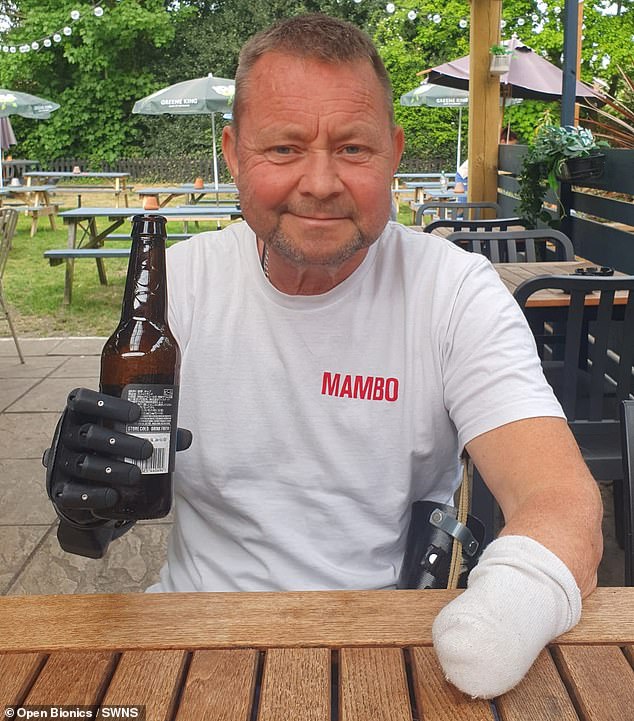
Michael White, 55, lost all four limbs due to a rare inflammatory disease but was able to do some pool shooting and sip ice-cold beer thanks to his new robotic limbs
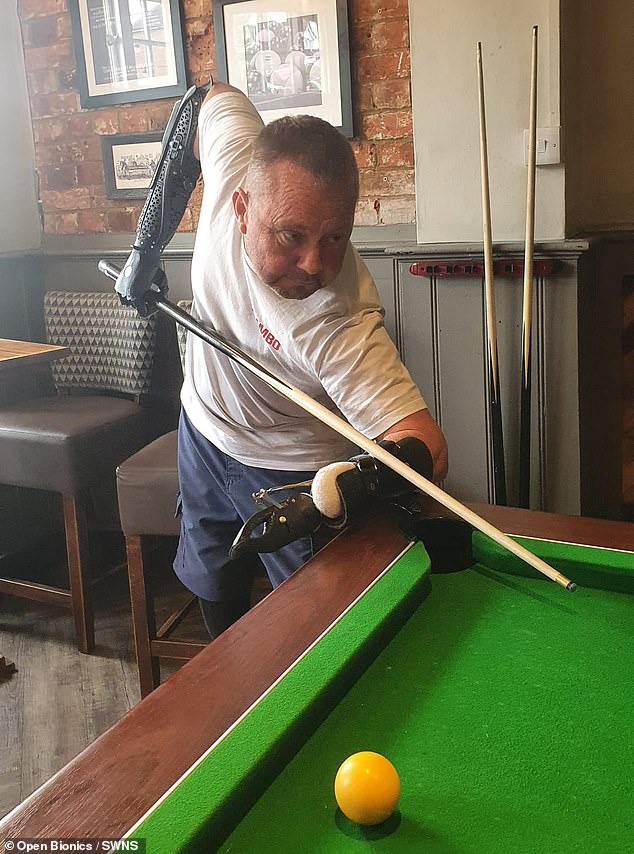
He was diagnosed with Behçet's syndrome between 2012 and 2017, a condition which causes the immune system to mistakenly attack healthy tissue and which affects only 1,000 people in the UK
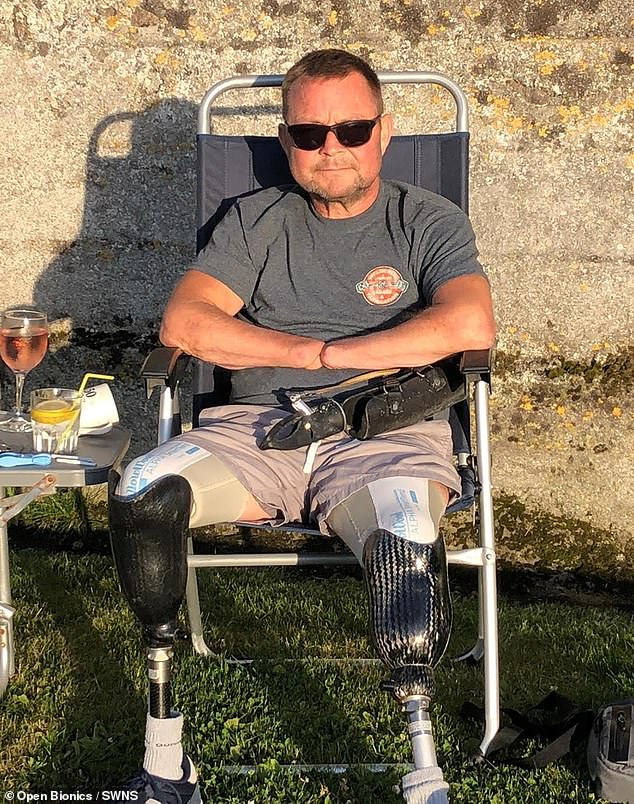
Mr White, from Fleet in Hampshire, was in so much pain from his "dying" limbs turning black that he begged medics to cut off his hands. He had to endure around 30 operations, which meant that doctors had to amputate both of his legs and hands
Unlike his other prosthetics with limited functions, the new arm connects the bionic limb directly to his brain, allowing the device to precisely record sensations and create natural movements.
The device uses myoelectric sensors attached to his muscles that detect the underlying muscle contractions produced by specific muscle groups in his arm.
These signals are then amplified and converted into hand movements in the bionic limb.
The custom arm was 3D printed to better fit his body.
Before the amputation, Mr White said his condition led him to beg doctors to cut off his hands because "any little cut would just turn them black, they would die and the pain was unbearable".
Behçet's disease causes overactivity of the immune system, which leads to excessive inflammation in the blood vessels and can affect any part of the body.
Most people's symptoms are painful but not life-threatening and can be treated with medications that suppress the immune system.
It's not clear what causes the condition, but experts believe it's genetics or unidentified external factors.
Mr White said: "With my NHS prescribed cosmetic arm I can't pick anything up. When I go to the pub I can now hold a pint with my bionic arm.
Celebrating his birthday with a game of pool and holding a cue for the first time in five years was the first thing Mr. White did after being fitted for his new arm.
He was able to sink balls and use the cue to the best of his ability before he was diagnosed with the life-changing condition.
Mr White said: “I was looking for something that was functional and looked cool and to see if it would make my life easier and a little less frustrating.
"I'm just striving to get back to normal, that's all I wanted to do, and no matter what happens, that's what I wanted to do - get back to some form of normality. To be able to drive, to be able to go back to work."
"I didn't want to sit at home and be waited on hand and foot. I've always been an independent person. There are things I want to do with my family. I should be able to hold a pool cue."
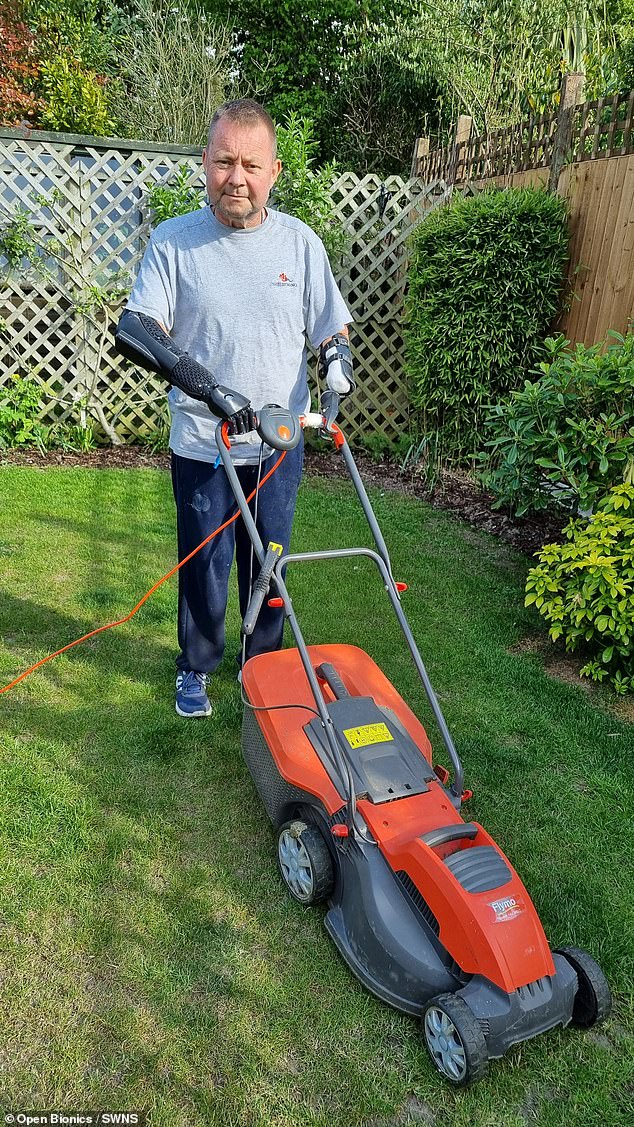
Mr White was fitted with cosmetic arms, but these did not allow him to pick up objects, forcing him to pick up objects with his teeth and carry objects under his armpit. But with his new arm connected to his brain via sensors, the former gardener can now mow the lawn and complete everyday tasks
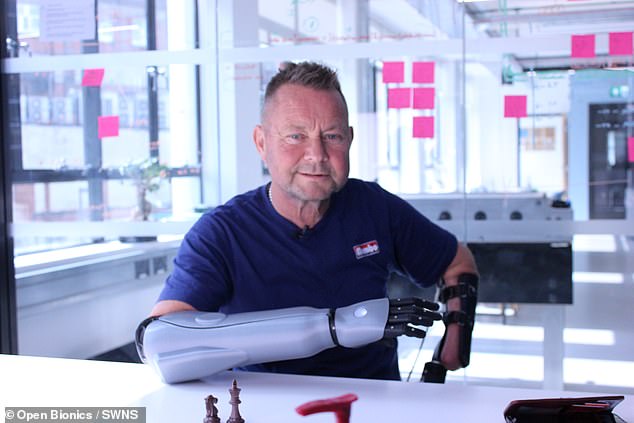
Mr White was initially fitted with NHS cosmetic arms after his limbs were amputated, but he was unable to use them to pick up objects. Unlike his other prosthetics with limited functions, the new arm connects the bionic limb directly to his brain, allowing the device to precisely record sensations and create natural movements
Although seven years have passed since the amputations, Mr. White is still working to return to some form of normality as he still wants to go fishing, he said.
Mr White added: "Before the amputations I was always an independent person. There are still so many things I really want to do, simple hobbies like going fishing and being able to hold a fishing rod.
“It will be so great now to be able to hold my phone and still pick something up.
“I'll be able to do it with two hands instead of trying to put something under my armpit or hold it with my teeth.
“If you’re an able-bodied person, you say, ‘Oh, I have to work.’ But I’m really looking forward to being able to go to work.
"Amputees need to help other amputees - there is light at the end of the tunnel. Hang in there and keep a positive mindset, be determined because you can do it."
After an arm adjustment consultation with an upper extremity prosthetist at Open Bionics, which creates the bionic limb, Mr White was able to pick up objects such as fruit and bags for the first time since his amputation.
Thanks to a crowdfunding campaign, he was able to pay for the bespoke arm, made to his shape and persona design specification.
Makers Open Bionics said the company's mission is to help patients like Mr. White "turn their disabilities into superpowers."
Samantha Payne MBE, co-founder of Open Bionics, said: “Michael has embarked on an extraordinary journey to regain functionality and independence since his amputations.
“We are very pleased that Michael can pursue even more of his favorite hobbies with the Hero Arm.”
The company uses innovative technologies such as 3D printing and 3D scanning so that each “Hero Arm,” which can be fitted to children ages seven and older, is customized to fit each user’s body.