

 Suche
Suche
 Mein Konto


The "dairy-free" trend popularized by millennials in recent years is now affecting babies, experts warn.
There has been a massive increase in the number of babies being prescribed special infant formula because it is often far higher in sugar than milk-based products.
Experts said the problem is that children are diagnosed with milk allergy much more often than one would expect.
They warned that the increasing use of special formulas could promote obesity and tooth decay in young children.
Researchers at Imperial College London analyzed prescriptions of specialized infant formula in England, Norway and Australia.
Rates in England are 12 times higher than would be expected for the number of children with milk allergies, they found.
Prescription levels of special infant formula increased threefold in England from 2007 to 2018, with similar trends in other regions of the UK, they discovered.
Co-author Dr. Imperial's Robert Boyle claimed the rise may have been caused by "formula industry marketing".
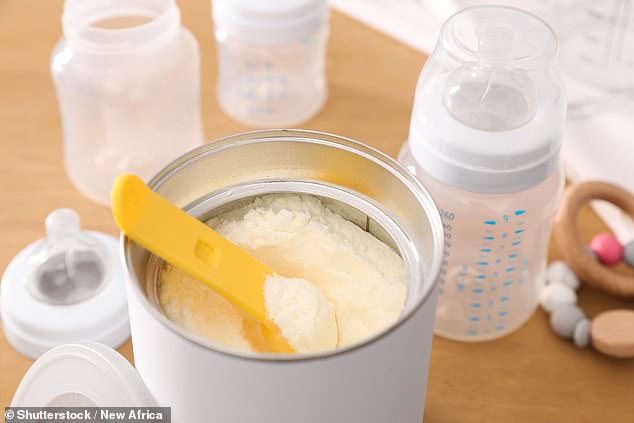
There has been a massive increase in the number of infants prescribed a special, dairy-free formula, which is often far higher in sugar than milk-based products (file image).
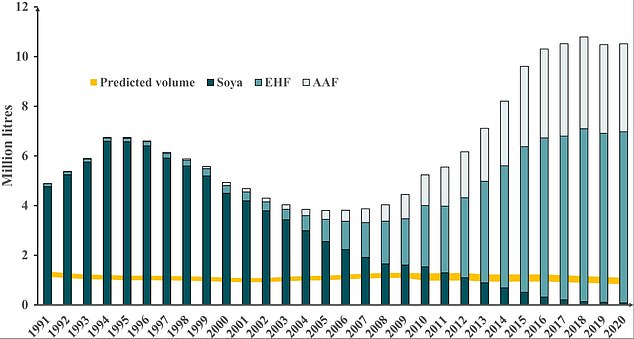
Researchers at Imperial College London found that newborns in England drank almost 11 million liters of expensive formula in 2018. That number was 2.8 times more than the less than 4 million liters prescribed to children under one year old in 2007, they found in a study
The amounts more than doubled in Norway between 2009 and 2020 and tripled in Australia between 2001 and 2012.
Dr. Boyle warned that the trend could increase childhood obesity rates.
More than a quarter of under-fives in the UK are overweight or obese - that's four in 11 11-year-olds. About one in four five-year-olds already has tooth decay.
It is estimated that cow's milk allergy affects up to one percent of children under the age of two.
Special products have been developed as alternatives to formulas containing milk powder.
The study, published in Clinical and experimental allergy tracked national prescribing data in England from 1991 to 2020 for babies in all three countries in May.
The researchers modeled the expected prescription rate based on the assumption that one percent of all minors would need the formula each year.
This was compared to actual prescription numbers across three different types of formula: soy, extensively hydrolyzed formula and amino acid formula.
Total prescriptions increased 2.8-fold in England from 2007 to 2018 - with similar trends in other regions of the UK.
Amino acid formulas - which are of particular concern due to their higher sugar content - rose 6.7 percent in the country.
The number of all specialty foods prescribed increased 2.2-fold in Norway from 2009 to 2020 and 3.2-fold in Australia between 2001 and 2012.
Dr. Boyle said: “These data suggest a high level of overdiagnosis of milk allergies and mark an important shift in young children’s nutrition.
“Unnecessary use of specialized infant formulas can be a significant contributor to free sugar consumption in young children.”
Dr. Boyle claimed the overdiagnosis “appears to have been fueled by formula industry marketing activities.”
Breast milk contains nutrients that protect babies from infections - and even sudden infant death syndrome. It also reduces your risk of heart disease later in life.
Dr. Boyle said: “Although special formula is tolerated quite well by most infants and supports nutrition and growth, there are significant differences to standard formula or human breast milk.
“In specialty food products, the lactose naturally present in breast milk or cow's milk is partially or completely replaced by alternative sources of carbohydrates, often free sugars such as glucose or sucrose.
“High free sugar intake is an important risk factor for obesity and tooth decay and is a major public health concern.
“Therefore, it is conceivable that the unnecessary use of specialty foods may have important public health consequences that have not been previously studied.”