

 Suche
Suche
 Mein Konto


Drinking up to three cups of coffee every day could help you live longer, a decade-long study suggests.
Regular drinkers of the hot drink were up to 12 percent less likely to die.
And they were up to a fifth less likely to develop cardiovascular disease or have a stroke, the results showed.
However, experts found that the health benefits only come from consuming ground coffee - not instant varieties.
And drinking more than three cups a day has no good effects, according to a study of nearly 500,000 people.

Coffee is one of the most widely consumed beverages in the world, but previous studies have been conflicting about whether it could benefit or harm health. In addition to caffeine, the drink also contains minerals and antioxidants. Some studies have linked it to reducing the risk of cancer, obesity, type 2 diabetes and dementia. However, other studies have suggested an increased risk of suffering from high blood pressure and dying from cardiovascular disease
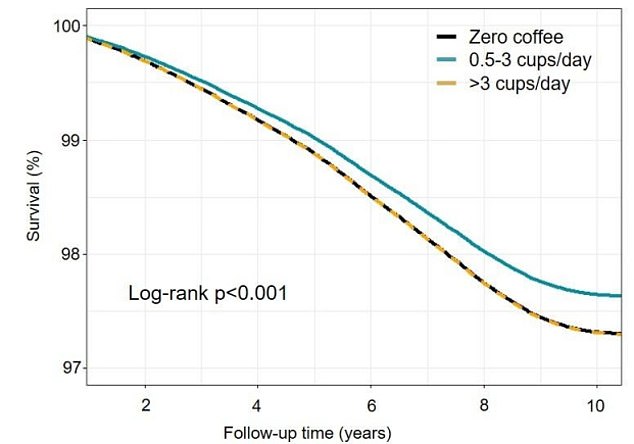
The graph shows the risk of dying from all causes depending on whether study participants drank no coffee (black line), half to three cups per day (blue line), or more than three cups per day (black line). The researchers found that those who drank between 0.5 and three cups per day had a 12 percent lower risk of death than non-coffee drinkers at the end of the 11-year study
Coffee is one of the most widely consumed beverages in the world, although previous studies have been conflicting about whether it could benefit or harm health.
In addition to caffeine, the drink also contains minerals and antioxidants. Some studies have linked it to reducing the risk of cancer, type 2 diabetes and dementia.
However, others have pointed to an increased risk of having high blood pressure and dying from cardiovascular disease.
The new study by a team of British and Hungarian scientists suggests the drink does not increase blood pressure and has cardiovascular benefits.
Dr. Steffen Petersen, one of the authors from Queen Mary University of London, said the results showed that moderate coffee consumption "is not cardiovascularly harmful and may even be beneficial."
“To the best of our knowledge, this is the largest volume of research to date focused on the cardiovascular effects of coffee consumption,” he added.
The participants were from the UK Biobank, were on average 56 years old and had no heart disease at the start of the study.
The volunteers were followed for 11 years so that experts could analyze the differences between the groups.
Among the participants, 22 percent were non-coffee drinkers and 58 percent drank up to three cups a day.
The others admitted to having at least three cups, according to the study published in European Journal of Preventive Cardiology.
The results showed that those who drank between 0.5 and 3 cups per day were 12 percent less likely to die at the end of the study than non-coffee drinkers.
Meanwhile, non-coffee drinkers were 17 percent less likely to die from cardiovascular disease and 21 percent less likely to have a stroke.
Those who drank more than three cups a day did not have a higher risk of high blood pressure - a concern from previous studies.
But they had similar rates of mortality, cardiovascular disease and stroke as non-coffee drinkers, suggesting that three cups a day is the maximum people can consume to achieve health benefits.
Researchers found no increase in high blood pressure rates among those who drank coffee daily, dispelling concerns that the caffeinated beverage triggers the condition.
However, when the group examined health benefits based on the type of coffee participants drank, those who consumed instant coffee - about a quarter of the group - experienced no health benefits.
The researchers said this was likely due to differences in coffee preparation.
Instant coffee contains more caffeine and antioxidants, but twice as much acrylamide - a substance found in some foods that has been linked to an increased risk of cancer and damage to the nervous system.
The team said the "beneficial effect" of coffee could be explained by changes in heart structure in those who consumed the caffeinated drink.
They examined cardiovascular MRI scans available for 30,000 participants and saw evidence that those who drank coffee had healthier hearts.
Those who consumed a moderate or high amount of the caffeinated beverage had larger ventricles, meaning they could pump more blood.