

 Suche
Suche
 Mein Konto


It is estimated that up to ten million Americans may suffer from a red meat allergy caused by tick bites - but many cases go undiagnosed because it can take up to 12 hours for symptoms to develop.
Alpha-gal syndrome is usually caused by bites from the lone star tick – identified by the white spot on its back – which lives in forested areas in the eastern United States. But they can also cause bites from other ticks.
Dr. Jonathan Oliver, a public health expert at the University of Minnesota, told DailyMail.com that the beetle's saliva contains molecules that appear to be similar to those found in red meat. This means that when the immune system attacks saliva, it also develops cells that target molecules from red meat - which triggers the allergy.
Most tick bites do not result in the disease, Oliver said, but he warned that more frequent bites increase the risk of developing the disease.
Sufferers experience symptoms such as hives, severe abdominal pain and swelling of the lips several hours after eating red meat. In severe cases, it can also trigger anaphylactic shock or a severe immune reaction that can be fatal.
Treatment focuses on avoiding tick bites and taking medications to treat allergic reactions.
The AGS awareness campaign says up to three percent of Americans - or about 10 million people - may be affected in some areas, but that the vast majority go undiagnosed.

Scientists have linked many cases to the lone star tick (left), which lives in forested areas in the eastern United States and can be identified by the white spot on its back. They fear that molecules in his saliva resemble those of red meat and could trigger the allergy
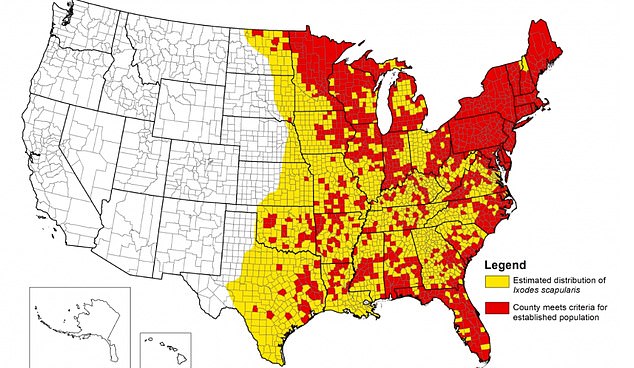
Other ticks can also cause the disease. Scientists are investigating whether the black-legged tick (left) could be behind some cases. It has a wider ranger than the lone star (right)

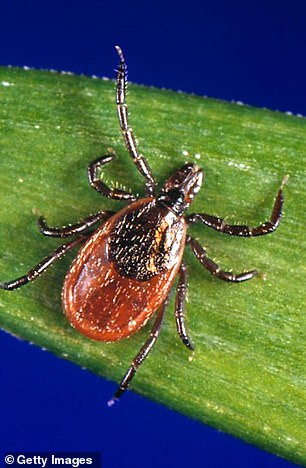
Pictured above is the lone star tick (left), which is associated with most cases of AGS. Other species of ticks, including the blacklegged tick (right), may also cause the condition, it has been suggested
An article about AGS published last year in the Frontiers in cell and infection microbiology also says up to three percent of the population has the condition.
To date, fewer than a million cases have been diagnosed in the United States.
Oliver - who studies tick-borne diseases - said more people with the allergy were being discovered every year as awareness of the allergy increased.
"Often there's a real delay between eating red meat and vomiting, maybe eight to 12 hours," he explained.
"That's why people often don't make the connection that they're reacting to red meat that they ate the night before or much earlier in the day."
He said the vast majority of cases appear to be linked to the lone star tick, which lives in "high densities" in forests.
But there are also clusters outside their natural range that may be due to a species of deer tick called the black-legged tick.
Other species of ticks are still being studied, and different species have been blamed for the allergy in different countries.
Most bites don't cause an allergy, Oliver said, although it's best to avoid being bitten if possible.
“There are certainly many, many more Lone Star tick bites every year, so the chance of getting them from a single bite is pretty low,” he said.
“But the people at higher risk are the ones who are bitten by ticks more often.”
Scientists are not yet sure what causes the condition, although it appears to be linked to a reaction to molecules in tick saliva.
Explaining they could look like those from red meat to the immune system and trigger the allergy, Oliver said: "It's not like a lot of allergies you're exposed to [what causes it].
"Instead, it's like a whole class of compounds that somehow trigger this."
People with allergies can still eat fish and chicken.
Symptoms of the condition include hives or an itchy rash, nausea, and swelling of the lips, throat, tongue, or eyelids.
In rare cases, anaphylaxis can also occur, a potentially fatal condition in which a severe allergic reaction occurs.
The CDC recommends that people can avoid the condition by avoiding tick bites.
That means staying away from grassy, bushy, or wooded areas where the insects might be lurking, and thoroughly checking for ticks after entering.
Sufferers are advised to avoid red meat, which could trigger their condition, and to avoid animal products such as cow's milk and Haribo, which could also trigger an allergic reaction.
Oliver said: “There is so much unknown about this disease, really knowing what combination or proteins cause AGS, knowing whether infection with other tick-borne diseases alters the allergy and so on.
“We also need to identify other species of ticks that are capable of this and find out under what conditions they trigger this.
“There is a lot of work that needs to be done.”
The allergy was discovered in 2001 when Dr. Thomas Platts-Mills, a professor of medicine at the University of Virginia, was working on a monoclonal antibody drug when he noticed that it caused anaphylaxis in some patients.
After a person was not treated with the drug called cetuximab, an investigation found that the antibodies were being attacked by separate antibodies in the body.
Further investigation revealed that the drug's antibodies contained AGS because they were grown using animal cells.
Perhaps the most famous person to publicly admit to suffering from AGS is mystery author John Grisham, who became infected after a tick bite and no longer eats meat.