
The 19-year-old teenager who begged doctors to chop off his leg after breaking his tibia in a freak sledding accident is learning to walk again

Transparenz: Redaktionell erstellt und geprüft.
Veröffentlicht am und aktualisiert am

Ben Thompson crashed into a metal post while sledding in Burton-Upon-Trent The brutal impact resulted in his broken tibia piercing the calf muscle and artery Doctors told him he may never walk again due to nerve damage in his leg A teenager who said he would never walk again after he injured himself in a freak sledding accident After breaking his shin, he took his first steps. Ben Thompson, 19, begged doctors to chop off his leg after he hit a metal sign while sliding down a snow-covered hill in Burton-Upon-Trent, Staffordshire, in November. In the horror accident his...

Ben Thompson ist beim Schlittenfahren in Burton-Upon-Trent gegen einen Metallpfosten gekracht Der brutale Aufprall führte dazu, dass sein gebrochenes Schienbein den Wadenmuskel und die Arterie durchbohrte Die Ärzte sagten ihm, dass er aufgrund von Nervenschäden in seinem Bein möglicherweise nie wieder gehen könne Ein Teenager, der sagte, er würde nie wieder laufen, nachdem er sich bei einem verrückten Schlittenunfall das Schienbein gebrochen hatte, hat seine ersten Schritte gemacht. Ben Thompson, 19, bat die Ärzte, ihm das Bein abzuhacken, nachdem er im November in Burton-Upon-Trent, Staffordshire, ein Metallschild getroffen hatte, als er einen schneebedeckten Hügel hinunterrutschte. Bei dem Horrorunfall brach sein …
Ben Thompson crashed into a metal post while sledding in Burton-Upon-Trent The brutal impact resulted in his broken tibia piercing the calf muscle and artery Doctors told him he may never walk again due to nerve damage in his leg A teenager who said he would never walk again after he injured himself in a freak sledding accident After breaking his shin, he took his first steps. Ben Thompson, 19, begged doctors to chop off his leg after he hit a metal sign while sliding down a snow-covered hill in Burton-Upon-Trent, Staffordshire, in November. In the horror accident his...

The 19-year-old teenager who begged doctors to chop off his leg after breaking his tibia in a freak sledding accident is learning to walk again

  • Ben Thompson ist beim Schlittenfahren in Burton-Upon-Trent gegen einen Metallpfosten gekracht
  • Der brutale Aufprall führte dazu, dass sein gebrochenes Schienbein den Wadenmuskel und die Arterie durchbohrte
  • Die Ärzte sagten ihm, dass er aufgrund von Nervenschäden in seinem Bein möglicherweise nie wieder gehen könne

A teenager who said he would never walk again after breaking his tibia in a freak sledding accident has taken his first steps.

Ben Thompson, 19, begged doctors to chop off his leg after he hit a metal sign while sliding down a snow-covered hill in Burton-Upon-Trent, Staffordshire, in November.

The horror accident fractured his tibia and punctured the muscle and artery in his calf, completely destroying the nervous system in his leg.

He was told he could lose his leg during an operation at Queen's Hospital Burton - and even after the operation was successful, medics told him he may never walk again.

In the weeks following his operation, Mr Thompson's leg continued to expand due to infection and doctors had to give him a skin graft.

The former warehouse worker asked doctors to cut off his leg because of the unbearable pain - which felt worse because he wasn't given the "right medication".

Five months later, Mr. Thompson can walk again, although he will be taking painkillers for the foreseeable future.
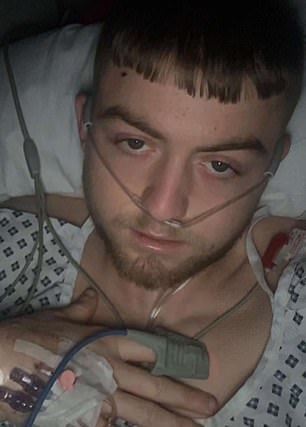
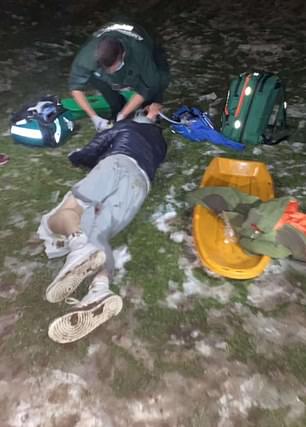
Ben Thompson, der die Ärzte anflehte, ihm das Bein abzuhacken, nachdem er sich bei einem Schlittenunfall das Schienbein gebrochen hatte, hat begonnen zu laufen – obwohl die Ärzte sagten, dass er es vielleicht nie wieder tun würde

Ben Thompson, 19, prallte im November letzten Jahres in Burton Upon Trent, Staffordshire, gegen einen Metallpfosten, als er auf einem Plastikschlitten einen Hügel hinunterrutschte

Ben Thompson (left), 19, hit a metal pole while sliding down a hill on a plastic toboggan in Burton Upon Trent, Staffordshire, in November last year (right).
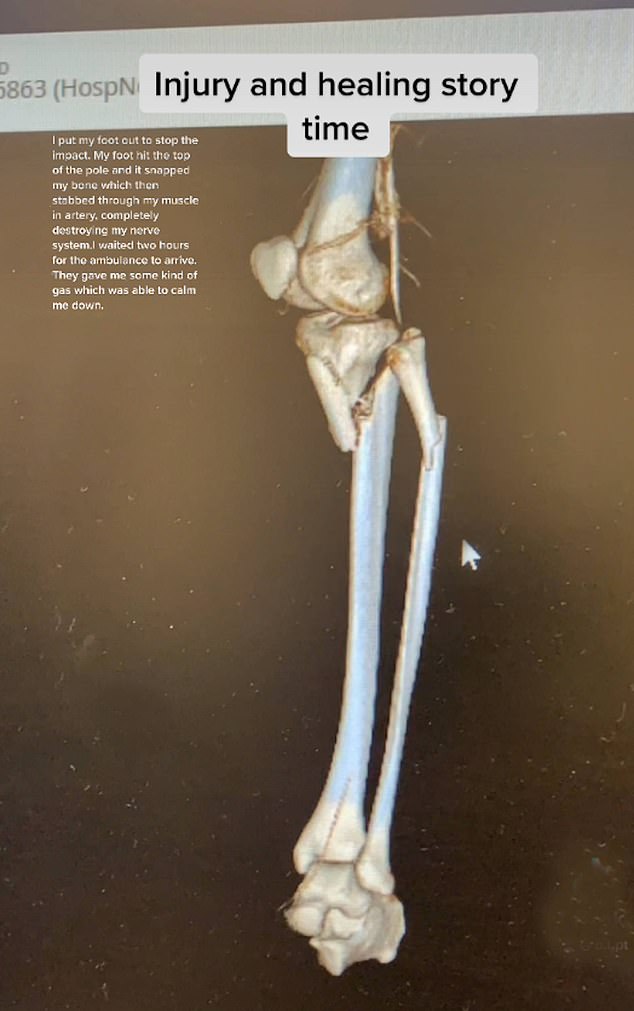
Der brutale Aufprall führte dazu, dass sein gebrochenes Schienbein den Muskel und die Arterie in seiner Wade durchbohrte, bevor das Nervensystem in seinem Bein vollständig zerstört wurde

The brutal impact caused his broken tibia to pierce the muscle and artery in his calf before completely destroying the nervous system in his leg

Ihm wurde gesagt, dass er während der Operation sein Bein verlieren könnte – und selbst nachdem er operiert worden war, sagten ihm Mediziner, dass er vielleicht nie wieder gehen würde

In den Wochen nach seiner Operation dehnte sich das Bein von Herrn Thompson aufgrund von Infektionen weiter aus, und die Ärzte mussten ihm eine Hauttransplantation geben

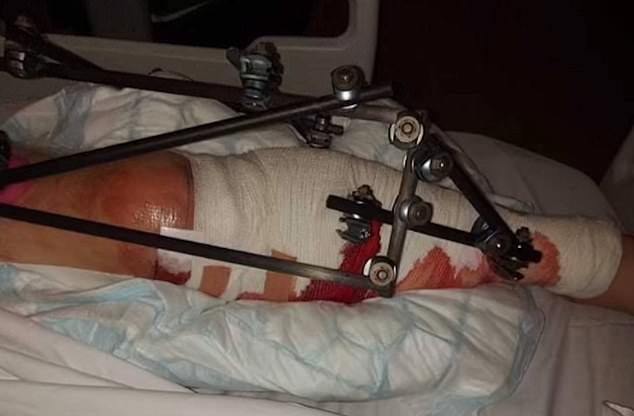
He was told he could lose his leg during surgery - and even after he had surgery, medics told him he might never walk again. Mr Thompson's leg continued to expand due to infection in the weeks following his operation and doctors had to give him a skin graft (right).
Der ehemalige Lagerarbeiter bat die Ärzte, ihm wegen der unerträglichen Schmerzen das Bein abzuschneiden – was sich schlimmer anfühlte, weil er nicht die „richtigen Medikamente“ erhielt.

The former warehouse worker asked doctors to cut off his leg because of the unbearable pain - which felt worse because he wasn't given the "right medication".

HOW IS A LEG BREAK USUALLY TREATED?

A broken leg is very painful and may be swollen or bruised and you usually cannot walk on it.

If the fracture is severe, the leg may have a strange shape and the bone may even protrude from the skin.

There may have been a "cracking" sound when the leg was broken, and the shock and pain of breaking the leg may make you feel weak, dizzy, or sick.

First, a doctor will give you pain medication and may attach a splint to your leg to hold it in place and prevent further damage.

If the pain is severe, you may be given a pain-relieving gas through a face mask or medication through a drip into a vein.

An x-ray is often necessary to assess the fracture.

If the broken bone is still in place, you usually only need a cast. This holds the bone in place so it can heal.

If there is severe swelling, you can simply place a splint or cast around the back half of your leg until the swelling goes down. A full cast can be fitted a few days later.

You may be given pain medication to take home and information about caring for your cast.

If the bones are misaligned, a doctor or surgeon may need to put them back in place. This is called “reduction.”

Sometimes sedatives are given before the procedure and a local or regional anesthetic is used to numb the fracture site.

In some cases, general anesthesia is required, which means you will sleep during the procedure.

Once the bones are in the correct position, a plaster cast can be made.

Severe fractures are often treated with surgery to realign and fix the broken bones. Surgeons can fix bones with metal wires, plates, screws, or rods.

Anzeige

Describing the accident, Mr Thompson said: “I was sledding with someone else on a hill in Shobnall Park.

"We didn't see the thin metal post in front of us. At the last minute the other rider was able to get out, but I wasn't so lucky.

“I stuck my foot out to stop the impact and the bar hit the bottom of my foot.

“That broke my bone, which then went through my muscle and tore both my artery and my nervous system from the shinbone down.”

After arriving at hospital in Burton, he was taken to Royal Stoke University Hospital where he underwent emergency surgery to insert metal pins into his leg and hold his shinbone in place.

They told him that his leg might not be salvageable and that he could wake up days later from a second operation as an amputee.

Paramedics managed to save his leg, but the former warehouse worker was told he would be disabled for life and may never walk again.

After the operation, Mr. Thompson's muscle began to stretch again, requiring a skin graft on both sides of his calf, with doctors taking skin from his thigh.

At times, Mr. Thompson's pain became so severe that he repeatedly asked doctors to amputate his leg.

However, a change in medication helped Mr Thompson manage the pain and he slowly began exercising his leg again.

He said: “I was in hospital for three weeks with constant pain and no signs of recovery.

“About two months later the doctors said I was still disabled and they could barely see any signs of movement.

"I'm also on long-term medication for the rest of my life. Walking is very difficult for me and even five months later my foot hasn't healed any better, but I'm learning to live with it and make adjustments.

“Because they hadn't given me the right medication, I was in complete agony and begged them to stop it.

“I was close to going through with it but decided against it because I didn’t want to give up.”

Mr Thompson documented his recovery on social media, where followers encouraged him with his progress.

He said: “Learning to walk was very difficult because not only could I not feel my leg, but I had been lying down continuously for over a month so my leg muscles were very weak.

“In the beginning I had a big, heavy boot and a pair of crutches, but I still found it difficult to walk anywhere.

"I would practice in my bedroom and work my muscles. Once I got my foot brace, my foot was much easier to move.

“I was determined to get well, and in a few months I was able to move into my house.”

.

Source: Dailymail UK
