

 Suche
Suche
 Mein Konto


A boy's skull has been put back together like a puzzle to prevent his brain from being crushed due to a life-threatening condition.
Daniel Bradly, from Alfreton in Derbyshire, was diagnosed with a rare craniosynostosis, which affects only one in 2,500 babies, when he was three months old.
It is caused when joints in the skull fuse together, meaning there is not enough space for the brain to grow.
If left untreated, it can crush parts of the brain as it expands, causing an unusually shaped head, learning difficulties, eye problems and, in some cases, death.
During the operation to save Daniel's life in 2012, doctors had to painstakingly dismantle Daniel's skull at just one year old, rebuild it piece by piece and put it back together like a puzzle.
The procedure created a gap in Daniel's head, allowing his skull to fuse back together as he grew older.
The youngster, now 10, made a full recovery after surgery which left him with a huge zigzag scar on his head.
He is now training for a triathlon to raise money for Birmingham Children's Hospital, where doctors performed the life-saving operation.

Daniel Bradly (pictured in 2012) from Alfreton in Derbyshire was diagnosed at three months old with a rare craniosynostosis, which affects only one in 2,500 babies. It is caused when joints in the skull fuse together, meaning there is not enough space for the brain to grow
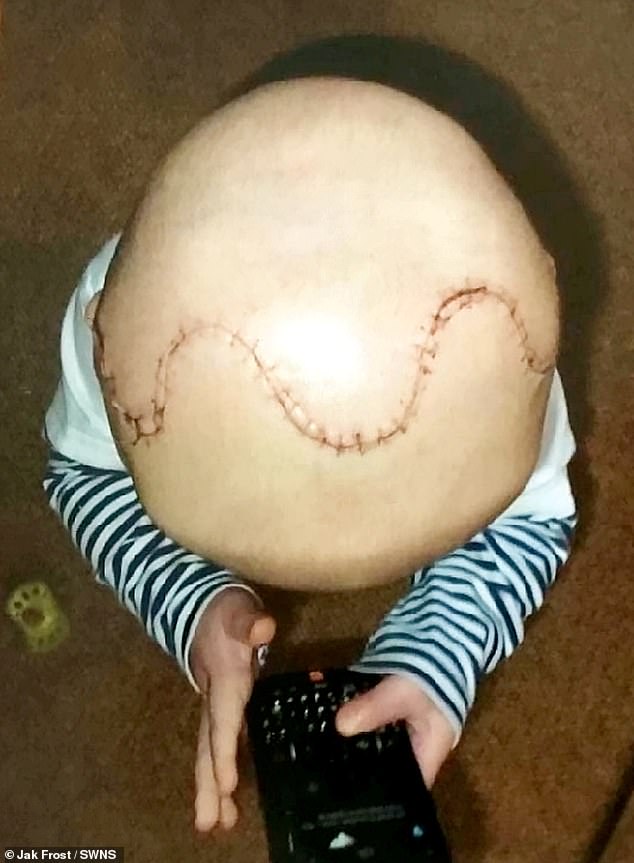
During the life-saving operation in 2012, doctors had to painstakingly dismantle Daniel's skull, rebuild it piece by piece and put it back together like a puzzle. The procedure created a gap in Daniel's head, allowing his skull to fuse back together as he grew older. The operation left him with a huge zigzag scar on his head (pictured)
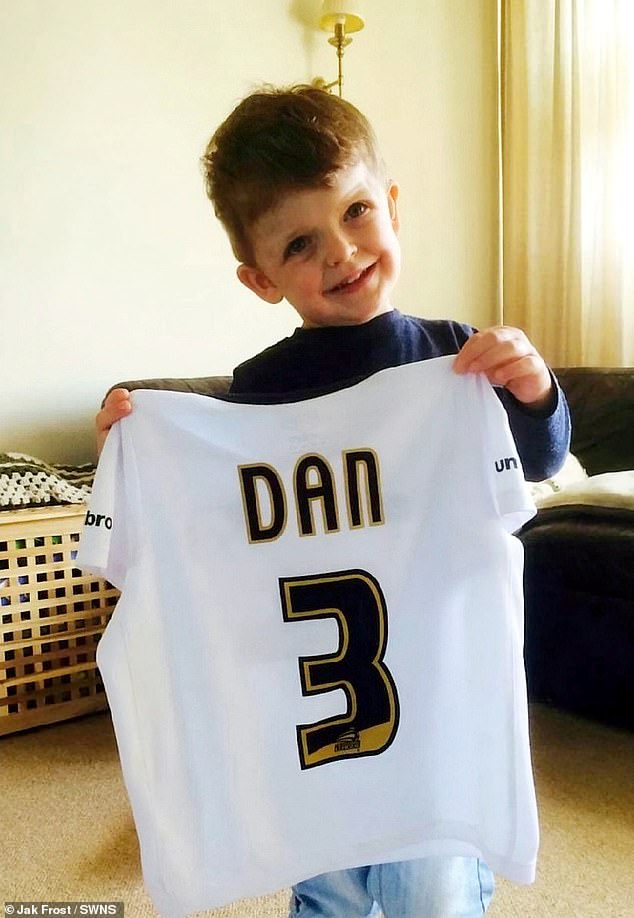
Daniel (pictured) made a full recovery after surgery. The Derby County fan is now training for a triathlon to raise money for Birmingham Children's Hospital, where doctors carried out the life-saving operation
The bones in babies' bones usually have small gaps between them to allow the skull to make room for the brain as it grows in size.
But in patients with craniosynostosis, one or more of these gaps fuses sooner than intended, restricting the skull's growth.
Doctors don't know what causes the condition, which affects about one in 2,500 to 3,000 babies. Boys are three times more likely than girls to develop craniosynostosis.
Daniel's mother, Victoria, 38, a beautician, said: "We were told his brain would grow but his skull would crush his brain because there was no room for the brain to grow with his skull - it was fusing too quickly."
A week after his first birthday, doctors performed a grueling nine-hour operation.
Ms Bradly: “Surgeons broke his skull into pieces and moved his forehead to the top of his head, removing his eyebrow bones.
“If he hadn’t had surgery, he would have died.
"Fortunately, the operation was a success and he has been able to lead a normal life since then. He was on his feet just a few hours after the operation."
Daniel now plans to complete a triathlon next month to raise money for the hospital that carried out the life-saving operation.
To thank medics and “help other kids in the hospital, I came up with the idea of doing a triathlon,” he said.
A GoFundMe Page set up by Daniel's family with a target of £1,000 has so far raised almost £3,500.
The funds will go towards medical research, purchasing new hospital equipment and improving the welfare of patients and staff, as well as the Ronald McDonald Housing Charity, where Daniel's family lived during his time at the hospital.
Along with his best friend Finley Whysall, Daniel will swim 500 meters, run three miles and cycle six miles around Shipley and Alfreton on April 24.
Daniel said he was inspired to complete the fitness challenge after watching the Tokyo Olympics last year.
The Derby County fan said: “I told my mum I was going to do a triathlon for Birmingham Children’s Hospital where they looked after me when I was a baby.
“I was training at my local swimming pool and they closed off a lane specifically for me.

Daniel now plans to complete a triathlon next month to raise money for the hospital that carried out the life-saving operation. Along with his best friend Finley Whysall, Daniel will swim 500 meters, run three miles and cycle six miles around Shipley and Alfreton on April 24
“We also ran, although not too much as we want to try and save ourselves for the day of the event.
"All of our teachers, family and friends have been really helpful and I'm very happy with the money we've raised so far. I really appreciate it.
“I'm really enjoying training at the moment, I want to be a footballer but I plan to do more triathlons.
“I’ll probably take a break after this triathlon, but I want to do more in the future.”
Ms Bradly said she was “extremely proud” of Daniel, who was “really enjoying the training”.
She said: “We are so grateful to everyone who helped and everyone who looked after Daniel when he was a baby.
“We can’t thank them enough and have been totally overwhelmed by all the donations.
“With the support of everyone who donates to her triathlon, the money will go to a great place and a great cause.
“Birmingham Children’s Hospital and Ronald McDonald Housing Charity supported us when Daniel was unwell and this is Daniel’s way of saying thank you.”