
The 32-year-old mother of three shares the tiny change she noticed on her back that indicated she had CANCER - as she warned other young Australians to check their skin

Transparenz: Redaktionell erstellt und geprüft.
Veröffentlicht am und aktualisiert am

An Australian mother has warned young people to check their skin Just a few weeks ago Kia Bourke noticed that one of her freckles was changing color Her husband recommended she make an appointment with her GP and she did The result was a test that confirmed she had melanoma and needed surgery She is grateful her GP took it seriously and she is now recovering well A young Australian mother of three got the shock of her life when she was diagnosed with melanoma at just 32 years old was because she mistakenly believed...

Eine australische Mutter hat junge Menschen gewarnt, ihre Haut zu untersuchen Erst vor ein paar Wochen bemerkte Kia Bourke, dass sich eine ihrer Sommersprossen verfärbte Ihr Mann empfahl ihr, einen Termin beim Hausarzt zu vereinbaren, und sie tat es Das Ergebnis war ein Test, der bestätigte, dass sie ein Melanom hatte und operiert werden musste Sie ist dankbar, dass ihr Hausarzt es ernst genommen hat und sie sich jetzt gut erholt Eine junge australische Mutter von drei Kindern bekam den Schock ihres Lebens, als bei ihr im Alter von nur 32 Jahren ein Melanom diagnostiziert wurde, weil sie fälschlicherweise glaubte, …
An Australian mother has warned young people to check their skin Just a few weeks ago Kia Bourke noticed that one of her freckles was changing color Her husband recommended she make an appointment with her GP and she did The result was a test that confirmed she had melanoma and needed surgery She is grateful her GP took it seriously and she is now recovering well A young Australian mother of three got the shock of her life when she was diagnosed with melanoma at just 32 years old was because she mistakenly believed...

The 32-year-old mother of three shares the tiny change she noticed on her back that indicated she had CANCER - as she warned other young Australians to check their skin

  • Eine australische Mutter hat junge Menschen gewarnt, ihre Haut zu untersuchen
  • Erst vor ein paar Wochen bemerkte Kia Bourke, dass sich eine ihrer Sommersprossen verfärbte
  • Ihr Mann empfahl ihr, einen Termin beim Hausarzt zu vereinbaren, und sie tat es
  • Das Ergebnis war ein Test, der bestätigte, dass sie ein Melanom hatte und operiert werden musste
  • Sie ist dankbar, dass ihr Hausarzt es ernst genommen hat und sie sich jetzt gut erholt

A young Australian mother of three got the shock of her life when she was diagnosed with melanoma aged just 32 because she mistakenly believed it affected “older people”.

Kia Bourke first noticed in February that a small mole on her torso had changed color, becoming darker than the freckles around it.

Her husband discovered it a week later and raised the alarm, urging the young mother to visit her family doctor and have it examined by a professional.

Kia Bourke bemerkte im Februar zum ersten Mal, dass ein kleiner Leberfleck auf ihrem Oberkörper seine Farbe geändert hatte und dunkler wurde als die Sommersprossen um ihn herum

Kia Bourke first noticed in February that a small mole on her torso had changed color, becoming darker than the freckles around it

"It was a big, big shock to me and my family. Totally unexpected," Kia said on The Morning Show.

"I just noticed it had gotten a bit darker and my husband said I think you should get it checked. I went to the GP and luckily he took it seriously and we tested it and it was melanoma."

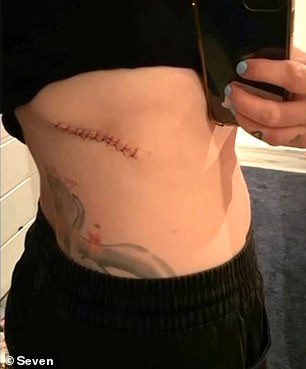
The result was extensive surgery to remove the mole and surrounding lymph nodes, with a long stream of stitches now visible on her side.

Oben im Kreis ist das krebsartige Melanom abgebildet

Frau Bourke erholt sich jetzt von der Operation

"It was a big, big shock to me and my family. Totally unexpected," Kia said on The Morning Show.

"I feel okay. It's been a few days where I've been sore and pretty injured, but I'm recovering well," she said.

Melanoma is the most common cancer for the 20-39 age group in Australia, due in part to our outdoor lifestyle and harsh climate.

It happens after the DNA in skin cells is damaged (typically by harmful UV rays) and then isn't repaired, triggering mutations that can form malignant tumors.

Melanoma: The most dangerous form of skin cancer

Melanoma is the most dangerous form of skin cancer. It happens after the DNA in skin cells is damaged (typically by harmful UV rays) and then isn't repaired, triggering mutations that can form malignant tumors.

Causes

  • Sonneneinstrahlung: UV- und UVB-Strahlen von Sonne und Solarium sind schädlich für die Haut
  • Muttermale: Je mehr Muttermale Sie haben, desto größer ist das Risiko, ein Melanom zu bekommen
  • Hauttyp: Hellere Haut hat ein höheres Melanomrisiko
  • Haarfarbe: Rothaarige sind stärker gefährdet als andere
  • Persönliche Vorgeschichte: Wenn Sie einmal ein Melanom hatten, ist es wahrscheinlicher, dass Sie es erneut bekommen
  • Familienanamnese: Wenn frühere Verwandte diagnostiziert wurden, erhöht dies Ihr Risiko

Treatment

  • Entfernung des Melanoms:

This can be done by removing the entire section of tumor or by having the surgeon remove the skin layer by layer. When a surgeon removes it layer by layer, it helps them figure out exactly where the cancer stops so they don't have to remove more skin than necessary.

  • Hauttransplantation:

The patient may opt for skin grafting if the surgery has left discoloration or a dent.

  • Immuntherapie, Bestrahlung oder Chemotherapie:

This is required when the cancer reaches stage III or IV. This means that the cancer cells have spread to the lymph nodes or other organs in the body.

prevention

  • Verwenden Sie Sonnencreme und verbrennen Sie nicht
  • Vermeiden Sie es, sich draußen und in Betten zu bräunen
  • Tragen Sie Sonnencreme 30 Minuten, bevor Sie nach draußen gehen, auf
  • Halten Sie Neugeborene von der Sonne fern
  • Untersuchen Sie Ihre Haut jeden Monat
  • Suchen Sie Ihren Arzt jedes Jahr für eine Hautuntersuchung auf

Source: Skin Cancer Foundation and American Cancer Society

Anzeige

Kia's advice for those who have never examined their skin is to make an appointment and take the first step.

Also know your own body so that you can easily decipher any changes that occur.

"Be smart. It can happen to anyone. And get checked regularly," Kia warned.

Kia is urging Australians to get involved and donate to the Melanoma Institute Australia's Melanoma March fundraising campaign, with events taking place this weekend. Individuals can register or donate at www.melanomamarch.org.au.

What are the warning signs of melanoma?

The first five letters of the alphabet are a guide to help you recognize the warning signs of melanoma.

A stands for asymmetry.Most melanomas are asymmetrical. If you draw a line through the center of the lesion, the two halves don't fit together, so it looks different from a round to an oval and symmetrical common mole.

B stands for border.Melanoma borders tend to be uneven and may have jagged or notched edges, while common moles tend to have smoother, more even edges.

C stands for color.Multiple colors are a warning sign. While benign moles are usually a single shade of brown, melanoma can be various shades of brown, tan, or black. The colors red, white or blue may also appear during growth.

D stands for diameter or dark.While it's ideal to detect a melanoma when it's small, it's a warning sign when a lesion is the size of a pencil eraser (about 6 mm or ¼ inch in diameter) or larger. Some experts say it's also important to look for lesions that are darker than others, regardless of size. Rare, amelanotic melanomas are colorless.

E stands for development.Any change in size, shape, color, or elevation of a spot on your skin, or any new symptom in it, such as bleeding, itching, or crusting, may be a warning sign of melanoma.

Source: skincancer.org

Anzeige

.

Source: Dailymail UK
