

 Suche
Suche
 Mein Konto


Hormone replacement therapy for breast cancer survivors is safe, according to research that debunks myths.
For decades, doctors have avoided recommending HRT to women who have beaten the disease because they fear it could trigger a relapse.
Danish scientists have since dismissed concerns raised by just two studies in the 1990s. They found that there was no increased risk of recurrence in women taking HRT.
The discovery gives hope to thousands who have survived breast cancer only to be plagued by hot flashes and reduced libido.
Many have struggled through menopause with natural remedies or nothing at all, activists say.
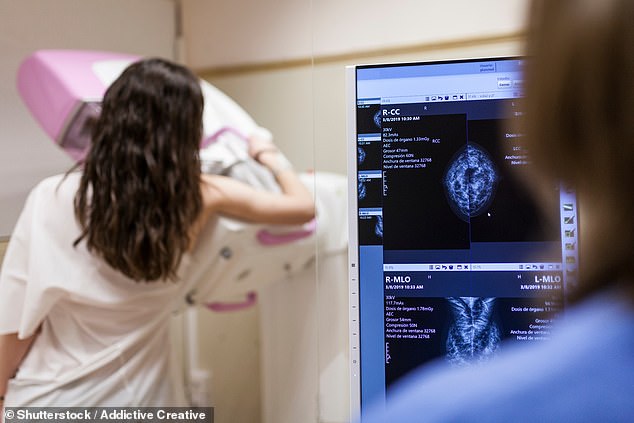
A Danish study of 8,500 women with breast cancer has raised hopes that more women can use HRT to treat menopausal symptoms without increasing the risk of the disease coming back (stock image of a breast cancer scan)
The new study from Odense University Hospital followed 8,500 postmenopausal women.
All participants were diagnosed with estrogen receptor-positive breast cancer, which thrives on the female sex hormone. Around three quarters of all breast cancers in the UK are of this type.
HRT replenishes declining estrogen levels, which is why fears of cancer make doctors reluctant to hand out patches, gels and implants.
Women received tamoxifen or aromatase inhibitors. Both drugs work by blocking the effects of estrogen, slowing the growth of breast cancer.
Just over 2,000 of the women took some form of HRT in the years following their cancer diagnosis.
Participants were followed for up to a decade or until cancer recurrence or death.
During the analysis, 1,333 (16 percent) women experienced a recurrence of breast cancer.
Of these, 111 took vaginal estrogen, 16 took another form of HRT and 1,206 took none.
Calculations showed that recurrence rates were 15.4 percent in the vaginal estrogen group and 17.1 percent in the other HRT group.
This compares to a risk of 19.2 percent in the group without HRT.
However, researchers found a 39 percent increased risk of cancer recurrence in a subgroup of women who took both vaginal estrogen and aromatase inhibitors.
Dr. Elizabeth Cathcart-Rake, breast oncologist at the prestigious Mayo Clinic in the US, said: “This large study helps enable nuanced discussions between clinicians and breast cancer survivors about the safety of vaginal estrogen therapy.
“The results suggest that breast cancer survivors on tamoxifen with severe genitourinary symptoms can receive vaginal estrogen therapy without increasing their risk of breast cancer recurrence.”
However, she still advised caution when considering vaginal estrogen for breast cancer survivors with aromatase inhibitors.
A spokesperson for Cancer Research UK said further research was needed to confirm the results of the Danish study.
While the study raises hope that breast cancer survivors could use more forms of HRT, it comes as tens of thousands of women in the UK are struggling to access menopause medication due to ongoing supply shortages.
There are around 56,000 breast cancer diagnoses in the UK at any given time, the vast majority (99 per cent) of which are in women.
Around 11,000 people die from breast cancer in the UK every year, with three quarters of people diagnosed with the disease surviving for at least a decade.
Charity Breast Cancer Now estimates there are 600,000 breast cancer survivors in the UK.
In the United States, 260,000 cases of breast cancer are diagnosed each year, with 42,000 deaths.
The most common sign of breast cancer is a new lump in the breast. Women who notice a new lump in their breast or an area of thickened tissue should have it checked by their primary care doctor.