

 Suche
Suche
 Mein Konto


Interest in abortion drugs increased after news broke in May that the U.S. Supreme Court was likely to overturn Roe v Wade, a decision that gave constitutional protection to abortion in America.
Researchers at the University of California, San Diego (UCSD) found that Google searches for the term "abortion pill" and for specific drug names reached record highs in the days following the revelation that the case would be overturned.
In the three days following the decision, leaked searches increased by a total of 162 percent.
The unprecedented leak of the Supreme Court's decision in early May sent shockwaves across the country and shook the legal and political world. Because many states already had “trigger laws” on the books that would take effect with the decision, many scrambled to get access to the drugs while they still could.
Last week, the court's official decision was announced, opening the door for more than half of U.S. states to ban or restrict access to abortion.
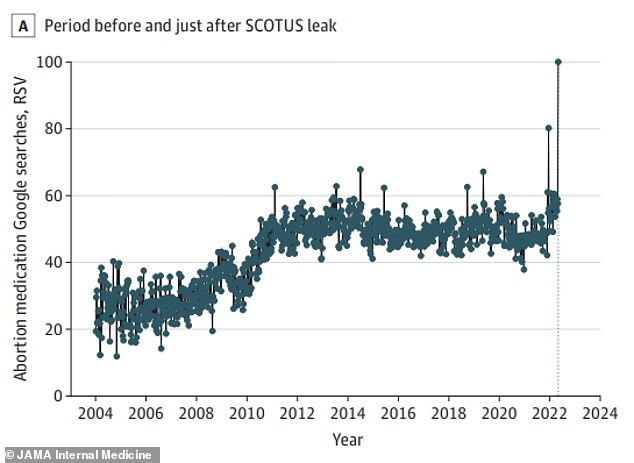
Online requests for abortion drugs reached record levels after the Supreme Court's Roe decision was leaked in May
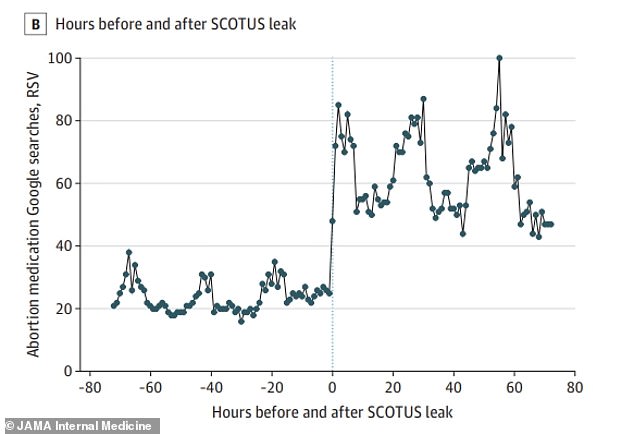
There was a massive spike in searches, particularly in the 72 hours immediately following the publication of the Politico article
On May 2nd Politically revealed the bombshell report that America's highest court planned to overturn the 1973 Supreme Court ruling that protected abortion rights in the US
The leak of a Supreme Court decision – later upheld by judges as legitimate – is unprecedented. Experts could not recall a similar example in the court's history.
Researchers who published their findings Wednesday in JAMA Internal Medicine collected Google search data from January 2004 to May 8, 2002 - six days after the leak - for the study.
They found that searches like “abortion pill” and others directly related to the drugs like “how to get misoprostol,” “order abortion pills,” or “buy mifepristone” were rising to record levels.
In states with more restrictive rules, such as those that have “trigger laws” that either banned or severely restricted abortion immediately after Roe was overturned, the number of requests was even higher.
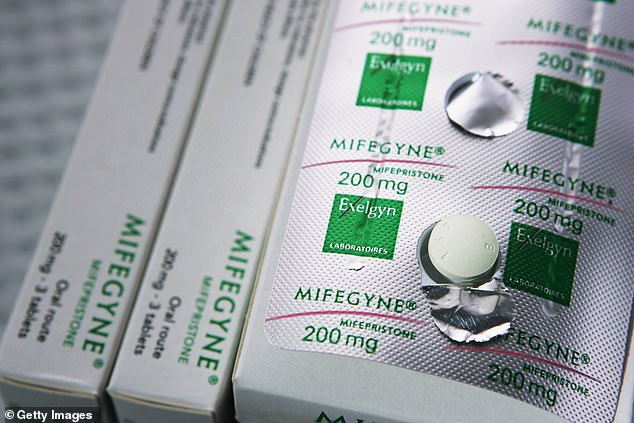
At-home abortion pills are easy to use and require little medical supervision. Experts are still afraid of workarounds
“In states with restrictive reproductive rights and where abortion is likely to be criminalized, women appear to be more likely to seek abortion medications following the SCOTUS leak,” Dr. Adam Poliak, a professor at Bryn Mawr College in the Philadelphia area who participated in the research, said.
“Although abortion medications require a prescription, women may attempt to hoard medications or dangerous black market options in anticipation of limited access.”
Researchers believe this is partly due to an inherent shame or embarrassment some women have when inquiring about abortion.
“An open discussion about abortion is not something many would like to do,” said Dr. Eric Leas, a professor at UCSD who was involved in the study.
"But Internet searches are anonymous. By examining aggregate Internet searches, decision makers can understand the public's needs based on the content and timing of their requests."
The research team warns that this data should also serve as a warning call to health authorities.
Many fear that many women in states where the procedure is banned and cannot afford to travel abroad to receive it will resort to dangerous abortions at home.
Although it is much safer today than it was before Roe to have an abortion at home due to these widely used medications, there are still some risks to bypassing a doctor when making medical decisions.
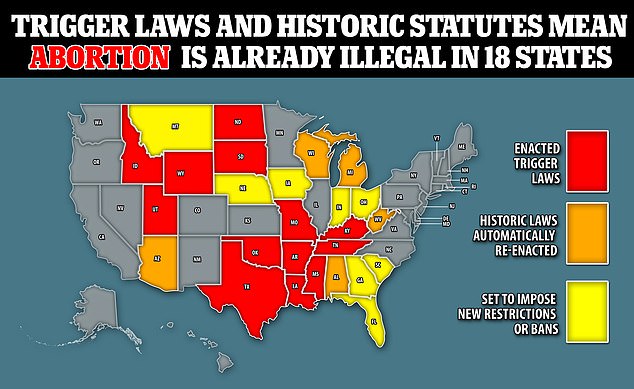
“Failure to meet the needs of online seekers may result in unsafe abortion attempts,” Dr. Steffanie Strathdee, a distinguished professor at UCSD and co-author of the study.
“Already 7 percent of women of childbearing age have attempted a self-administered abortion in their lifetime, and that number could increase following the SCOTUS decision.”
Planned Parenthood warns that taking the pills can cause heavy vaginal bleeding, blood clots, severe cramps and fever.
In these cases, women are advised to consult a doctor. However, if a woman fears getting into trouble for using abortion drugs illegally, she must not do so.
“The increased interest in abortion drugs should alert physicians that many of their patients will ultimately have abortions with or without abortion,” said Dr. Davy Smith, a doctor at UCSD and co-author of the study.