

 Suche
Suche
 Mein Konto
The immunity conferred by influenza vaccinations has been found to be independent of the timing of vaccination

In a recent study published in the Journal of Infections, researchers examined the influence of the timing of flu vaccine administration on vaccine-induced immunity to infections. Study: Loss of immunity during the season following vaccination against seasonal influenza in early and late vaccination recipients. Photo credit: Angela_Macario/Shutterstock Studies have shown that inactivated influenza vaccines confer transient immune protection against influenza infection in HCWs (health care workers) at increased risk of influenza virus exposure. Immune responses have been found to decrease intraseasonally following influenza vaccinations. However, the significance of the decline in antibodies during flu season is not clear. About the study In the present prospective observational cohort study...

The immunity conferred by influenza vaccinations has been found to be independent of the timing of vaccination
In a recently published study in the Journal of Infections Researchers examined the influence of the timing of flu vaccine administration on vaccine-induced immunity to infections.
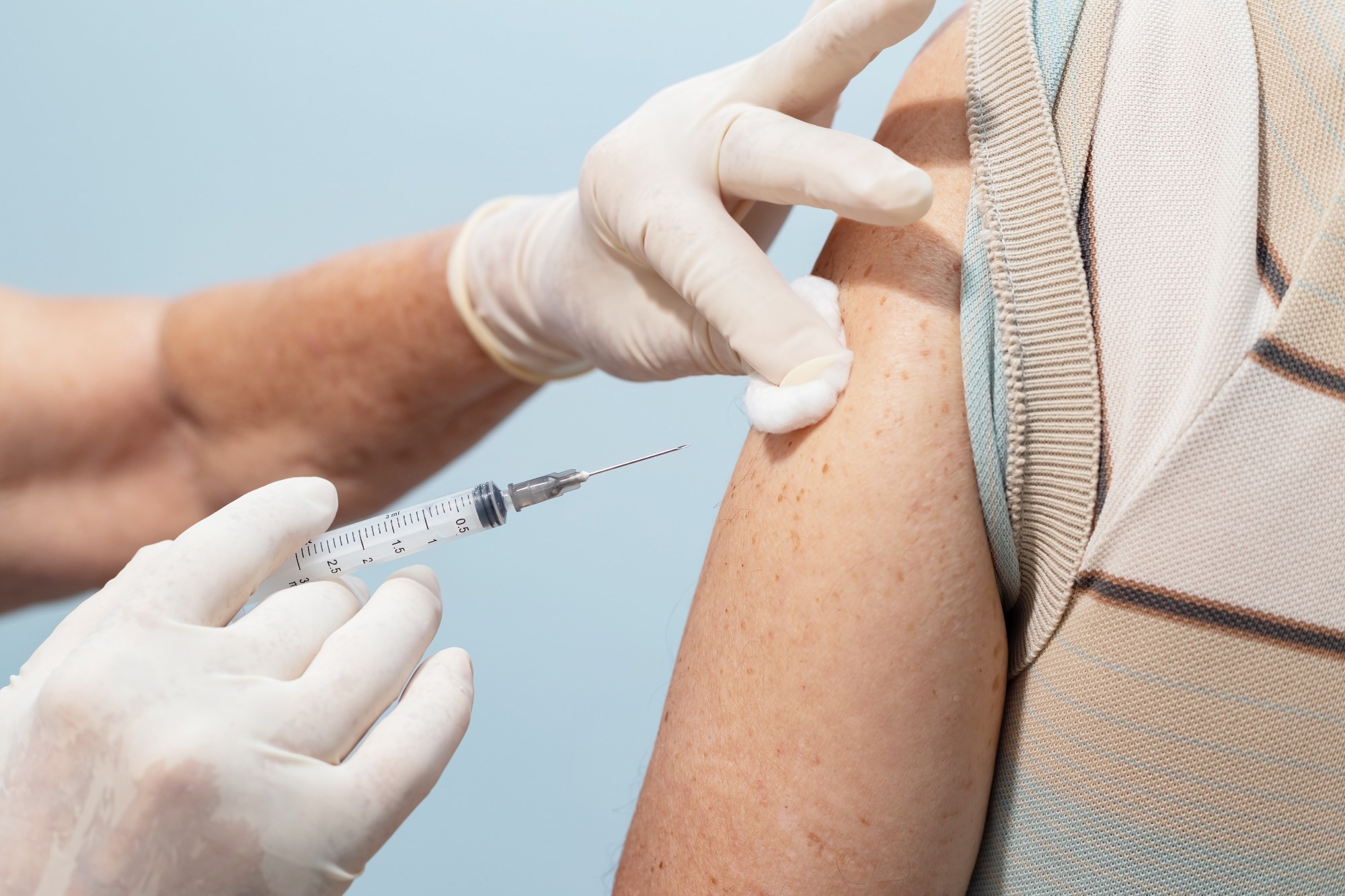
Studie: Nachlassen der Immunität während der Saison nach der Impfung gegen die saisonale Grippe bei Früh- und Spätimpfungsempfängern. Bildnachweis: Angela_Macario/Shutterstock
Studies have shown that inactivated influenza vaccines confer transient immune protection against influenza infection in HCWs (health care workers) at increased risk of influenza virus exposure. Immune responses have been found to decrease intraseasonally following influenza vaccinations. However, the significance of the decline in antibodies during flu season is not clear.
About the study
In the present prospective observational cohort study, researchers examined whether vaccination timing influences the immune protection against infections conferred by influenza vaccinations.
The single-center study was conducted between September and November 2021 and included 400 HCWs from the University Hospitals of Leicester NHS (National Health Service) Trust, UK. Participants were vaccinated with QIV (quadrivalent inactivated influenza vaccine) at two time points before the start of the flu season (between December 2020 and April 2021), i.e. late group, n=200).
The vaccines contained four influenza virus antigens: A/Hong Kong/2671/2019 A/H3N2-like, A/Guangdong-Maonan/SWL1536/2019 A/H1N1pdm-like, B/Phuket/3073/2013-like and B/Washington/02/2019-like.
For follow-up assessments, participants were required to undergo monitoring for ILI (influenza-like illness, elevated body temperature >38°C, and cough) and collect blood samples. The blood samples obtained were analyzed using HAI (hemagglutinin inhibition tests) carried out at four different time points: before vaccination, three weeks after vaccination, February 2021 (peak of flu season) and May 2021 (end of flu season).
Seroprotection rates were defined based on the EMEA (European Medicines Evaluation Agency) criteria as the proportion of subjects with titers greater than or equal to 1:40 and the values obtained were compared between the two groups at each follow-up visit. Multinomial linear regression modeling was used to evaluate the effects of timing of influenza vaccination, gender, age, and previous influenza vaccinations on geometric mean titers (GMTs) of HAI at the peak of the influenza season and at the end of the influenza season.
Results
HAI titers were comparable between the two groups of vaccinated subjects across follow-up time points for all influenza virus strains, with the exception of influenza strain A/H1N1pdm, for which the titers for the early group of vaccinated and the late group of vaccinated influenza season peaked at 76 and 99, respectively. The corresponding end-of-season titers were 54 or 67.
For influenza A virus (IAV) strains, seroprotection rates did not differ significantly between the two groups of vaccinated people at the peak and end of the season. Rates of influenza B virus strains were >98% across all follow-up time points. The multinomial analysis showed that HAI test titers at the peak and end of the season did not differ significantly between the two groups of vaccinated people for IAV strains, taking into account gender, age and previous influenza vaccinations.
In contrast, individuals who had not received ≥2 influenza vaccinations in the previous four years were associated with lower end-of-season HAI GMTs for the A/H1N1pdm strain (peak- and end-of-season adjusted coefficients were -0.7 and -0.8). respectively).
Similar results were found for individuals who received multiple Victoria/Influenza B virus flu vaccinations at the peak of the season (adjusted coefficient -0.4). ILI was reported during the follow-up period by sixteen individuals, none of whom were positive for influenza virus by polymerase chain reaction (PCR), ten individuals were positive for severe acute respiratory syndrome coronavirus 2 (SARS-CoV-2), one individual was rhinovirus positive, and five individuals were positive for none of the respiratory viruses tested.
Regardless of the timing of flu vaccinations, HAI GMTs after annual flu vaccinations are unlikely to differ significantly in the upcoming flu season. Participants vaccinated just before the flu season were able to elicit rapid antibody responses as GMTs at the peak of the flu season showed no differences compared to those vaccinated in the early group.
Therefore, influenza vaccination programs must not be stopped too early before the start of the influenza season to ensure maximum access to influenza vaccination for HCWs. HCWs in the late vaccination group showed greater likelihood of vaccine hesitancy factors, including lower ethnicity and age. Therefore, early termination of seasonal vaccination programs may reduce influenza vaccine uptake for these individuals.
Overall, the study result showed that the immune protection conferred by influenza vaccination in healthy adults does not differ significantly depending on the timing of vaccination, supporting the administration of influenza vaccines over longer periods of time to maximize influenza vaccine uptake.
Reference:
- Joshua Nazareth, Ian Barr, Sheena G. Sullivan, Charles Goss, Daniel Pan, Christopher A. Martin, Amandeep Sahota, Iain Stephenson, Julian W. Tang, Manish Pareek. (2022). Nachlassen der Immunität während der Saison nach der Impfung gegen die saisonale Grippe bei Früh- und Spätimpfungsempfängern. Zeitschrift für Infektionen. doi: https://doi.org/10.1016/j.jinf.2022.10.011 https://www.sciencedirect.com/science/article/pii/S0163445322006041