

 Suche
Suche
 Mein Konto


It might sound like something out of Blade Runner.
But science is getting closer to enabling blind people to see again - without using their eyes.
Researchers are developing high-tech glasses with a built-in camera that wirelessly pings images to the brain.
The device bypasses nerves between the eyes and brain that are damaged in most cases of blindness.
A team of Dutch experts is testing it in Eindhoven, described as “the place to be” when it comes to blindness research.
Similar technology was championed by legendary American musician Stevie Wonder, who lost his sight as a baby.
Over the past decade, medical advances have created a number of experimental treatments and devices for incurable blindness.
Those currently in the works include bionic eyes being tested in the US and UK and a trial of the gene-editing tool CRISPR to cure genetic blindness.

This graphical representation gives an idea of how the glasses would work in practice

Stevie Wonder, now 71, who made hits like "Superstition" and "Isn't She Lovely," went blind shortly after birth and was impressed by glasses similar to those being developed
The latest glasses are being developed as part of the NESTOR project, which aims to create a “neuroprosthesis” – a device capable of producing visual images in the brain.
A consortium of Dutch institutions, including the Eindhoven University of Technology, is working on the project.
The glasses workby capturing still images with a built-in camera at the touch of a button.
The images are then transmitted wirelessly to a tiny chip installed on a blind person's visual cortex using a combination of radio waves similar to the Wi-Fi and Bluetooth technology used.
The process is similar to the natural signals that the eyes send to this part of the brain, which was part of our sense of sight.
This part of the brain normally translates messages received from the eye into images, but researchers believe it is possible to replicate this by using tiny electrodes to stimulate brain cells.
Scientists have not yet tested their implant on humans, but laboratory tests and experiments on monkeys have been promising.
The developers hope their wireless model overcomes some of the shortcomings of previous implants, which connected directly to glasses and risked infection.
No release date or potential cost has been released, but similar technology in the US costs around £110,000, which excludes the operation to install a chip.
Adedayo Omisakin, a researcher from Eindhoven University of Technology, is part of a two-man team working specifically on the wireless implant for four years.
He said the technology could address the root cause of blindness for most people living with the disability by bypassing the eye and going directly to the brain.
“Many blind people have damaged nerves between the eyes and the brain, so our only option is to stimulate the visual cortex directly,” he said.
He added that wireless transmission of this data would provide numerous benefits to the lives of blind people.
“This not only prevents infections in the brain area from occurring, but also makes patients much more mobile,” he said.
Mr Omisakin said the current version of the chip consists of a staggering 1,024 electrodes divided into 16 different groups that send electrical signals to different parts of the visual cortex, creating an image.
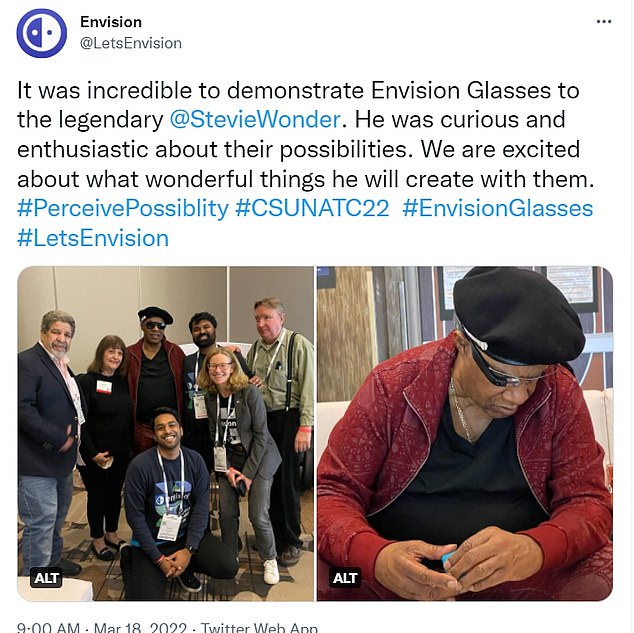
Multi-Grammy Award-winning musician Stevie Wonder was reportedly "excited" about a version of the glasses from Envision that takes photos with a camera and then audibly describes them to the wearer, giving blind people more independence.
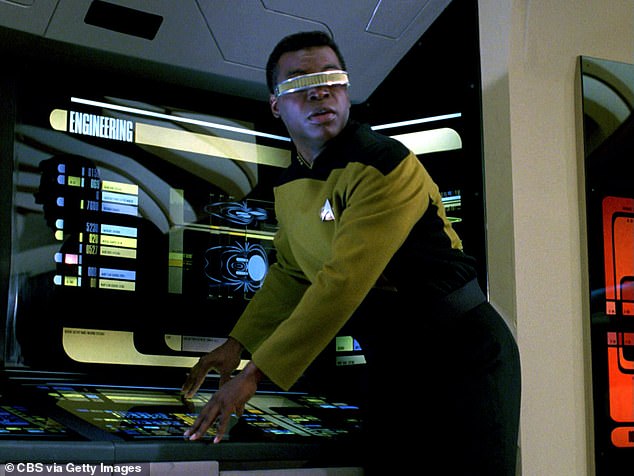
Scientists hope to one day develop glasses that can help blind people see again. Previously, this technology was the domain of science fiction, as is the case with the character Geordi La Forge (played by LeVar Burton) in Star Trek: The Next Generation
The main transmitter for the implant would be under the skin in the neck and connected to the visual cortex with wires.
“This way there is no unnecessary loss of signal through the skull,” he said.
Through rigorous testing, scientists have managed to reduce power consumption to less than a milliwatt, many thousands of times less than the power consumption of even an energy-efficient light bulb.
Electricity consumption is a critical hurdle to overcome, Mr. Omisakin said.
Previous attempts to insert similar chips into the brains of blind people caused patients to have epileptic seizures as electricity flowed through their skulls.
Researchers from the Netherlands Institute for Neuroscience are also involved in the project and have tested the chips on monkeys.
Mr Omisakin said the monkeys were able to recognize "signs, moving objects and lines", although he added that further testing was needed to see if the image quality could be improved.
“The number of electrodes will ultimately have to continue to increase if we want to have images of usable quality,” he said.
Mr Omisakin added that he could see the technology being ready for widespread use for blind people within the next decade.
There have been many breakthroughs in blindness devices in recent years, but none are yet in widespread use.
Brain implants were already tested in the USA in 2019 by the company Second Sight.
The resulting images were described as 1980s-style “grainy security footage” and could only be used for a few hours a day.
But participants said it was "awe-inspiring" to be able to see a semblance of their loved ones in real time.
It took patients six months to get used to the implants so they were ready to receive signals from the camera.
People can currently apply to be equipped with the latest version of Second Sight's technology, with the company claiming to have equipped over 350 people with their devices to date.
Second Sight does not publish the cost of such devices, saying they depend on a person's individual health condition and insurance plan, but reports suggest they cost around £110,000 ($150,000) without surgery.
Other similar technology, like one installed in the eye of an 88-year-old British grandmother earlier this year, avoids the brain entirely and instead installs an implant in the eye itself to aid image processing.
And a completely different technology has used gene therapy to restore some or most of the vision in some blind patients by regrowing and replacing damaged tissue in the eyes.
Meanwhile, Stevie Wonder was reportedly impressed by a pair of high-tech glasses developed by Dutch start-up Envision, which he tried on at a tech trade show in the US in March.
These glasses, like those from the NESTOR project, use a camera, but instead of transmitting the information to the brain, an AI program in the glasses interprets the image and acoustically describes it to the wearer.