

 Suche
Suche
 Mein Konto


Pharmaceutical giant Johnson & Johnson helped finance a prison experiment in the 1960s when a group of mostly black Pennsylvania prisoners were injected with asbestos to determine whether the substance could be safely used in talcum powder.
Documents confirming the company's involvement were obtained from Bloomberg, linking the New Jersey-based company to controversial experiments conducted by Dr. Albert Kligman, a University of Pennsylvania dermatologist whose human experiments were widely condemned as brutal and unethical. He died in 2010 at the age of 93.
Inmates at Holmesburg Prison in Philadelphia, Pennsylvania were offered $10 to $300 - the equivalent of between $100 and $2,500 in today's money when adjusted for inflation - to take part in the study - even though they were likely unaware of the significant risk they were taking.
Participants were injected with asbestos and talc - a powder that forms the basis of J&J's iconic baby powder product. Asbestos is an extremely dangerous chemical that has been linked to lung cancer, among other things.


Dr. Albert Kligman (left) is a disgraced former University of Pennsylvania doctor known for conducting brutal, unethical experiments on prisoners. One of those prisoners is Leodus Jones (right), whose daughter said her father "turned into a monster" after seeing his injuries
Researchers hoped to determine whether asbestos could be safely used in talc-based powder without causing negative reactions in subjects.
However, many participants were seriously injured. One was Leodus Jones, whose daughter described his injuries as so shocking that he had turned into a “monster.” Jones died in 2018 at the age of 74 after suffering a lifetime of terrible pain as a result of the experiments.
Dow Chemical, a Michigan-based chemical company, and the U.S. government were also previously involved in these experiments.
This is another controversy for J&J regarding its baby powder products, as the company has already faced thousands of lawsuits in recent years over its use of talc and its potential to cause cancer.
The company has already paid out billions of dollars in severance pay over its baby powder, leading it to file for bankruptcy earlier this year.
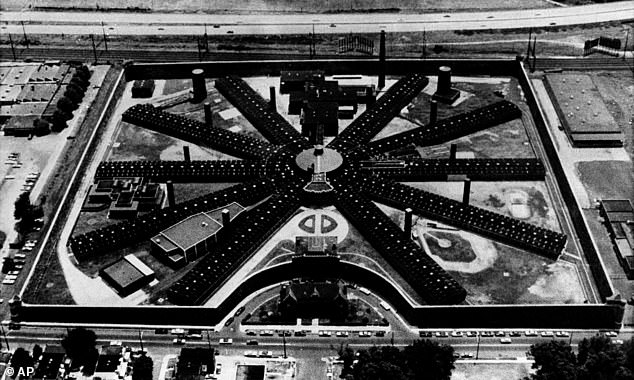
Kligman conducted his widely condemned experiments at Holmesburg Prison in Philadelphia, Pennsylvania (pictured)
Knowledge of these experiments has been publicly available for years, as their existence was revealed in previous lawsuits involving Dow Chemical, Bloomberg reports, although J&J's involvement has only just come to light.
“We deeply regret the conditions under which these studies were conducted, and they in no way reflect the values or practices we employ today,” a J&J spokesperson told Bloomberg.
'As the world's largest healthcare company, our transparent and conscientious approach to bioethics is at the heart of everything we promise to our customers and society.'
Kligman recruited ten prisoners for the 1971 study, in which he injected asbestos mixed with talc into the participants' lower backs.
Those injected with chrysotile asbestos developed granulomas, sores on the body caused by inflammation that often indicate a deeper medical problem, an expert testified.
Other studies deemed unethical included a 1968 study in which talc stored in various containers was exposed to the skin of 50 prisoners - 44 of whom were black - to see whether the method of storage had negative effects on a person's skin.
During these experiments the prisoners were said to have been deformed and seriously injured.

Johnson and Johnson is already facing thousands of lawsuits related to its iconic baby powder product, which causes cancer in some women due to asbestos exposure
"I was four or five when I saw my father's back for the first time and it scared me so much that I ran to my mother and told her that dad had turned into a monster," Adrianne Jones-Alston, the daughter of Leodus Jones, one of the study participants, told a newspaper at the time.
The University of Pennsylvania has distanced itself from Kligman and issued an official apology for his actions in 2021.
“Penn Medicine apologizes for the pain Dr. Kligman’s work has caused incarcerated individuals, their families and our broader community,” said Dr. J. Larry Jameson, executive vice president of the school, written in a letter.
“While we cannot change this history, the actions we are announcing today as an institution will change key aspects of our recognition of Dr. Kligman and his research, and will also dedicate significant resources to research focused on skin of color, as well as education and patient care for underserved and at-risk populations.”
The school also announced that an annual lecture and professorship named after Kligman would be renamed and established a scholarship fund for urban high school students interested in dermatology.

Some of the injuries reported by asbestos study participants include granulomas, where a collection of skin cells becomes inflamed and causes warts and lesions
J&J filed for bankruptcy earlier this year, citing the $3.5 billion it had paid out in settlements
This is just one of many problems J&J has faced in recent years with its iconic talc-based baby powder product.
J&J is facing thousands of lawsuits following allegations that some of its products that use talc - a type of mineral - are often contaminated with asbestos, which can pose a danger to its users.
Many women who developed cancer after using popular feminine hygiene products have already been awarded billions of dollars in damages.
Although safe on its own, it is often made from mines that contain asbestos and cross-contamination is possible.
Asbestos is a dangerous mineral and people exposed to it are at serious risk.
Inhaling asbestos can cause a variety of problems for a person. Mesothelioma, a cancerous tumor that can form on the outside of a person's lungs, heart and other organs, is most commonly associated with the mineral.
In October 2019, the FDA recalled J&J powder after finding traces of asbestos in a bottle.
The FDA then conducted a review of J&J's talc products and discovered asbestos in nine of 43 samples tested.
Asbestos has been linked to ovarian cancer in some women whose genitals were exposed to the mineral. It has also been linked to lung and throat cancer.
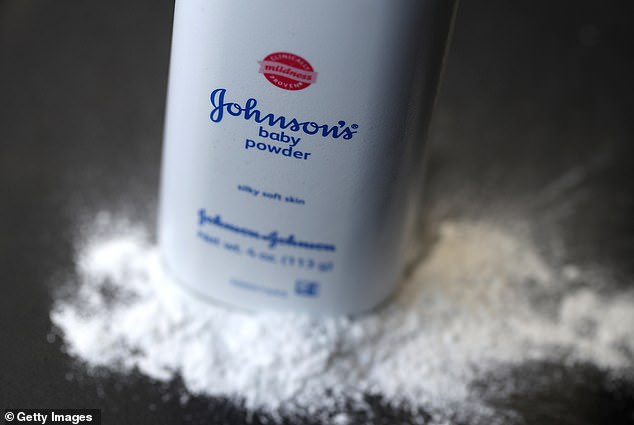
J&J's baby powder is talc-based, and while the compound itself is safe, it is often found in the same mines as the cancer-causing asbestos, and cross-contamination can be incredibly dangerous
J&J has denied the link between these cancers and talc, although revealed documents show that the company was aware of the risk of its talc being contaminated by asbestos as early as the 1970s.
Until 2018, it denied any possible contamination of its products with asbestos.
However, costly lawsuits began for the company in 2016.
In total, the company faces nearly 40,000 lawsuits related to potential dangers associated with the use of its talc products.
While their products have already been pulled from shelves in the US and Canada, they are still available in other parts of the world.
Last year, the Supreme Court dismissed another talcum powder case involving a $2 billion verdict. In total, the company made settlement payments of $3.5 billion in connection with the offering.
WHAT IS ASBESTOS
WHAT IS IT?
Asbestos is a heat-resistant mineral material that was popular in construction until the 1980s.
They contain microscopic fibers that, when inhaled, fester and can cause fatal diseases including cancers.
Asbestos was commonplace in construction in America and many other countries until the dangers it posed became clear.
Because it is heat-resistant and can be pulled apart to a fluffy consistency, it has been a popular insulation for cost-conscious builders.
Now it is banned in dozens of countries around the world, but the US is not one of them.
Its use is highly regulated and the U.S. Environmental Protection Agency has banned a list of products known to contain it.
The prohibited products are; Corrugated cardboard, rollboard, commercial paper, special paper and floor felt.
However, many others that contain it are not. This includes; Cement corrugated sheets, cement flat sheets, clothing, pipeline film, roofing felt, vinyl floor tiles, cement shingles, solid cardboard, cement pipes, automatic transmission components, clutch pads, friction materials, disc brake pads, drum brake pads, brake pads, seals, non-roof coatings, roof coatings.
In 1989, the EPA issued the Asbestos Ban and Phase-Out Rule (ABPR), which imposed a complete ban on the manufacture, importation, processing, and sale of products containing asbestos.
HEALTH RISKS
Exposure to asbestos is known to contribute to a number of diseases, including asbestosis, lung cancer and mesothelioma.
It is a natural substance that is inhaled in small doses by almost everyone without any health problems.
However, if a large amount is shredded and released into the air, more fibers will be inhaled and therefore pose a risk.
After the attacks of September 11, 2001, there were fears that many would suffer health problems due to their long exposure to the terrain covered in toxic debris.