

 Suche
Suche
 Mein Konto


None of the NHS hospitals feature on a list of the world's top 25, according to a ranking published today.
The top spots were dominated by hospitals in the United States, but locations in Canada, Germany, France, Sweden and Israel were also among the top ten.
Britain's first entry in the global rankings - compiled by Newsweek and Statista - was just 41, with London's St Thomas' Hospital.
Derriford Hospital in Plymouth ended up at the bottom of the list when the analysis was broken down to sites in the UK only.
Campaigners today blasted the NHS results as “disappointing” and said they raised “serious questions” about Britain’s health service.
But Department of Health bosses said they were “proud of the excellent care” provided by the NHS.
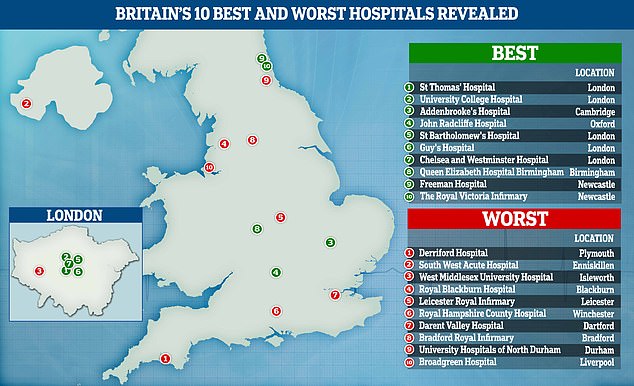
The above shows the ten best and worst NHS hospitals in the UK. The best were mostly in the capital, although two were in Newcastle. The worst were scattered across the country
Now in its fourth year, the annual ranking of the world's best hospitals lists 2,200 hospitals in 27 countries, including Brazil, India, Thailand, Saudi Arabia and Colombia.
Each hospital analyzed is given a score from 0 to 100. Not all NHS hospitals were included in the snapshot.
It is based on surveys from 80,000 medical experts and thousands of patients. Key performance indicators – such as waiting times and the ratio of doctors to patients – are also taken into account.
According to Newsweek, the results are only comparable between hospitals in the same country because they are based on the same performance metrics.
His report: “A score of 90 in Country A does not necessarily mean that this hospital is better than a hospital with a score of 87 in Country B.”
The Department of Health said the NHS was asked to pay for the rankings every year, saying it was effectively a "paid advertorial".
A spokesman said: “We are proud of the excellent care provided free of charge at the point of care in hospitals across the country and continue to work hard to ensure people receive the best care when they need it.
“Our record investment in NHS hospitals and other health services includes an additional £2 billion this year and £8 billion over the next three years.”
But campaign groups warned today that the NHS is not meeting other countries' standards.
John O’Connell, chief executive of the TaxPayers’ Alliance, said: “With new health and social care charges, UK taxpayers may be wondering whether they are getting their money’s worth.
“Healthcare bosses must ensure the NHS provides all patients with the level of care they need.”
He added: “These rankings raise serious questions about the performance of the NHS and how it really compares to other countries.”
Emily Fielder, from the thinktank Adam Smith Institute, said: “It is disappointing but not surprising that a UK hospital is not even ranked in the top 40, despite being the world’s fifth largest economy.
“The fact that the methodology used quality of care and patient safety performance indicators, as well as patient experience, to reach this conclusion points to the abject failure of the NHS to deliver for patients.”
The US dominated the list of top 50 hospitals, occupying no fewer than 14 of the positions.
Germany took the second most top spots with six places, followed by Switzerland with four and Canada, France and Japan with three places each.
Only one British hospital – St Thomas in London – was in the top 50.
Looking at the top 10 hospitals in the UK, half were in the capital. Newcastle had two of the best, while Cambridge, Oxford and Birmingham had one each.
Of the 10 worst, these were mostly scattered across rural areas, with two in both the northwest and southwest.
The Midlands, East of England, North East, Yorkshire and Humber, London and Northern Ireland each had one of the worst.
It comes after the NHS lost its rating as the best healthcare system in the world last year after seven years at the top of the charts.
The report by think tank Commonwealth Fund ranked the British service fourth among 11 wealthy countries. Norway, the Netherlands and Australia all now offer better care.
The slide in the rankings was attributed to delays in patients' access to care and treatment, a lack of investment in the service and poverty.
NHS waiting lists have risen to record highs following the pandemic, with 6.1 million people in England now queuing for care.
But government estimates suggest this could double in the coming years as patients come forward who have stayed away due to the virus.
Boris Johnson will raise taxes by 1.25 per cent from next month in a bid to bring in an extra £12 billion a year for the NHS.
Health Secretary Sajid Javid has also announced targets to end the two-year wait for supplies by July and the one-year wait by March 2025.
But Labour, health unions and even a senior Tory have criticized it as “not ambitious enough” and “seriously falling short of expectations”.