

 Suche
Suche
 Mein Konto


The number of children in the United States diagnosed with autism has skyrocketed in recent years, a new study shows.
Researchers at Guangdong Pharmaceutical University in China found that 3.49 percent of children and adolescents in the United States - or about one in 30 - had autism in 2020.
This is a sharp 52 percent increase from the 2.29 percent of adolescents in America who suffered from the disease in 2017.
While the research team did not provide an exact reason for the increase, many experts have speculated that the increase is related to parents better understanding early signs of autism in their child and better monitoring of the condition.
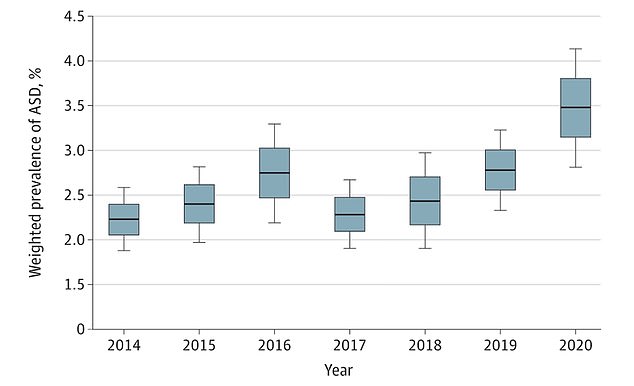
Nearly 3.5% of children and teens in the United States have autism, a number that has increased by about 50% since 2017. Experts say this is likely due to increased surveillance of the condition
Researchers who published their findings on Tuesday in JAMA Pediatrics collected data from the annual National Health Interview Survey (NHIS).
The survey, conducted by the Centers for Disease Control and Prevention, conducts household interviews and targeted screenings to learn more about the health of an average household.
In 2014, the NHIS found that 2.24 percent of children and teens in America had autism.
The number grew gradually and reached 2.76 percent in 2016. In 2017 it fell sharply by 2.44 percent.
It then grew steadily over the next three years until the most recent NHIS data from 2020 shows that 3.49 percent of American youth are on the spectrum.
Researchers note that the United States and Europe generally have higher rates of autism than the rest of the world, likely due to better screening and diagnosis.
Almost five percent of boys had autism, compared to just under two percent of girls.
Children who are black, come from a family in poverty or have a more educated family are most likely to be diagnosed.
The reasons for these discrepancies are not clear, but experts have long known that boys in particular are more likely to receive an autism diagnosis.
While the rising rates of autism may be alarming, some experts see them as more of a positive thing - they believe the number of people suffering from the condition has not increased but is instead a sign of better surveillance.
In 2006, the American Academy of Pediatrics recommended that all children between 18 months and two years of age be screened for autism.
As screening and diagnostic testing increased, so did the number of cases detected.
The average parent is now more likely to be more aware of early signs of autism than in years past, and may recognize things like failure to maintain eye contact, poor communication skills, and an inability to function out of structure as signs.
The social stigma surrounding autism has also lessened, and many parents are much more willing to have their child examined without fear of negative social repercussions.
However, some experts warn that having children in the womb has some negative effects that put them at higher risk.
Experts warn that older parents, pollution in the womb and even a mother who is overweight during pregnancy could be linked to an increased likelihood of developing autism.