

 Suche
Suche
 Mein Konto


Autism could be detected in the womb - by analyzing the brain scans of developing babies, a study suggests.
Researchers at Harvard Medical School examined ultrasound scans of 39 babies before they were born.
Nine teenagers diagnosed with autism had an insular lobe that was larger than normal, the results showed.
The area of the brain monitors social behavior and decision-making, two things that autistic people struggle with.
The results suggest that a larger insular lobe is a “powerful” biomarker that could predict which babies will develop autism later in life.
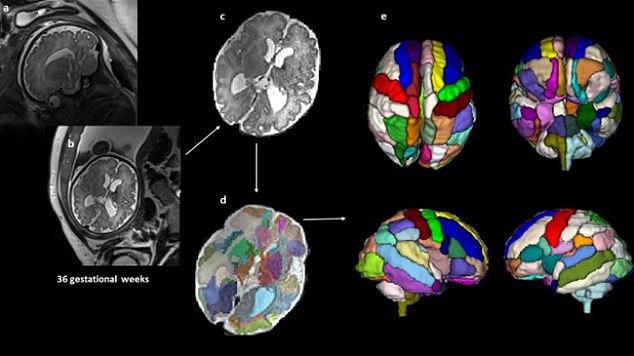
Researchers at Boston Children's Hospital examined ultrasound scans of 40 babies before they were born. Pictured: Ultrasound examination of the unborn baby's brain (a and b); a processed image of the scan to remove it from other parts of the baby and mother's body (c); the brain scan segmented by colors to show the different parts (d); 3D versions of the brain based on the scan results
Scientists don't know exactly what causes autism - but it is sometimes passed on to children from their parents.
And studies suggest it's more common in children of older parents, as well as in mothers who are overweight or have pregnancy complications.
Affected children may have difficulty making eye contact, understanding how others are feeling, or having a strong interest in certain topics. Autistic teens may also take longer to familiarize themselves with information or repeat things.
About one in 50 young people falls on the spectrum. However, it can currently only be diagnosed from 18 months at the earliest.
To diagnose a child, medical professionals ask their parents about their child's problems, observe how they interact with others, and talk to their family, friends or teachers.
Early diagnosis can help parents understand their child's needs and provide them with support at school.
Researchers led by Dr. Alpen Ortug retrospectively examined 39 fetal brain scans taken six months after conception.
Nine of the children were later diagnosed with autism and 20 had no developmental problems.
Ten other youth also did not have autism but had other underlying conditions that common autistic participants had.
The team then segmented the different parts of the brain in each scan to compare them between the different groups.
According to the results, children with autism had a “significantly larger” insular lobe compared to the other three groups.
This part of the brain is thought to play a crucial role in cognition, social behavior and decision-making.
Adolescents with autism also had larger amygdala (which processes emotions and memories associated with fear) and hippocampal commissures (needed for memory and learning) compared to children without autism.
Academics said their finding is consistent with other recent studies that have found differences in some of these parts of the brain in adults with autism.
Dr. Ortug said "it is ideal" to detect the earliest signs of brain abnormalities in potential autism patients in order to understand the "many genetic and environmental factors that may be behind them."
“Earlier detection means better treatment,” she said.
“To the best of our knowledge, this is the first attempt to semi-automatically segment brain regions at the prenatal stage in patients later diagnosed with autism and to compare different control groups.”
The study will be presented today at the annual meeting of the American Association for Anatomy in Philadelphia.