

 Suche
Suche
 Mein Konto


Many psychiatrists have been aware for years that low serotonin levels may not cause depression, a psychology chair said.
Dr. Jonathan Raskin, a psychotherapist at the State University of New York, told DailyMail.com he had been concerned that the theory had been "incomplete" for "a while."
But he said many medical professionals continued to prescribe the drug because it was "easier" than offering a more time-intensive treatment.
The pills could still be helpful for some patients, he said, but he hoped warnings about their effectiveness would encourage more people to take control of their treatment.
This week, a landmark British study called into question society's ever-growing reliance on antidepressants such as Prozac.
The $15 billion industry, expected to grow to $21 billion in the next decade, sees patients prescribing pills like Prozac on the promise that they will cure people's depression by increasing levels of serotonin, a neurotransmitter in the brain.
But after reviewing 17 key studies, scientists at University College London said they found no convincing evidence that a deficiency in the chemical caused the disease.
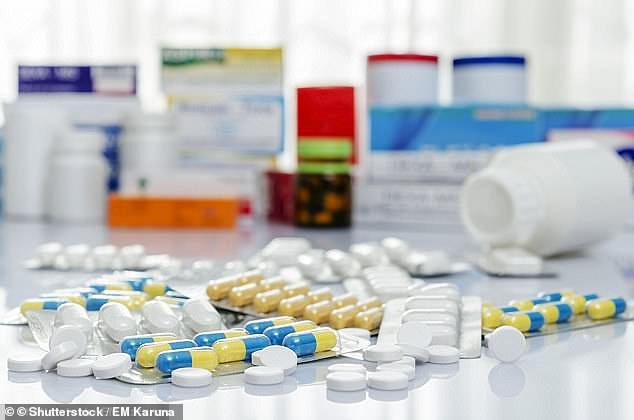
Researchers at University College London said a review of evidence found no link between low levels of serotonin and depression, raising doubts about antidepressants designed to increase levels of the "feel-good" chemical. But other experts have expressed doubts about the results

Dr. Jonathan Raskin, chair of psychology at the State University of New York at New Paltz, said many experts were concerned the theory was "incomplete."
Figures show that about 13 percent of American adults take antidepressants each year.
But rates are much higher among women, with up to 18 percent prescribed the drugs annually.
When asked whether low serotonin levels cause depression, Raskin said, "I think most mental health professionals who are familiar with the research have known for some time that the serotonin theory of depression is incomplete and supported by mixed research results.
“Depression is a complicated issue and the idea that we can simply reduce it to serotonin is not correct.
"When we give antidepressants, we don't do it based on biological tests that show they don't have enough serotonin - but if we think it might help them."
Asked whether people should continue taking the pills, he said: “I think this is worth having a conversation.
“I'm not going to say people should take them or not, but I think the idea that we've reduced depression to low serotonin has been widely disseminated in the population.
“Antidepressants sometimes have some effect for some people, but I don’t think they’re a panacea.”
He added: “They are easier to prescribe and administer than more time-consuming things like psychotherapy.
“So they can be offered to people even though other solutions are the same or more effective.”
A scientist involved in the British study described the results as “eye-opening” and that “everything I thought I knew was turned on its head.”
Lead author Professor Joanna Moncrieff, a psychiatrist, said: “The popularity of the ‘chemical imbalance’ theory has coincided with a huge increase in the use of antidepressants.
“Thousands suffer from the side effects of antidepressants, including severe withdrawal symptoms that can occur when people try to stop taking them, yet prescription rates continue to rise.
Serotonin helps carry signals in the brain and is believed to have a positive impact on mood, emotions and sleep.
They are preferred over other types of antidepressants because they cause fewer side effects. Still, they can cause anxiety, diarrhea, dizziness, and blurred vision in patients who take them.
Depressed patients can also experience debilitating withdrawal symptoms when they try to stop taking the pills.
At the same time, a number of studies suggest that they work no better than a placebo.
The UCL study, published in the journal Molecular Psychiatry, analyzed 17 previous reviews dating back to 2010 and consisting of dozens of individual studies.
It doesn't prove that SSRIs don't work. However, it suggests that the drugs do not treat depression by fixing abnormally low levels of serotonin.
SSRIs have no other proven mode of action, said Professor Moncrieff and colleagues.
She added: “We can say with certainty that after a large amount of research conducted over several decades, there is no convincing evidence that depression is caused by serotonin abnormalities, particularly lower levels or reduced activity of serotonin.
“We don’t understand exactly what antidepressants do to the brain.
“Giving people this type of misinformation prevents them from making an informed decision about whether or not they should take antidepressants.”
The studies used in the review included hundreds of thousands of people from different countries.
They found that there was no difference in serotonin levels between people diagnosed with depression and healthy people, despite surveys suggesting that up to 95 percent of the public believe this.
Even artificially lowering serotonin levels in healthy subjects did not lead to the development of depression.