

 Suche
Suche
 Mein Konto


Women endure agonizing adjustments of contraceptive coils with no pain relief - expected to "just grit their teeth and deal with it", experts warn.
The warning comes despite new guidelines issued by health chiefs last year recommending that women should always be offered "appropriate analgesia" before the procedure, which involves inserting a small T-shaped device, about half the length of a cotton swab, into the uterus.
The change was recommended by the Faculty of Sexual and Reproductive Medicine - part of the Royal College of Obstetricians and Gynecologists - after BBC broadcaster Naga Munchetty spoke about her "traumatic" experience with IUD fitting.
While many women find IUD insertion painless, some experience cramping, discomfort and anxiety, so anesthesia should be offered to all, the guidance added.
But exclusive data obtained by The Mail on Sunday shows up to a third of women received no pain relief at all during the procedure. And half of women who use a contraceptive coil describe the discomfort as a “five out of five” – the highest possible.

Women endure agonizing adjustments of contraceptive coils with no pain relief - expected to "just grit their teeth and deal with it", experts warn. Lucy Cohen (above), 39, from Swansea, underwent the procedure last summer. “It was excruciating, the worst pain I have ever felt,” says the accountant
Dr. Philippa Kaye, a GP who focuses on women's health, believes the problem is partly because women's pain is often dismissed by the medical profession.
She says: "Women have always been expected to endure more pain than men - it's assumed that this is just part of being a woman. It's really disappointing that this still happens."
Dr. Rebecca Mawson, a GP and women's health expert at Sheffield University, added: "Some doctors believe women are stoic and just grit their teeth."
More than a million women in the UK use the contraceptive coil, with at least 45,000 undergoing the procedure to have an IUD fitted each year.
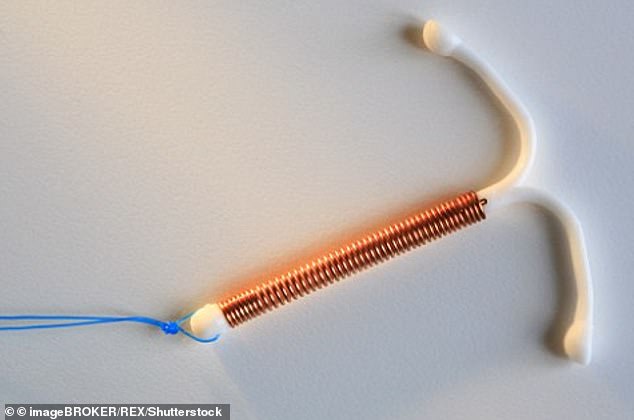
The warning comes despite new guidelines issued by health chiefs last year recommending that women should always be offered "appropriate analgesia" before the procedure, which involves inserting a small T-shaped device, about half the length of a cotton swab, into the uterus
There are two types of coils – one made of copper and the other made of plastic. The copper coil, also known as a contraceptive intrauterine device or IUD, releases copper ions into the uterus. These affect the fluids in the fallopian tubes and uterus, which become toxic to sperm and destroy them on contact.
It can stay in place for ten years before needing to be replaced. The plastic coil, or intrauterine system (IUS), releases the hormone-like drug progestin, which stops pregnancy and lasts for up to five years.
Both IUDs are 99 percent effective at preventing pregnancy, but the plastic IUD can also be used to treat a range of conditions, including heavy menstrual bleeding, period pain and some menopausal symptoms.
During the insertion procedure, which usually lasts about five minutes, a GP or nurse first inserts a speculum - a duckbill-shaped device - into the vagina to open access to the uterus.
The thin lining of the cervix is then pierced with a tenaculum, an instrument that looks like a pair of scissors with a tiny hook at the end of each prong. This secures the cervix in place. The coil is then threaded through the speculum and positioned in the uterus.
Last June, Ms Munchetty revealed that she had screamed so loudly during the procedure that her husband, who was waiting in a nearby corridor, tried to find the room where she was in an attempt to stop the procedure. “I fainted twice and felt hurt, weak and angry,” she said.
Ms Munchetty claimed she was not offered any pain relief during the procedure but was told to take paracetamol and ibuprofen before her appointment.
While experts say their experience is unusual, studies show that a large number of women experience severe discomfort during the fitting of a contraceptive coil.
A year later, that newspaper asked The Lowdown, a website that reviews contraceptive products, to survey readers about their experiences with IUD fitting. More than 600 women responded, and 32 percent said they were not offered pain relief.
Over 60 percent said they had previously self-medicated with over-the-counter painkillers, and yet some said the procedure was "excruciating" and even "the worst pain I've ever experienced." “I fainted from the pain,” one wrote. Another said: "I had to take three days off work because I was in so much pain."
Experts say the results are particularly frustrating because pain relief — usually a local anesthetic spray applied to the cervix to numb the area — is easily accessible and carries minimal risk.
“The spray is easy to use and most GPs will use it or another form of local pain relief,” says Dr. Kaye. “Despite this, some doctors are still unaware that they could use these for coil adjustments.
"We want to make it as easy as possible for women to access contraception, and if they are afraid of pain they are less likely to use contraception. Not everyone will need pain relief, but it should definitely be offered."
Lucy Cohen, 39, from Swansea, underwent the procedure last summer. “It was excruciating, the worst pain I have ever felt,” says the accountant. “It took 20 minutes and I was shaking and sweating.”
Lucy, who is married to Adam, 37, an engineer, says her GP asked her if she wanted to stop but offered no pain relief. She adds, "The coil is amazing. I just don't think you have to go through that much pain to get it."