
Can YOU stand on one leg for 10 seconds? Scientists warn that if you can't balance like a flamingo in your 60s, you're twice as likely to die early

Transparenz: Redaktionell erstellt und geprüft.
Veröffentlicht am und aktualisiert am

Researchers found that those who cannot stand on one leg were 84% more likely to die Those who failed the test were more likely to suffer from heart disease and diabetes The 'flamingo test' could be used in health checks to guide the risk of death Scientists say middle-aged people who cannot balance on one leg are twice as likely to die early. Researchers in Brazil who studied 2,000 people ages 50 to 75 found that those who couldn't stand on one leg for 10 seconds were 84 percent more likely to die within the next decade...

Forscher fanden heraus, dass diejenigen, die nicht auf einem Bein stehen können, mit 84 % höherer Wahrscheinlichkeit sterben Diejenigen, die den Test nicht bestanden, litten mit größerer Wahrscheinlichkeit an Herzerkrankungen und Diabetes Der „Flamingo-Test“ könnte bei Gesundheitschecks als Orientierungshilfe für das Sterberisiko verwendet werden Wissenschaftler sagen, dass Menschen mittleren Alters, die nicht auf einem Bein balancieren können, doppelt so häufig früh sterben. Forscher in Brasilien, die 2.000 Menschen im Alter von 50 bis 75 Jahren untersuchten, fanden heraus, dass diejenigen, die 10 Sekunden lang nicht auf einem Bein stehen konnten, mit 84 Prozent höherer Wahrscheinlichkeit innerhalb des nächsten Jahrzehnts starben …
Researchers found that those who cannot stand on one leg were 84% more likely to die Those who failed the test were more likely to suffer from heart disease and diabetes The 'flamingo test' could be used in health checks to guide the risk of death Scientists say middle-aged people who cannot balance on one leg are twice as likely to die early. Researchers in Brazil who studied 2,000 people ages 50 to 75 found that those who couldn't stand on one leg for 10 seconds were 84 percent more likely to die within the next decade...

Can YOU stand on one leg for 10 seconds? Scientists warn that if you can't balance like a flamingo in your 60s, you're twice as likely to die early

  • Forscher fanden heraus, dass diejenigen, die nicht auf einem Bein stehen können, mit 84 % höherer Wahrscheinlichkeit sterben
  • Diejenigen, die den Test nicht bestanden, litten mit größerer Wahrscheinlichkeit an Herzerkrankungen und Diabetes
  • Der „Flamingo-Test“ könnte bei Gesundheitschecks als Orientierungshilfe für das Sterberisiko verwendet werden

Scientists say middle-aged people who can't balance on one leg are twice as likely to die early.

Researchers in Brazil who studied 2,000 people ages 50 to 75 found that those who couldn't stand on one leg for 10 seconds were 84 percent more likely to die within the next decade than those who completed the exercise.

The "simple and safe" balance test can detect people in poorer health - those who struggle to complete the activity are more likely to suffer from heart disease, high blood pressure and diabetes.

The "flamingo test" could be used in routine health checks for older adults to provide "useful information" about their risk of death, the team said.

Forscher in Brasilien, die 2.000 Menschen im Alter von 50 bis 75 Jahren untersuchten, fanden heraus, dass diejenigen, die 10 Sekunden lang nicht auf einem Bein stehen konnten, mit 84 Prozent höherer Wahrscheinlichkeit innerhalb des nächsten Jahrzehnts starben als diejenigen, die die Übung absolvierten.  Der „Flamingo-Test“ könnte bei routinemäßigen Gesundheitsuntersuchungen für ältere Erwachsene verwendet werden, um „nützliche Informationen“ über ihr Sterberisiko zu liefern, sagte das Team

Researchers in Brazil who studied 2,000 people ages 50 to 75 found that those who couldn't stand on one leg for 10 seconds were 84 percent more likely to die within the next decade than those who completed the exercise. The "flamingo test" could be used in routine health checks for older adults to provide "useful information" about their risk of death, the team said
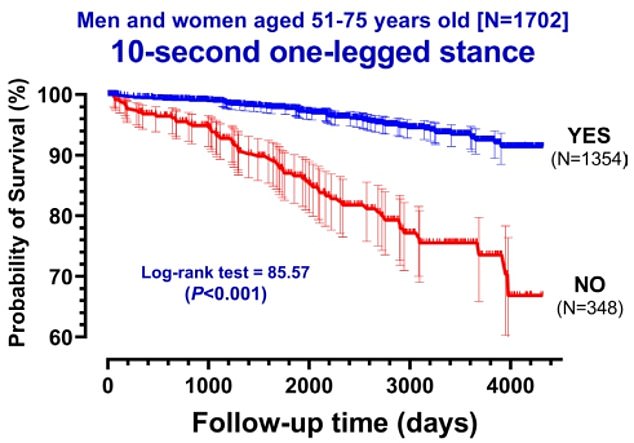
Nach Berücksichtigung von Alter, Geschlecht und zugrunde liegenden Gesundheitszuständen starben diejenigen, die 10 Sekunden lang nicht ohne Unterstützung auf einem Bein stehen konnten, mit 84 Prozent höherer Wahrscheinlichkeit innerhalb des nächsten Jahrzehnts an irgendeiner Ursache.  Die Grafik zeigt die Überlebenschancen derjenigen, die die 10-Sekunden-Herausforderung auf einem Bein gemeistert haben (blaue Linie) und derjenigen, die daran gescheitert sind (rote Linie).

After controlling for age, gender and underlying health conditions, those who could not stand on one leg without support for 10 seconds were 84 percent more likely to die from any cause within the next decade. The graph shows the survival chances of those who completed the 10-second one-leg challenge (blue line) and those who failed (red line).
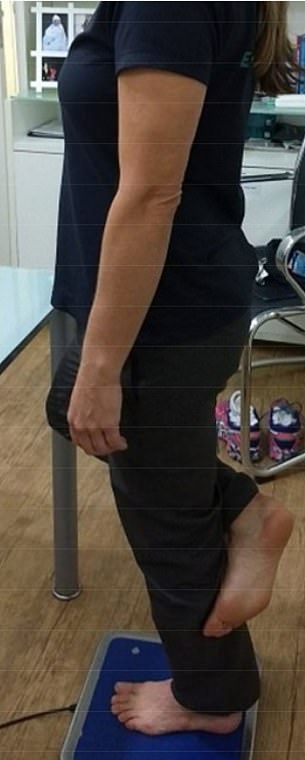
Um sicherzustellen, dass alle Teilnehmer dies auf die gleiche Weise taten, wurden sie gebeten, die Vorderseite eines Fußes auf die Rückseite des gegenüberliegenden Unterschenkels zu stellen, während sie ihre Arme an ihrer Seite hielten und ihren Blick geradeaus richteten (Bild).

To ensure that all participants did this in the same way, they were asked to place the front of one foot on the back of the opposite lower leg while keeping their arms at their sides and looking straight ahead (pictured).

Improbable aerobic fitness, muscular strength and flexibility, balance is usually maintained fairly well until people are in their 60s - at which point it deteriorates.

Balance tests are not routinely included in health checks for older people, which the researchers say is due to the lack of a standardized test to measure them.

Aside from an increased likelihood of falls, there is also limited data on how balance relates to health.

To find out whether a balance test could be an indicator of health, the team at the exercise medicine clinic CLINIMEX in Rio de Janeiro examined the results of a previous study.

The study, which began in 1994, recruited 1,702 people in Brazil who underwent various fitness tests, including standing on one leg for 10 seconds without any support.

To ensure that all participants did this in the same way, they were asked to place the front of one foot on the back of the opposite lower leg while keeping their arms at their sides and looking straight ahead.

The researchers also collected data on weight, waist circumference and blood pressure. Volunteers were monitored for an average of seven years.

The results, published in the British Journal of Sports Medicine show that a fifth of participants were unable to stand on one leg.

The rate increased with age, with only five percent of 51- to 55-year-olds failing the task, compared to 54 percent of 71- to 75-year-olds.

About 123 people died during the course of the study.

The scientists found no clear trends in the cause of death between those who were able to complete the test and those who could not.

However, after controlling for age, gender and underlying health conditions, those who could not stand on one leg without support for 10 seconds were 84 percent more likely to die from any cause within the next decade.

Those who failed the test also tended to have poorer health. A higher proportion were obese, had heart disease, high blood pressure and unhealthy blood lipid levels.

And type 2 diabetes was three times as common in this group.

The researchers noted that all participants were white Brazilians, so the results may not apply to other ethnicities and nationalities.

And no information was available about factors that could affect the balance, such as: B. the volunteers' recent fall history, their physical activity level, diet, smoking and drug use.

However, the researchers noted that the 10-second balance test “provides the patient and healthcare professional with rapid and objective feedback regarding static balance.”

They said it “adds useful information about mortality risk in middle-aged and older men and women.”

HOW CAN I IMPROVE MY BALANCE?

There are some simple balance exercises that can be done at home to improve health and mobility.

The NHS recommends doing balance exercises at least twice a week.

Walk sideways

A. Stand with your feet together and your knees slightly bent.

B. Walk sideways slowly and with control, moving one foot to the side first.

C. Move the other to join it.

Avoid lowering your hips while walking. Take 10 steps in each direction or walk from one side of the room to the other.

Simple vine

This involves walking sideways by crossing one foot over the other.

A. Start by crossing your right foot over your left.

B. Bring your left foot to join him.

Try 5 cross steps on each side. If necessary, place your fingers against a wall for stability. The smaller the step, the more you work on your balance.

Walk from heel to toe

A. Stand tall and place your right heel on the floor directly in front of your left toe.

B. Then do the same with your left heel. Make sure you are always looking forward. If necessary, place your fingers against a wall for stability.

Try to complete at least 5 steps. As you continue, move away from the wall.

One-legged stand

A. Start by standing facing the wall with your arms extended and your fingertips touching the wall.

B. Raise your left leg, keeping your hips straight and the opposite leg slightly bent. Carefully place your foot back on the floor.

Hold the lift for 5 to 10 seconds and perform 3 on each side.

Source: NHS

Anzeige

.

Source: Dailymail UK
