
Two-thirds of Americans don't sleep properly: 70% don't get enough restful sleep each night, a study finds

Transparenz: Redaktionell erstellt und geprüft.
Veröffentlicht am und aktualisiert am

A large majority of Americans don't get good, "restorative" sleep every night, a new study finds. A research team from Boston, Massachusetts, found that only 28% of Americans reported quality sleep. They also found that longer sleep duration does not necessarily mean better sleep quality. Poor nighttime sleep can have devastating health consequences and a variety of heart and heart problems Causing Brain Problems According to a news study, the majority of Americans don't get enough quality sleep every night. Researchers at Brigham Women's Hospital and Harvard Medical School - both in Boston, Massachusetts - found that...

Eine große Mehrheit der Amerikaner bekommt nicht jede Nacht guten, „erholsamen“ Schlaf, wie eine neue Studie herausfindet Ein Forschungsteam aus Boston, Massachusetts, fand heraus, dass nur 28 % der Amerikaner über einen qualitativ hochwertigen Schlaf berichteten Sie fanden auch heraus, dass eine längere Schlafdauer nicht unbedingt auch eine bessere Schlafqualität bedeutet Schlechter nächtlicher Schlaf kann verheerende gesundheitliche Folgen haben und eine Vielzahl von Herz- und Gehirnproblemen verursachen Laut einer Nachrichtenstudie bekommt die Mehrheit der Amerikaner nicht jede Nacht ausreichend guten Schlaf. Forscher des Brigham Women’s Hospital und der Harvard Medical School – beide in Boston, Massachusetts – fanden heraus, dass …
A large majority of Americans don't get good, "restorative" sleep every night, a new study finds. A research team from Boston, Massachusetts, found that only 28% of Americans reported quality sleep. They also found that longer sleep duration does not necessarily mean better sleep quality. Poor nighttime sleep can have devastating health consequences and a variety of heart and heart problems Causing Brain Problems According to a news study, the majority of Americans don't get enough quality sleep every night. Researchers at Brigham Women's Hospital and Harvard Medical School - both in Boston, Massachusetts - found that...

Two-thirds of Americans don't sleep properly: 70% don't get enough restful sleep each night, a study finds

  • Eine große Mehrheit der Amerikaner bekommt nicht jede Nacht guten, „erholsamen“ Schlaf, wie eine neue Studie herausfindet
  • Ein Forschungsteam aus Boston, Massachusetts, fand heraus, dass nur 28 % der Amerikaner über einen qualitativ hochwertigen Schlaf berichteten
  • Sie fanden auch heraus, dass eine längere Schlafdauer nicht unbedingt auch eine bessere Schlafqualität bedeutet
  • Schlechter nächtlicher Schlaf kann verheerende gesundheitliche Folgen haben und eine Vielzahl von Herz- und Gehirnproblemen verursachen

The majority of Americans don't get enough quality sleep every night, according to a news study.

Researchers at Brigham Women's Hospital and Harvard Medical School - both in Boston, Massachusetts - found that 70 percent of Americans reported feeling unrefreshed after a night's sleep.

They found that it wasn't just sleep duration that affected how a person felt the next day, but also overall sleep quality.

The study points to a potential crisis in America as so many struggle to get basic rest each night. Sleep disorders are also linked to a variety of health problems later in life, such as high blood pressure and even brain damage.
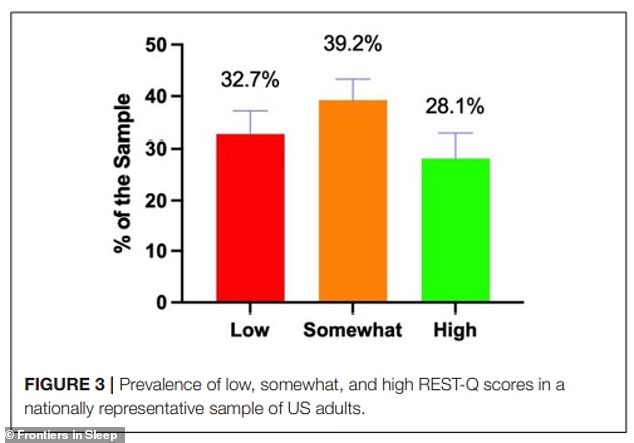
Die Forscher fanden heraus, dass weniger als 30 % der Teilnehmer an der Studie einen „hochwertigen“ Schlaf (grün) hatten, was der Schwellenwert war, der erreicht werden musste, damit er als erholsam angesehen werden konnte

The researchers found that fewer than 30% of participants in the study had “high-quality” sleep (green), which was the threshold that had to be met for it to be considered restful

Schlechter Schlaf wurde mit Bluthochdruck, Herzkrankheiten, Hirnschäden und sogar mit der Beschleunigung des kognitiven Verfalls im Zusammenhang mit Alzheimer in Verbindung gebracht (Dateifoto)

Poor sleep has been linked to high blood pressure, heart disease, brain damage and even the acceleration of cognitive decline linked to Alzheimer's disease (file photo)

Researchers who published their results on Thursday in Limits in sleep collected data from 1,055 Americans for the study.

First, they assembled a team of seven sleep experts to develop survey criteria that best reflected how to measure a person's sleep quality.

The group of experts identified nine key signs that could indicate whether a person slept well the night before.

Participants were asked if they felt: grumpy; in a good mood; tired,; sleepy; rested; refreshed; energetic; energetic; awake and ready for the day. They were asked to rate their feelings on a scale of one to five.

How insomnia determines your life

  • Entsprechend Mayo-Klinik Schlaflosigkeit ist eine häufige Schlafstörung, die das Einschlafen, Durchschlafen oder Wiedereinschlafen nach dem Aufwachen erschweren kann.
  • Menschen, die unter Schlaflosigkeit leiden, spüren ihre Auswirkungen oft auch den ganzen Tag.
  • Die Schlafstörung kann ein niedriges Energieniveau und Stimmungsschwankungen verursachen und Ihre allgemeine Arbeitsleistung und Lebensqualität beeinträchtigen.
  • Obwohl die benötigte Schlafmenge von Person zu Person unterschiedlich ist, benötigen die meisten Erwachsenen sieben bis acht Stunden Schlaf pro Nacht.
  • Viele Erwachsene leiden unter kurzfristiger (akuter) Schlaflosigkeit, die Tage oder Wochen anhält und oft die Folge von Stress oder einem traumatischen Ereignis ist.
  • Manche Menschen haben eine langfristige (chronische) Schlaflosigkeit, die einen Monat oder länger anhält.
  • Schlaflosigkeit kann das Hauptproblem sein oder mit anderen Erkrankungen oder Medikamenten in Verbindung gebracht werden
  • Denjenigen, die an Schlaflosigkeit leiden, wird empfohlen, einen Spezialisten für Schlafmedizin oder sogar einen Therapeuten aufzusuchen, um sich mit den Problemen zu befassen, die die Ursache ihrer Probleme sind
Anzeige

Each participant's scores were scaled from zero to 100 to assess their overall sleep quality.

A score of 49.9 or less was considered “low” sleep. A score of 50 to 74.99 was considered “somewhat” good sleep, while any higher score was considered “high” sleep.

Participants who were given a “high” score were considered to have a restful sleep. Only 28 percent of participants reached this mark.

The research also found that there was no direct relationship between sleep duration and overall quality, going against the usual narrative about sleep health.

"Qualitative assessment is an important feature of sleep health, yet the vast majority of high-quality, nationally representative data collected among U.S. adults have assessed quantitative aspects such as sleep duration, which preclude a holistic understanding of sleep in the population," researchers wrote in the study.

They are aware of some shortcomings of this type of study. Self-reported data always opens up the potential for false positives.

There are also other reasons why a person may feel grumpy or less alert when waking up in the morning, aside from poor sleep.

Still, researchers hope a study like this can help give the world a new understanding of how sleep works and how to assess it.

“Our study addresses conceptual ambiguities that remain in the sleep domain regarding restful sleep,” they explained.

“For example, our literature search returned more than 350 articles from a keyword search for “restorative sleep,” but only 48 measured nonrestorative or restorative sleep. Upon further investigation, we found that “restful” was often used in studies as a synonym for adequate sleep duration or satisfaction with sleep, such as: B. high ratings of sleep quality.'

Poor sleep is linked to a variety of health conditions. Some relatively minor ones, such as B. poor alertness and tiredness during the day.

Poor sleep habits can develop into more serious medical problems over time, including high blood pressure, heart disease and diabetes.

Previous studies have shown that it can even cause brain damage and accelerate cognitive decline associated with Alzheimer's.

.

Source: Dailymail UK
