

 Suche
Suche
 Mein Konto
Albinism
Albinism
overview
The term albinism typically refers to oculocutaneous (ok-u-low-ku-TAY-nee-us) albinism (OCA) – a group of inherited disorders in which there is little or no production of the pigment melanin. The type and amount of melanin produced by your body determines the color of your skin, hair and eyes. Melanin also plays a role in the development of the optic nerves, so people with albinism have vision problems.
Signs of albinism are usually noticeable in a person's skin, hair, and eye color, but sometimes the differences are subtle. People with albinism are also sensitive to the effects of the sun, putting them at increased risk of developing skin cancer.
Although there is no cure for albinism, people with the disorder can take steps to protect their skin and eyes and maximize their vision.
Symptoms
Signs and symptoms of albinism affect skin, hair, eye color, and vision.
skin
The most recognizable form of albinism results in white hair and very light skin compared to siblings. Skin color (pigmentation) and hair color can range from white to brown and can be almost the same as parents or siblings without albinism.
When exposed to sunlight, some people may develop:
- Sommersprossen
- Muttermale, mit oder ohne Pigment – Muttermale ohne Pigment sind im Allgemeinen rosa gefärbt
- Große sommersprossenartige Flecken (Lentigines)
- Sonnenbrand und die Unfähigkeit zu bräunen
In some people with albinism, skin pigmentation never changes. For others, melanin production may begin or increase during childhood and teenage years, causing mild changes in pigmentation.
hair
Hair color can range from very white to brown. People of African or Asian descent with albinism may have yellow, reddish, or brown hair color. Hair color may also darken or become discolored in early adulthood due to contact with normal minerals in the water and environment, appearing darker with age.
Eye color
Eyelashes and eyebrows are often pale. Eye color can range from very light blue to brown and can change with age.
The lack of pigment in the colored part of the eyes (iris) makes the iris somewhat translucent. This means that the iris cannot completely block light from entering the eye. For this reason, very light eyes may appear red in some lighting conditions.
vision
Visual impairment is a key feature of all types of albinism. Eye problems and problems can include:
- Schnelle, unwillkürliche Hin- und Herbewegung der Augen (Nystagmus)
- Kopfbewegungen wie Wippen oder Neigen des Kopfes, um zu versuchen, die unwillkürlichen Augenbewegungen zu reduzieren und besser zu sehen
- Unfähigkeit beider Augen, auf denselben Punkt gerichtet zu bleiben oder sich gemeinsam zu bewegen (Strabismus)
- Extreme Kurzsichtigkeit oder Weitsichtigkeit
- Lichtempfindlichkeit (Photophobie)
- Abnormale Krümmung der Vorderfläche des Auges oder der Linse im Inneren des Auges (Astigmatismus), die verschwommenes Sehen verursacht
- Abnormale Entwicklung der Netzhaut, die zu vermindertem Sehvermögen führt
- Nervensignale von der Netzhaut zum Gehirn, die nicht den üblichen Nervenbahnen folgen (Fehlleitung des Sehnervs)
- Schlechte Tiefenwahrnehmung
- Rechtliche Blindheit (Sehvermögen weniger als 20/200) oder vollständige Blindheit
When to go to the doctor?
If the doctor notices a lack of pigment in the hair or skin that affects the eyelashes and eyebrows when your child is born, the doctor will likely order an eye exam and closely monitor any changes in your child's pigmentation and vision.
If you notice signs of albinism in your baby, talk to your doctor.
Contact your doctor if your child with albinism has frequent nosebleeds, easy bruising, or chronic infections. These signs and symptoms may indicate the presence of Hermansky-Pudlak syndrome or Chediak-Higashi syndrome, which are rare but serious disorders that include albinism.
Causes
Autosomal recessive inheritance pattern
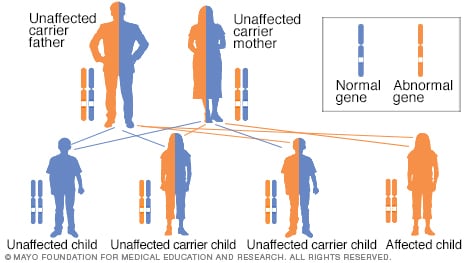
Autosomal recessive inheritance pattern
To have an autosomal recessive disorder, you inherit two altered genes (mutations), one from each parent. These diseases are usually passed on between two carriers. Their health is rarely affected, but they have an altered gene (recessive gene) and an unaffected gene (dominant gene) for the disease. Two carriers have a 25 percent chance of having an unaffected child with two unaffected genes (left), a 50 percent chance of having an unaffected child who is also a carrier (center), and a 25 percent chance of having an affected child with two recessively altered genes (right).
Several genes provide instructions for making one of several proteins involved in the production of melanin. Melanin is produced by cells called melanocytes, which are found in the skin, hair, and eyes.
Albinism is caused by a mutation in one of these genes. Different types of albinism can occur, depending primarily on which gene mutation caused the disorder. The mutation can result in no melanin at all or a significantly reduced amount of melanin.
Types of albinism
Types of albinism are classified based on their inheritance and the gene affected.
- Okulokutaner Albinismus (OCA), Der häufigste Typ bedeutet, dass eine Person zwei Kopien eines mutierten Gens geerbt hat – eine von jedem Elternteil (autosomal-rezessive Vererbung). Es ist das Ergebnis einer Mutation in einem von sieben Genen, die von OCA1 bis OCA7 gekennzeichnet sind. OCA verursacht eine verminderte Pigmentierung von Haut, Haaren und Augen sowie Sehstörungen. Die Pigmentmenge variiert je nach Typ, und die resultierende Farbe von Haut, Haaren und Augen variiert ebenfalls je nach und innerhalb des Typs.
- Augenalbinismus ist hauptsächlich auf die Augen beschränkt und verursacht Sehprobleme. Die häufigste Form ist Typ 1, vererbt durch eine Genmutation auf dem X-Chromosom. X-chromosomaler Augenalbinismus kann von einer Mutter, die ein mutiertes X-Gen trägt, an ihren Sohn weitergegeben werden (X-chromosomal-rezessive Vererbung). Augenalbinismus tritt fast ausschließlich bei Männern auf und ist viel seltener als OCA.
- Albinismus im Zusammenhang mit seltenen erblichen Syndromen kann auftreten. Beispielsweise umfasst das Hermansky-Pudlak-Syndrom eine Form von OCA sowie Probleme mit Blutungen und Blutergüssen sowie Lungen- und Darmerkrankungen. Das Chediak-Higashi-Syndrom umfasst eine Form von OCA sowie Immunprobleme mit wiederkehrenden Infektionen, neurologischen Anomalien und anderen schwerwiegenden Problemen.
Complications
Albinism can include skin and eye complications as well as social and emotional challenges.
Eye complications
Vision problems can affect learning, employment and the ability to drive.
Skin complications
People with albinism have skin that is very sensitive to light and sun. Sunburn is one of the most serious complications associated with albinism because it can increase the risk of skin cancer and sun-related skin thickening.
Social and emotional challenges
Some people with albinism may experience discrimination. Other people's reactions to people with albinism can often have a negative impact on people with the condition.
People with albinism may experience bullying, teasing, or probing questions about their appearance, glasses, or vision aids. They usually look very different from members of their own family or ethnic group, so they may feel like outsiders or be treated like outsiders. These experiences can contribute to social isolation, low self-esteem and stress.
The use of the term “person with albinism” is preferred to avoid the stigma of other terms.
prevention
If a family member has albinism, a genetic counselor can help you understand the type of albinism and the chances of having a future child with albinism. He or she can also explain the tests available.
Sources:
- Albinismus. Informationszentrum für genetische und seltene Krankheiten. https://rarediseases.info.nih.gov/diseases/5768/albinism. Abgerufen am 28. November 2017.
- Albinismus. American Association for Pediatric Ophthalmology and Strabismus. https://aapos.org/terms/conditions/12. Abgerufen am 28. November 2017
- Albinismus. Merck Manual Professional-Version. https://www.merckmanuals.com/professional/dermatologic-disorders/pigmentation-disorders/albinism. Abgerufen am 28. November 2017.
- Wright TS. Die Genodermatosen. https://www.uptodate.com/contents/search. Abgerufen am 28. November 2017.
- Okulokutaner Albinismus. Nationale Organisation für seltene Erkrankungen. https://rarediseases.org/rare-diseases/oculocutan-albinism/. Abgerufen am 28. November 2017.
- Albinismus. Amerikanisches College für osteopathische Dermatologie. http://www.aocd.org/page/Albinism. Abgerufen am 28. November 2017.
- Fragen Sie MayoExpert. Albinismus. Rochester, Minnesota: Mayo Foundation for Medical Education and Research; 2017.
- Hand JL (Gutachten). Mayo Clinic, Rochester, Minnesota, 9. Februar 2018.
- Nationalbibliothek für Medizin. Okulokutaner Albinismus. Genetik-Home-Referenz. https://ghr.nlm.nih.gov/condition/oculocutan-albinism. Abgerufen am 14. Februar 2018.
- Summers CG, et al. Hermansky-Pudlak-Syndrom. https://www.uptodate.com/contents/search. Abgerufen am 14. Februar 2018.
- Stiehm ER. Chediak-Higashi-Syndrom. https://www.uptodate.com/contents/search. Abgerufen am 14. Februar 2018.
- Summers CG, et al. Okulokutaner Albinismus. https://www.uptodate.com/contents/search. Abgerufen am 14. Februar 2018.