

 Suche
Suche
 Mein Konto
Aortic valve insufficiency
Aortic valve insufficiency
overview
Aortic valve insufficiency

Aortic valve insufficiency
In aortic valve insufficiency, the aortic valve does not close properly, causing blood to flow back from the body's main artery (aorta) into the lower left ventricle (left ventricle).
Aortic valve regurgitation – or aortic regurgitation – is a condition that occurs when your heart's aortic valve doesn't close tightly. As a result, some of the blood pumped from your heart's main pumping chamber (left ventricle) leaks backwards.
The leak can prevent your heart from pumping blood efficiently to the rest of your body. As a result, you may feel tired and short of breath.
Aortic valve regurgitation can develop suddenly or over decades. Once aortic valve regurgitation becomes severe, surgery is often required to repair or replace the aortic valve.
Symptoms
Most often, aortic valve regurgitation develops gradually. You may not have any signs or symptoms for years. You may not know you have the condition. However, sometimes aortic valve regurgitation occurs suddenly, usually as a result of an infection in the valve.
As aortic valve regurgitation worsens, the following signs and symptoms may occur:
- Kurzatmigkeit bei körperlicher Anstrengung oder im Liegen
- Müdigkeit und Schwäche, besonders wenn Sie Ihr Aktivitätsniveau erhöhen
- Herzgeräusch
- Unregelmäßiger Puls (Arrhythmie)
- Benommenheit oder Ohnmacht
- Schmerzen in der Brust (Angina pectoris), Unbehagen oder Engegefühl, die während des Trainings häufig zunehmen
- Empfindungen eines schnellen, flatternden Herzschlags (Palpitationen)
- Geschwollene Knöchel und Füße
When to go to the doctor?
Contact your doctor immediately if you have signs and symptoms of aortic valve regurgitation.
Sometimes the first signs of aortic valve insufficiency are related to heart failure. Make an appointment with your doctor if you have fatigue that doesn't improve with rest, shortness of breath, and swollen ankles and feet, which are common symptoms of heart failure.
Causes
Chambers and valves of the heart
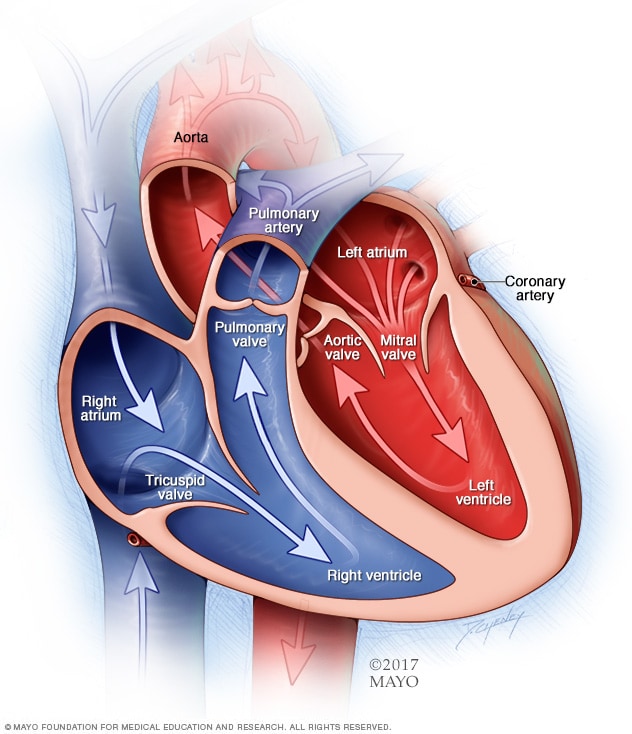
Chambers and valves of the heart
A typical heart has two upper and two lower chambers. The upper chambers, the right and left atria, receive incoming blood. The lower chambers, the more muscular right and left ventricles, pump blood from the heart. The heart valves are gates at the ventricular openings. They ensure that the blood flows in the right direction.
The aortic valve is one of four valves that control blood flow through the heart. It separates the heart's main pumping chamber (left ventricle) and the main artery that supplies your body with oxygen-rich blood (aorta). The valve has flaps (cusps or leaflets) that open and close once during each heartbeat.
In aortic valve insufficiency, the valve does not close properly, causing blood to flow back into the heart's main pumping chamber (left ventricle). As a result, the left ventricle holds more blood, potentially causing it to enlarge and thicken.
First, the larger left ventricle with more power helps maintain good blood flow. But eventually, these changes weaken the left ventricle — and your heart as a whole.
Aortic valve regurgitation usually occurs gradually but can develop suddenly if caused by a valve infection. Any condition that damages the aortic valve can cause regurgitation. However, you can develop aortic valve regurgitation without known risk factors.
The causes of aortic valve regurgitation include:
-
Congenital heart valve disease.Some people are born with an aortic valve that has only two leaflets (bicuspid valve) or fused leaflets instead of the normal three separate leaflets. Sometimes a valve may have only one cusps (unicuspid) or four cusps (quadricuspid), but this is less common.
These congenital heart defects put you at risk of developing aortic valve regurgitation at some point in your life. Having a parent or sibling with a bicuspid valve increases your risk of having a bicuspid valve. However, you can have a premolar valve even if you have no family history of the defect.
- Verengung der Aortenklappe (Aortenstenose). Mit zunehmendem Alter können sich auf der Aortenklappe Kalkablagerungen ansammeln, die dazu führen, dass die Aortenklappe steif und eng wird. Dieser Zustand, der als Aortenstenose bezeichnet wird, verhindert das Öffnen der Klappe und verursacht eine Blockade. Aortenstenose kann auch verhindern, dass die Klappe richtig schließt.
- Entzündung der Auskleidung der Herzkammern und Herzklappen (Endokarditis). Dieser lebensbedrohliche Zustand wird normalerweise durch eine Infektion verursacht. Es kann die Aortenklappe beschädigen.
- Rheumatisches Fieber. Rheumatisches Fieber ist eine Komplikation der Halsentzündung und war einst eine häufige Kinderkrankheit in den Vereinigten Staaten. Es kann dazu führen, dass die Aortenklappe steif und eng wird (Stenose), wodurch Blut austritt. Wenn Sie aufgrund von rheumatischem Fieber eine abnormale Herzklappe haben, spricht man von einer rheumatischen Herzerkrankung.
- Andere Krankheiten. Andere seltene Erkrankungen können die Aorta und die Aortenklappe vergrößern und zum Aufstoßen führen, einschließlich des Marfan-Syndroms, einer Bindegewebserkrankung. Einige Autoimmunerkrankungen, wie Lupus, können auch zu Aortenklappeninsuffizienz führen.
- Riss oder Verletzung der Hauptarterie des Körpers (Aorta). Eine traumatische Brustverletzung oder ein Aortenriss (Dissektion) kann einen Rückfluss von Blut durch die Aortenklappe verursachen.
Risk factors
Things that make you more likely to develop aortic valve regurgitation include:
- Älteres Alter
- Bestimmte bei der Geburt vorhandene Herzerkrankungen (angeborene Herzfehler)
- Vorgeschichte von Infektionen, die das Herz betreffen können
- Bestimmte Erkrankungen, die das Herz beeinträchtigen können, wie z. B. das Marfan-Syndrom
- Andere Herzklappenerkrankungen, wie Aortenklappenstenose
- Hoher Blutdruck
Complications
Possible complications of aortic valve regurgitation include:
- Ohnmacht oder Benommenheit
- Herzfehler
- Infektionen, die das Herz betreffen, wie Endokarditis
- Herzrhythmusstörungen (Arrhythmien)
- Tod
prevention
If you have any type of heart disease, see your doctor regularly so he can monitor you. If you have a parent, child, brother or sister with bicuspid aortic valve, you should have an echocardiogram to check for aortic regurgitation. Detecting aortic valve regurgitation or other heart disease before it develops or in its early stages can make it easier to treat.
Additionally, take steps to avoid conditions that may increase your risk of aortic valve regurgitation, including:
- Rheumatisches Fieber. Wenn Sie starke Halsschmerzen haben, suchen Sie einen Arzt auf. Eine unbehandelte Halsentzündung kann zu rheumatischem Fieber führen. Streptokokken lassen sich leicht mit Antibiotika behandeln.
- Hoher Blutdruck. Kontrollieren Sie regelmäßig Ihren Blutdruck. Stellen Sie sicher, dass es gut kontrolliert wird, um eine Aorteninsuffizienz zu verhindern.
Treatment of aortic valve insufficiency
Sources:
- Herzklappenerkrankung. Nationales Institut für Herz, Lunge und Blut. https://www.nhlbi.nih.gov/health-topics/heart-valve-disease. Abgerufen am 29. April 2021.
- Problem: Aortenklappeninsuffizienz. American Heart Association. https://www.heart.org/en/health-topics/heart-valve-problems-and-disease/heart-valve-problems-and-causes/problem-aortic-valve-regurgitation#.WNA5Ldjrvcs. Abgerufen am 29. April 2021.
- Bonow RO, et al., Hrsg. Aortenklappenerkrankung. In: Herzkrankheit Braunwald: Ein Lehrbuch der Herz-Kreislauf-Medizin. 11. Aufl. Elsevier; 2019. https://www.clinicalkey.com. Abgerufen am 29. April 2021.
- Gaasch WH. Klinische Manifestationen und Diagnose der chronischen Aorteninsuffizienz bei Erwachsenen. https://www.uptodate.com/contents/search. Abgerufen am 29. April 2021.
- Gaasch WH. Naturgeschichte und Management der chronischen Aorteninsuffizienz bei Erwachsenen. https://www.uptodate.com/contents/search. Abgerufen am 29. April 2021.
- Rawasia WF, et al. Sicherheit und Wirksamkeit des Transkatheter-Aortenklappenersatzes bei nativer Aortenklappeninsuffizienz: Eine systematische Überprüfung und Metaanalyse. Katheterisierung und kardiovaskuläre Eingriffe. 2019; doi:10.1002/ccd.27840.
- Fragen Sie MayoExpert. Aortenklappeninsuffizienz. Rochester, Minnesota: Mayo Foundation for Medical Education and Research; 2017.
- Otto CM, et al. 2020 ACC/AHA-Leitlinie für die Behandlung von Patienten mit Herzklappenerkrankungen: Ein Bericht des American College of Cardiology/American Heart Association Joint Committee on Clinical Practice Guidelines. Zeitschrift des American College of Cardiology. doi:10.1016/j.jacc.2020.11.018.
- Wie kann ich meinen Lebensstil gesünder gestalten? American Heart Association. https://www.heart.org/en/health-topics/consumer-healthcare/answers-by-heart-fact-sheets/answers-by-heart-fact-sheets-lifestyle-and-risk-reduction#.WC9socnFjVY . Abgerufen am 29. April 2021.
- Akinseye OA, et al. Aortenklappeninsuffizienz: Eine umfassende Überprüfung. Aktuelle Probleme in der Kardiologie. 2018; doi:10.1016/j.cpcardiol.2017.10.004.
- Riggin EA. Allscripts EPSi. Mayo-Klinik. 21. Januar 2021.
- Lopez-Jimenez F (Gutachten). Mayo-Klinik. 17. Mai 2021.