

 Suche
Suche
 Mein Konto
Ocular melanoma
Ocular melanoma
overview
Where eye melanoma occurs
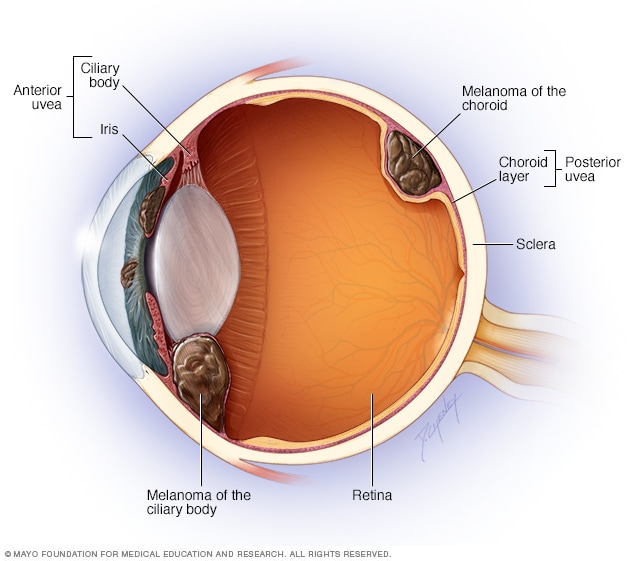
Where eye melanoma occurs
Ocular melanoma most commonly affects the middle layer of your eye (uvea). Parts of the uvea of your eye that can develop melanoma include the colored part of your eye (iris), the muscle fibers around your eye lens (ciliary body), and the layer of blood vessels that lines the back of your eye (choroid).
Melanoma is a type of cancer that develops in the cells that produce melanin, the pigment that gives your skin its color. Your eyes also have melanin-producing cells and can develop melanoma. Eye melanoma is also called ocular melanoma.
Most ocular melanomas form in the part of the eye that you cannot see when looking in a mirror. This makes it difficult to detect ocular melanoma. Additionally, ocular melanoma usually does not cause early signs or symptoms.
Treatment is available for ocular melanoma. Treatment for some small eye melanomas may not affect your vision. However, treatment of large eye melanoma typically causes some vision loss.
Symptoms
Eye melanoma may not cause any signs and symptoms. When they occur, signs and symptoms of ocular melanoma may include:
- Ein Gefühl von Blitzen oder Staubkörnern in Ihrer Sicht (Floater)
- Ein wachsender dunkler Fleck auf der Iris
- Eine Veränderung der Form des dunklen Rings (Pupille) in der Mitte Ihres Auges
- Schlechtes oder verschwommenes Sehen auf einem Auge
- Verlust des peripheren Sehens
When to go to the doctor?
Make an appointment with your doctor if you have any signs or symptoms that worry you. Sudden changes in your vision signal an emergency, so seek help immediately in such situations.
Causes
It is not clear what causes ocular melanoma.
Doctors know that ocular melanoma occurs when errors develop in the DNA of healthy eye cells. The DNA errors tell the cells to grow and multiply uncontrollably, so the mutated cells continue to live when they would normally die. The mutated cells accumulate in the eye and form ocular melanoma.
Where eye melanoma occurs
Ocular melanoma most often develops in the cells of the middle layer of the eye (uvea). The uvea consists of three parts and anyone can be affected by ocular melanoma:
- Die Iris, das ist der farbige Teil vor dem Auge
- Die Aderhautschicht, Dies ist die Schicht aus Blutgefäßen und Bindegewebe zwischen der Sklera und der Netzhaut auf der Rückseite der Uvea
- Der Ziliarkörper, die sich vor der Uvea befindet und die durchsichtige Flüssigkeit (Kammerwasser) ins Auge absondert.
Ocular melanomas can also occur on the outermost layer on the front of the eye (conjunctiva), in the orbit surrounding the eyeball, and on the eyelid, although these types of ocular melanomas are very rare.
Risk factors
Risk factors for primary melanoma of the eye include:
- Helle Augenfarbe. Menschen mit blauen oder grünen Augen haben ein höheres Risiko für ein Melanom des Auges.
- Weiß sein. Weiße Menschen haben ein größeres Risiko für Augenmelanome als Menschen anderer Rassen.
- Das Alter. Das Risiko eines Augenmelanoms steigt mit dem Alter.
-
Certain hereditary skin diseases.A condition called dysplastic nevus syndrome, which causes abnormal moles, may increase your risk of developing melanoma on your skin and in your eye.
In addition, people with abnormal skin pigmentation of the eyelids and adjacent tissues and increased pigmentation of their uvea – known as ocular melanocytosis – also have an increased risk of developing ocular melanoma.
- Exposition gegenüber ultraviolettem (UV) Licht. Die Rolle der UV-Exposition beim Augenmelanom ist unklar. Es gibt einige Hinweise darauf, dass die Exposition gegenüber UV-Licht, wie z. B. Licht von der Sonne oder von Sonnenbänken, das Risiko eines Augenmelanoms erhöhen kann.
- Bestimmte genetische Mutationen. Bestimmte Gene, die von Eltern an Kinder weitergegeben werden, können das Risiko eines Augenmelanoms erhöhen.
Complications
Complications of ocular melanoma can include:
- Erhöhter Augeninnendruck (Glaukom). Ein wachsendes Augenmelanom kann ein Glaukom verursachen. Anzeichen und Symptome eines Glaukoms können Augenschmerzen und Rötungen sowie verschwommenes Sehen sein.
-
Loss of vision.Large eye melanomas often cause vision loss in the affected eye and can cause complications such as retinal detachment, which also causes vision loss.
Small ocular melanomas can cause vision loss if they occur in critical parts of the eye. You may have difficulty seeing in the center of your field of vision or to the side. Very advanced eye melanomas can lead to complete loss of vision.
- Augenmelanom, das sich über das Auge hinaus ausbreitet. Ein Augenmelanom kann sich außerhalb des Auges und auf entfernte Bereiche des Körpers ausbreiten, einschließlich Leber, Lunge und Knochen.
Sources:
- Uveales Melanom. Fort Washington, Pa.: Nationales umfassendes Krebsnetzwerk. http://www.nccn.org/professionals/physician_gls/f_guidelines.asp. Abgerufen am 2. April 2018.
- Intraokulare (uveale) Melanombehandlung (PDQ). Nationales Krebs Institut. https://www.cancer.gov/types/eye/patient/intraocular-melanoma-treatment-pdq. Abgerufen am 8. Juli 2018.
- Bowling B. Augentumoren. In: Kanski’s Clinical Ophthalmology: A Systematic Approach. 8. Aufl. Edinburgh, Großbritannien: Elsevier, Ltd.; 2016. https://www.clinicalkey.com. Abgerufen am 8. Juli 2018.
- Harbor JW, et al. Erstbehandlung von uvealen und konjunktivalen Melanomen. https://www.uptodate.com/contents/search. Abgerufen am 8. Juli 2018.
- Bräunen in Innenräumen ist nicht sicher. Zentren für die Kontrolle und Prävention von Krankheiten. https://www.cdc.gov/cancer/skin/basic_info/indoor_tanning.htm. Abgerufen am 8. Juli 2018.
- Chirurgische Maßnahmen. American Society of Ocularists. http://www.ocularist.org/resources_surgical_procedures.asp. Abgerufen am 8. Juli 2018.
- Symptome, Tests, Prognose und Stadien des intraokularen (uvealen) Melanoms (PDQ). Nationales Krebs Institut. https://www.cancer.gov/types/eye/patient/about-intraocular-melanoma-pdq#section/all. Abgerufen am 8. Juli 2018.
- Fragen Sie MayoExpert. Augenmelanom. Rochester, Minnesota: Mayo Foundation for Medical Education and Research; 2017.