

 Suche
Suche
 Mein Konto
Dislocated shoulder
Dislocated shoulder
overview
A dislocated shoulder is an injury in which your humerus bone pops out of the cup-shaped socket that is part of your shoulder blade. The shoulder is the most mobile joint in the body and is therefore susceptible to dislocations.
If you suspect a dislocated shoulder, seek medical attention immediately. Most people regain full shoulder function within a few weeks. However, once you have had a dislocated shoulder, your joint may become unstable and prone to repeated dislocations.
Symptoms
Shoulder dislocation
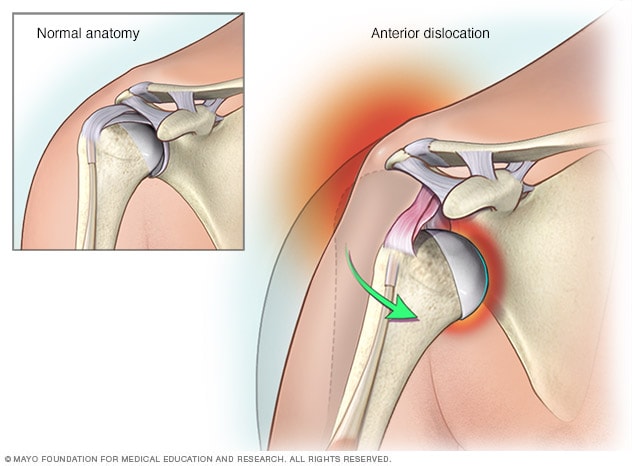
Shoulder dislocation
Das Schultergelenk ist das am häufigsten ausgerenkte Gelenk des Körpers. Because it moves in multiple directions, your shoulder can dislocate forward, backward, or downward. The most common variant is an anterior dislocation.
Signs and symptoms of a dislocated shoulder can include:
- Eine sichtbar deformierte oder deplazierte Schulter
- Schwellungen oder Blutergüsse
- Intensiver Schmerz
- Unfähigkeit, das Gelenk zu bewegen
A shoulder dislocation may also cause numbness, weakness, or tingling near the injury, such as: B. in the neck or on the arm. The muscles in your shoulder can spasm from the disorder, often increasing the intensity of your pain.
When to go to the doctor?
Get medical attention immediately for a shoulder that appears dislocated.
While waiting for medical attention:
- Bewegen Sie das Gelenk nicht. Schienen oder schlingen Sie das Schultergelenk in seiner aktuellen Position. Versuchen Sie nicht, die Schulter zu bewegen oder sie mit Gewalt wieder an ihren Platz zu bringen. Dadurch können das Schultergelenk und die umliegenden Muskeln, Bänder, Nerven oder Blutgefäße geschädigt werden.
- Vereise das verletzte Gelenk. Das Auftragen von Eis auf Ihre Schulter kann helfen, Schmerzen und Schwellungen zu lindern, indem innere Blutungen und die Ansammlung von Flüssigkeiten in und um Ihr Schultergelenk kontrolliert werden.
Causes
The shoulder joint is the most commonly dislocated joint in the body. Because your shoulder moves in multiple directions, it can dislocate completely or partially forward, backward, or downward, although most dislocations occur at the front of the shoulder. Additionally, fibrous tissue that connects the bones of your shoulder can be stretched or torn, often making dislocation more difficult.
It takes a strong force, such as B. a sudden blow on the shoulder to loosen the bones. Extreme rotation of your shoulder joint can cause the ball of your humerus to pop out of your shoulder socket. A partial dislocation – where your humerus is partly inside and partly outside your shoulder socket – can also occur.
A dislocated shoulder can be caused by:
- Sportverletzungen. Eine Schulterluxation ist eine häufige Verletzung bei Kontaktsportarten wie Fußball und Hockey sowie bei Sportarten, bei denen es zu Stürzen kommen kann, wie Skifahren, Turnen und Volleyball.
- Trauma nicht im Zusammenhang mit Sport. Ein harter Schlag auf die Schulter bei einem Autounfall ist eine häufige Ursache für eine Luxation.
- Stürze. Sie können Ihre Schulter während eines Sturzes ausrenken, z. B. von einer Leiter oder durch Stolpern auf einem losen Teppich.
Risk factors
Men in their teens and 20s, a group that tends to be physically active, are at the highest risk of shoulder dislocation.
Complications
Complications of a dislocated shoulder can include:
- Reißen der Muskeln, Bänder und Sehnen, die Ihr Schultergelenk verstärken
- Schädigung von Nerven oder Blutgefäßen in oder um Ihr Schultergelenk
- Schulterinstabilität, insbesondere wenn Sie eine schwere Luxation oder wiederholte Luxationen haben, was Sie anfälliger für erneute Verletzungen macht.
If you stretch or tear ligaments or tendons in your shoulder or damage nerves or blood vessels around your shoulder joint, you may need surgery to repair these tissues.
prevention
To prevent a dislocated shoulder:
- Aufpassen um Stürze zu vermeiden
- Schutzausrüstung tragen wenn Sie Kontaktsport betreiben
- Regelmäßig Sport treiben um Kraft und Flexibilität in Ihren Gelenken und Muskeln zu erhalten
Once you have dislocated your shoulder joint, you may be more susceptible to future shoulder dislocations. To prevent a recurrence, follow the specific strength and stability exercises you and your doctor have discussed for your injury.
Sources:
- Sherman SC, et al. Schulterluxation und -reduktion. http://www.uptodate.com/home. Abgerufen am 30. Juni 2014.
- Ausgerenkte Schulter. Amerikanische Akademie der orthopädischen Chirurgen. http://orthoinfo.aaos.org/topic.cfm?topic=a00035. Abgerufen am 30. Juni 2014.
- Fragen und Antworten zu Schulterproblemen. National Institute of Arthritis and Musculoskeletal and Skin Diseases. http://www.niams.nih.gov/Health_Info/Shoulder_Problems/default.asp. Abgerufen am 30. Juni 2014.
- Traumatische Schulterluxation. Amerikanische Orthopädische Gesellschaft für Sportmedizin. http://www.sportsmed.org/Patient/Sports_Tips/AOSSM_Sports_Tips_Sheets/. Abgerufen am 30. Juni 2014.
- Zacchilli MA, et al. Epidemiologie von Schulterluxationen, die in Notaufnahmen in den Vereinigten Staaten vorstellig werden. Das Journal of Bone and Joint Surgery. 2010;92:542.