

 Suche
Suche
 Mein Konto
Diabetes insipidus
Diabetes insipidus
overview
Diabetes insipidus (die-uh-BEE-teze in-SIP-uh-dus) is a rare disease that causes an imbalance of fluids in the body. This imbalance causes you to produce large amounts of urine. It also makes you very thirsty, even if you have something to drink.
Although the terms “diabetes insipidus” and “diabetes mellitus” sound similar, they are not related. Diabetes mellitus – which is associated with high blood sugar levels and can occur as type 1 or type 2 – is common and is often simply referred to as diabetes.
There is no cure for diabetes insipidus. But treatments can relieve your thirst and reduce your urine output and prevent dehydration.
Symptoms
Signs and symptoms of diabetes insipidus include:
- Extrem durstig sein
- Produktion großer Mengen von hellem Urin
- Nachts häufig zum Wasserlassen aufstehen müssen
- Bevorzugt kalte Getränke
If your condition is serious and you drink plenty of fluids, you may produce up to 20 liters (about 19 quarts) of urine per day. A healthy adult typically urinates an average of 1 to 2 quarts (about 1 to 2 liters) per day.
An infant or young child with diabetes insipidus may have the following signs and symptoms:
- Schwere, nasse Windeln
- Bettnässen
- Schlafstörungen
- Fieber
- Erbrechen
- Verstopfung
- Verzögertes Wachstum
- Gewichtsverlust
When to go to the doctor?
See your doctor immediately if you notice excessive urination and extreme thirst.
Causes
Female urinary system
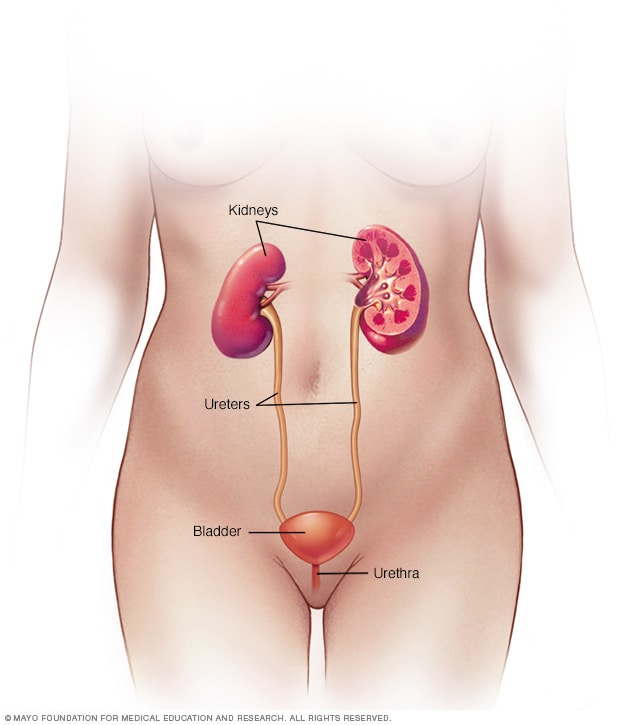
Female urinary system
Your urinary system includes the kidneys, ureters, bladder, and urethra. The urinary system removes waste products from the body through urine. The kidneys are located in the back of the upper abdomen. They filter waste and fluid from the blood and produce urine. Urine travels from the kidneys through narrow tubes to the bladder. These tubes are called ureters. The bladder stores urine until it is time to urinate. Urine leaves the body through another small tube called the urethra.
Pituitary gland and hypothalamus
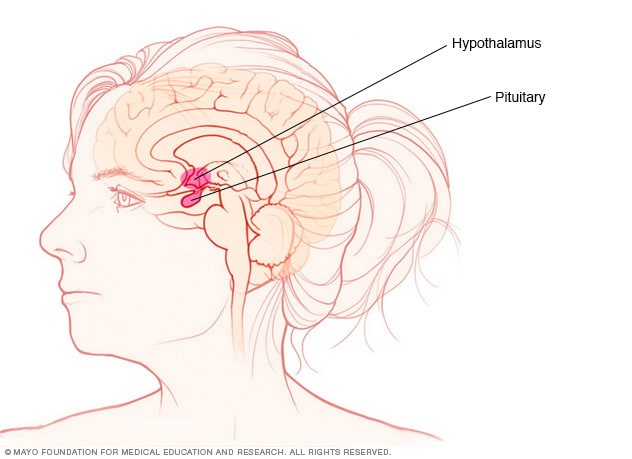
Pituitary gland and hypothalamus
The pituitary gland and hypothalamus are located in the brain and control hormone production.
Diabetes insipidus occurs when your body cannot properly balance the body's fluid levels.
Your kidneys filter the liquid part of your blood to remove waste products. Most of the fluid is returned to the bloodstream, while the waste and a smaller amount of fluid form urine. Urine is excreted from your body after being temporarily stored in your bladder.
A hormone called antidiuretic hormone (ADH), or vasopressin, is needed to allow fluid filtered by the kidneys to return to the bloodstream. ADH is made in a part of the brain called the hypothalamus and is stored in the pituitary gland, a small gland located at the base of the brain. Conditions that cause ADH deficiency or block the action of ADH result in excessive urine production.
If you have diabetes insipidus, your body cannot balance fluid levels properly. The cause depends on the type of diabetes insipidus you have. Types include:
- Zentraler Diabetes insipidus. Schäden an der Hypophyse oder dem Hypothalamus durch eine Operation, einen Tumor, eine Kopfverletzung oder eine Krankheit können einen zentralen Diabetes insipidus verursachen, indem sie die normale Produktion, Speicherung und Freisetzung von ADH beeinträchtigen. Auch eine erbliche genetische Erkrankung kann diesen Zustand verursachen.
-
Nephrogenic diabetes insipidus.Nephrogenic diabetes insipidus occurs when there is a defect in the structures of your kidneys that prevents your kidneys from responding properly to ADH.
The defect can be due to a hereditary (genetic) disorder or chronic kidney disease. Certain medications such as lithium or antiviral medications such as foscarnet (Foscavir) can also cause nephrogenic diabetes insipidus.
- Schwangerschaftsdiabetes insipidus. Gestationsdiabetes insipidus ist selten. Es tritt nur während der Schwangerschaft auf, wenn ein von der Plazenta gebildetes Enzym ADH bei der Mutter zerstört.
-
Primary polydipsia.This condition, also known as dipsogenic diabetes insipidus, can result in the production of large amounts of dilute urine by drinking excessive amounts of fluids.
Primary polydipsia can be caused by damage to the thirst-regulating mechanism in the hypothalamus. The condition has also been linked to mental illnesses such as schizophrenia.
Sometimes there is no obvious cause of diabetes insipidus. However, in some people, the disorder may be the result of an autoimmune reaction that causes the immune system to damage the cells that produce vasopressin.
Risk factors
Nephrogenic diabetes insipidus, which occurs at or shortly after birth, usually has a hereditary (genetic) cause that permanently alters the kidneys' ability to concentrate urine. Nephrogenic diabetes insipidus usually affects men, although women can pass the gene to their children.
Complications
dehydration
Diabetes insipidus can lead to dehydration. Dehydration can cause:
- Trockener Mund
- Veränderungen der Hautelastizität
- Durst
- Ermüdung
Electrolyte imbalances
Diabetes insipidus can cause an imbalance of minerals in your blood, such as: B. Sodium and potassium (electrolytes), which maintain fluid balance in your body. Symptoms of an electrolyte imbalance can include:
- Die Schwäche
- Brechreiz
- Erbrechen
- Appetitverlust
- Muskelkrämpfe
- Verwirrtheit
Sources:
- Fragen Sie MayoExpert. Diabetes insipidus und Polyurie (Kind). Mayo-Klinik; 2019.
- Garrahy A. et al. Diagnose und Management des zentralen Diabetes insipidus bei Erwachsenen. Klinische Endokrinologie. 2019;90:23.
- Diabetes insipidus. Nationales Institut für Diabetes und Verdauungs- und Nierenerkrankungen. https://www.niddk.nih.gov/health-information/kidney-disease/diabetes-insipidus. Abgerufen am 15. Januar 2021.
- Melmed S. et al. Hintere Hypophyse. In: Williams Lehrbuch der Endokrinologie. 14. Aufl. Elsevier; 2020. https://www.clinicalkey.com. Abgerufen am 15. Januar 2021.
- Ferri FF. Diabetes insipidus. In: Ferri’s Clinical Advisor 2021. Elsevier; 2021. https://www.clinicalkey.com. Abgerufen am 15. Januar 2021.
- Kochhar RS, et al. Diabetes insipidus. Medizin. 2017;45:488.
- Robertson GL, et al. Diabetes insipidus: Differentialdiagnose und Behandlung. Best Practice & Research Klinische Endokrinologie & Stoffwechsel. 2016;30:205.
- Bichet DG. Klinische Manifestationen und Ursachen des zentralen Diabetes insipidus. https://www.uptodate.com/contents/search. Abgerufen am 15. Januar 2021.
- Walls RM, et al., Hrsg. Elektrolytstörungen. In: Rosens Notfallmedizin: Konzepte und klinische Praxis. 9. Aufl. Elsevier; 2018. https://www.clinicalkey.com. Abgerufen am 15. Januar 2021.
- Levy M. et al. Diabetes insipidus. Britisches medizinisches Journal. 2019; doi: 10.1136/bmj.l321.
- Nippoldt TB (Gutachten). Mayo-Klinik. 15. Januar 2021.