

 Suche
Suche
 Mein Konto
Ebstein anomaly
Ebstein anomaly
overview
Ebstein anomaly
Ebstein anomaly
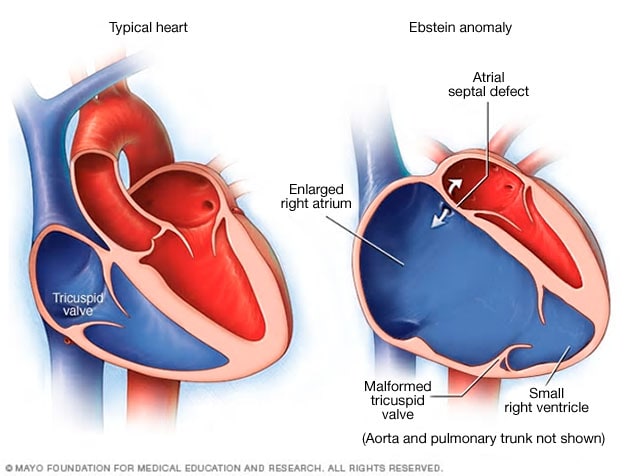
Ebstein anomaly is a rare congenital heart defect in which the tricuspid valve is malformed and positioned deeper than usual in the heart. An atrial septal defect is a hole between the two upper chambers of the heart. About half of people with Ebstein anomaly have an atrial septal defect.
Ebstein anomaly is a rare heart defect that is present at birth (congenital). In this condition, your tricuspid valve is in the wrong position and the flaps (cusps) of the valve are malformed. This causes the valve to not function properly.
Blood can flow back through the valve, causing your heart to work less efficiently. Ebstein anomaly can also lead to heart enlargement and heart failure.
If you don't have any signs or symptoms related to Ebstein's anomaly, regular monitoring of your heart may be enough. You may need treatment if signs and symptoms bother you or if your heart becomes enlarged or weaker. Treatment options include medication and surgery.
Symptoms
Mild forms of Ebstein anomaly may not cause symptoms until later adulthood. Signs and symptoms can include:
- Kurzatmigkeit, besonders bei Anstrengung
- Ermüdung
- Herzklopfen oder Herzrhythmusstörungen (Arrhythmien)
- Eine bläuliche Verfärbung der Lippen und der Haut aufgrund von Sauerstoffmangel (Zyanose)
When to go to the doctor?
If you or your child have signs or symptoms of heart failure - such as: If you experience symptoms such as easy fatigue or shortness of breath, even with normal activity - or if the skin around your lips and nails looks blue or you have swelling in your legs, talk to your doctor. He can refer you to a doctor who specializes in congenital heart defects (cardiologist).
Causes
Ebstein anomaly is a congenital (congenital) heart defect. The cause is unknown. To understand how Ebstein's anomaly affects your heart, it is helpful to know how the heart supplies blood to your body.
How your heart works
Chambers and valves of the heart
Chambers and valves of the heart
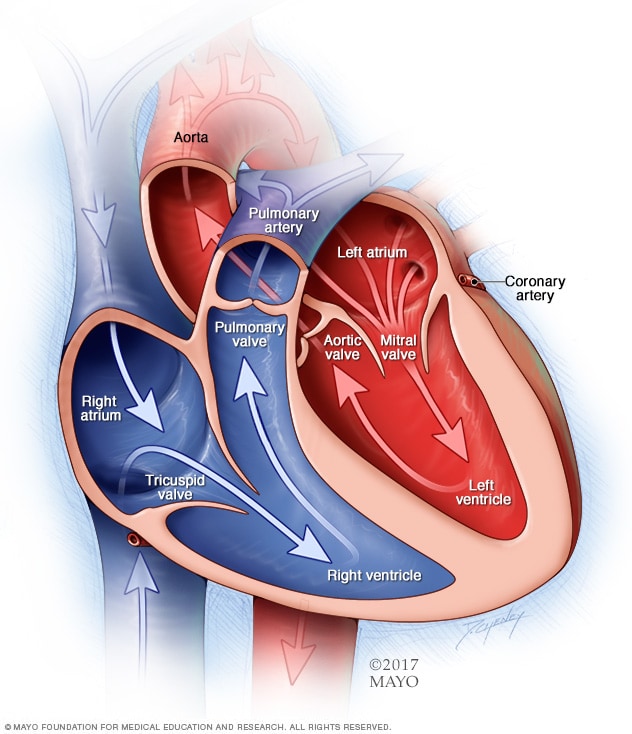
A typical heart has two upper and two lower chambers. The upper chambers, the right and left atria, receive incoming blood. The lower chambers, the more muscular right and left ventricles, pump blood from the heart. The heart valves, which keep blood flowing in the right direction, are gates at the chamber openings.
Your heart consists of four chambers. The two upper chambers (atria) receive blood. The two lower chambers (ventricles) pump blood.
Four valves open and close to allow blood to flow in one direction through the heart. Each valve is made up of two or three strong, thin flaps of tissue (leaflets). A closed valve prevents blood from flowing into the next chamber or returning to the previous chamber.
Oxygen-poor blood from your body flows into the right atrium. The blood then flows through the tricuspid valve into the right ventricle of the heart, which pumps the blood to your lungs. On the other side of your heart, oxygen-rich blood flows from your lungs into the left atrium, through the mitral valve, and into the left ventricle, which then pumps the blood to the rest of your body.
What happens with the Ebstein anomaly?
The tricuspid valve normally sits between the two right chambers of the heart (right atrium and right ventricle).
In Ebstein's anomaly, the tricuspid valve sits deeper than normal in the right ventricle. This causes part of the right ventricle to become part of the right atrium, causing the right atrium to enlarge and no longer function properly.
The leaflets of the tricuspid valve are also abnormally shaped. This can lead to a backflow of blood into the right atrium (tricuspid valve regurgitation).
The position of the valve and how poorly formed it is varies from person to person. Some people have a slightly abnormal valve. Others have a valve that leaks badly.
Other heart diseases related to Ebstein anomaly
Common associated heart diseases include:
-
Holes in the heart.Many people with Ebstein anomaly have a hole between the two upper chambers of the heart called an atrial septal defect, or an opening called a patent foramen ovale (PFO). A PFO is a hole between the upper chambers of the heart that all babies have before birth and that usually closes after birth. It can remain open in some people without causing problems.
These holes can reduce the amount of oxygen available in your blood and cause a bluish discoloration of the lips and skin (cyanosis).
- Abnorme Herzschläge (Arrhythmien). Ein anormaler Herzrhythmus oder schnelle Herzschläge erschweren die ordnungsgemäße Funktion des Herzens, insbesondere wenn die Trikuspidalklappe stark undicht ist. Manchmal verursacht ein sehr schneller Herzrhythmus Ohnmachtsanfälle (Synkopen).
- Wolff-Parkinson-White (WPW)-Syndrom. Menschen mit WPW-Syndrom haben einen anormalen elektrischen Weg im Herzen, der zu schnellen Herzfrequenzen und Ohnmachtsanfällen führen kann.
Risk factors
Congenital heart defects like Ebstein anomaly occur when the baby's heart is developing in the womb.
Doctors aren't sure what risk factors are associated with the defect. Genetic and environmental factors are thought to play a role. A family history of heart defects or the mother taking certain medications such as lithium during pregnancy may increase the risk of Ebstein anomaly in the child.
Complications
A mild Ebstein anomaly may not cause complications.
However, possible complications of Ebstein anomaly include:
- Herzfehler
- Plötzlichen Herzstillstand
- Streicheln
Taking a few precautions before exercising or becoming pregnant can help prevent complications.
If your heart size is close to normal and you don't have any cardiac arrhythmias, you can probably participate in most physical activities. Depending on your signs and symptoms, your doctor may recommend that you avoid certain competitive sports, such as soccer or basketball.
If you are planning to have a baby, talk to your doctor. Many women with mild Ebstein anomaly can have children without any problems. But pregnancy, labor, and delivery place additional strain on your heart. Rarely, serious complications can develop that can lead to the death of the mother or child.
Together with your doctor, you can decide how much monitoring you need during pregnancy and birth. Sometimes other treatments may be recommended for your condition or symptoms before you become pregnant.
Treatment of Ebstein anomalies
Sources:
- Ebsteins Anomalie. American Heart Association. https://www.heart.org/en/health-topics/congenital-heart-defects/about-congenital-heart-defects/ebsteins-anomaly. Abgerufen am 20. März 2019.
- Walsh EP. Ebsteins Anomalie der Trikuspidalklappe: Ein natürliches Labor für Reentry-Tachykardien. Zeitschrift des American College of Cardiology: Klinische Elektrophysiologie. 2018;4:1271.
- Holst KA, et al. Ebsteins Anomalie. Methodist Debakey Cardiovascular Journal. 2019; doi:10.14797/mdcj-15-2-138.
- Riggins EA. Allscripts EPSi. Mayo-Klinik, 17. März 2021.
- Connolly HM, et al. Klinische Manifestationen und Diagnose der Ebstein-Anomalie. https://www.uptodate.com/contents/search. Abgerufen am 21. März 2019.
- Wie das gesunde Herz funktioniert. American Heart Association. https://www.heart.org/en/health-topics/congenital-heart-defects/about-congenital-heart-defects/how-the-healthy-heart-works. Abgerufen am 5. April 2021.
- Sharma N. et al. Ebstein-Anomalie mit Schwangerschaft: Ein seltener Fall. Zeitschrift für reproduktive Unfruchtbarkeit. 2018;19:119.
- Connolly HM, et al. Management und Prognose der Ebstein-Anomalie. https://www.uptodate.com/contents/search. Abgerufen am 21. März 2019.