

 Suche
Suche
 Mein Konto
Endometriosis
Endometriosis
overview
Endometriosis
Endometriosis
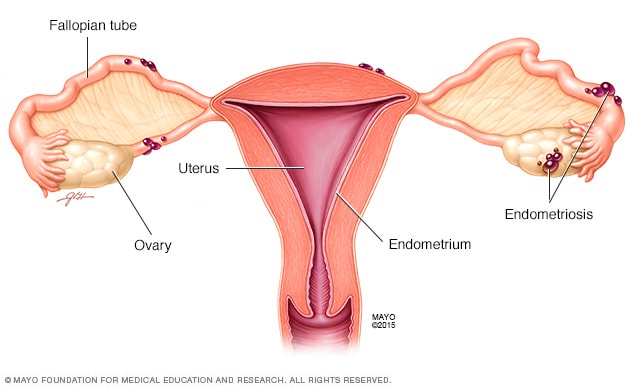
In endometriosis, parts of the lining of the uterus (endometrium) – or similar endometrial-like tissue – grow outside the uterus on other pelvic organs. Outside the uterus, the tissue thickens and bleeds, just like typical endometrial tissue during the menstrual cycle.
Endometriosis (en-doe-me-tree-O-sis) is an often painful condition in which tissue similar to the tissue that normally lines the inside of your uterus - the endometrium - grows outside your uterus. Endometriosis most commonly affects your ovaries, fallopian tubes, and the tissue that lines your pelvis. Rarely, endometrial-like tissue may be found outside the area where pelvic organs are located.
In endometriosis, the endometrial-like tissue behaves like endometrial tissue – it thickens, breaks down, and bleeds with each menstrual cycle. However, since this tissue has no way to leave your body, it becomes trapped. When endometriosis affects the ovaries, cysts called endometriomas can form. The surrounding tissue can become irritated and eventually develop scar tissue and adhesions – bands of fibrous tissue that can cause pelvic tissues and organs to stick together.
Endometriosis can cause pain - sometimes severe - especially during menstruation. Fertility problems can also occur. Fortunately, there are effective treatments.
Symptoms
The primary symptom of endometriosis is pelvic pain, which often accompanies menstruation. Although many experience cramps during their menstruation, people with endometriosis typically describe menstrual pain that is far worse than usual. Pain can also increase over time.
Common signs and symptoms of endometriosis include:
- Schmerzhafte Perioden (Dysmenorrhoe). Beckenschmerzen und -krämpfe können vor der Menstruation beginnen und sich über mehrere Tage erstrecken. Sie können auch Rücken- und Bauchschmerzen haben.
- Schmerzen beim Geschlechtsverkehr. Schmerzen während oder nach dem Sex sind bei Endometriose häufig.
- Schmerzen beim Stuhlgang oder beim Wasserlassen. Diese Symptome treten am ehesten während einer Menstruation auf.
- Starke Blutung. Es kann gelegentlich zu starken Menstruationsblutungen oder Blutungen zwischen den Perioden (Zwischenblutungen) kommen.
- Unfruchtbarkeit. Manchmal wird Endometriose zuerst bei Patienten diagnostiziert, die eine Behandlung wegen Unfruchtbarkeit suchen.
- Andere Anzeichen und Symptome. Es können Müdigkeit, Durchfall, Verstopfung, Blähungen oder Übelkeit auftreten, insbesondere während der Monatsblutung.
The severity of your pain may not be a reliable indicator of the extent of your condition. You could have mild endometriosis with severe pain, or you could have advanced endometriosis with little or no pain.
Endometriosis is sometimes confused with other conditions that can cause pelvic pain, such as: B. Pelvic inflammatory disease (PID) or ovarian cysts. It can be confused with irritable bowel syndrome (IBS), a condition that causes diarrhea, constipation, and abdominal cramps. IBS can accompany endometriosis, which can make diagnosis difficult.
When to go to the doctor?
See your doctor if you have signs and symptoms that may indicate endometriosis.
Endometriosis can be a difficult disease. Early diagnosis, a multidisciplinary medical team, and an understanding of your diagnosis can lead to better management of your symptoms.
Causes
Although the exact cause of endometriosis is not certain, possible explanations include:
- Rückläufige Menstruation. Bei der retrograden Menstruation fließt Menstruationsblut, das Endometriumzellen enthält, zurück durch die Eileiter und in die Beckenhöhle anstatt aus dem Körper. Diese Endometriumzellen haften an den Beckenwänden und Oberflächen der Beckenorgane, wo sie wachsen und sich im Laufe jedes Menstruationszyklus weiter verdicken und bluten.
- Transformation von Peritonealzellen. In der sogenannten „Induktionstheorie“ schlagen Experten vor, dass Hormone oder Immunfaktoren die Umwandlung von Peritonealzellen – Zellen, die die Innenseite Ihres Bauches auskleiden – in Endometrium-ähnliche Zellen fördern.
- Embryonale Zelltransformation. Hormone wie Östrogen können embryonale Zellen – Zellen in den frühesten Entwicklungsstadien – während der Pubertät in Endometrium-ähnliche Zellimplantate umwandeln.
- Chirurgische Narbenimplantation. Nach einer Operation, wie einer Hysterektomie oder einem Kaiserschnitt, können Endometriumzellen an einem chirurgischen Einschnitt anhaften.
- Endometriumzelltransport. Die Blutgefäße oder das Gewebeflüssigkeitssystem (Lymphsystem) können Endometriumzellen in andere Teile des Körpers transportieren.
- Störung des Immunsystems. Ein Problem mit dem Immunsystem kann dazu führen, dass der Körper Endometrium-ähnliches Gewebe, das außerhalb der Gebärmutter wächst, nicht erkennen und zerstören kann.
Risk factors
Several factors increase the risk of developing endometriosis, such as:
- Niemals gebären
- Beginnen Sie Ihre Periode in einem frühen Alter
- Im Alter in die Wechseljahre kommen
- Kurze Menstruationszyklen – zum Beispiel weniger als 27 Tage
- Starke Monatsblutungen, die länger als sieben Tage andauern
- Haben Sie einen höheren Östrogenspiegel in Ihrem Körper oder eine größere lebenslange Exposition gegenüber Östrogen, das Ihr Körper produziert
- Niedriger Body-Mass-Index
- Eine oder mehrere Verwandte (Mutter, Tante oder Schwester) mit Endometriose
- Jeder medizinische Zustand, der den Blutfluss aus dem Körper während der Menstruation verhindert
- Störungen der Fortpflanzungsorgane
Endometriosis usually develops several years after the onset of menstruation (menarche). Signs and symptoms of endometriosis may temporarily improve with pregnancy and disappear completely with menopause unless you take estrogen.
Complications
infertility
Fertilization and implantation
Fertilization and implantation
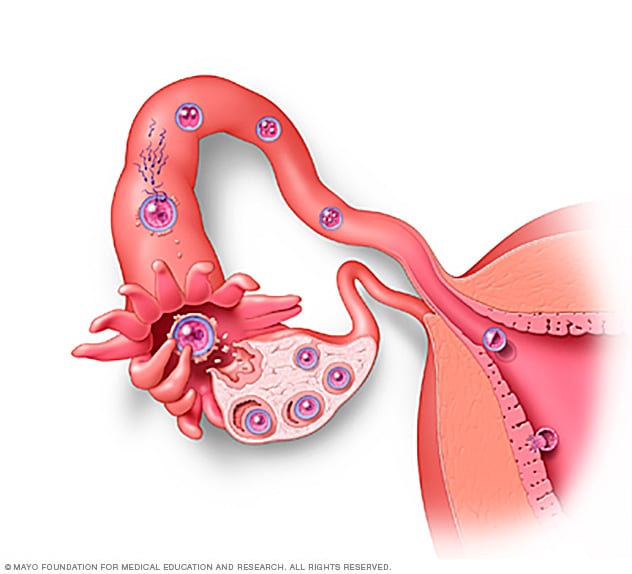
During fertilization, the sperm and egg unite in one of the fallopian tubes to form a zygote. The zygote then travels down the fallopian tube where it becomes a morula. Once it reaches the uterus, the morula becomes a blastocyst. The blastocyst then burrows into the lining of the uterus - a process called implantation.
The main complication of endometriosis is impaired fertility. About a third to half of women with endometriosis have difficulty becoming pregnant.
For pregnancy to occur, an egg must be released from one ovary, travel through the adjacent fallopian tube, be fertilized by a sperm cell, and attach to the uterine wall to begin development. Endometriosis can block the tube and prevent the egg and sperm from uniting. But the condition also appears to affect fertility in less direct ways, such as: B. due to damage to the sperm or egg.
Despite this, many with mild to moderate endometriosis can still become pregnant and carry a pregnancy to term. Doctors sometimes advise patients with endometriosis not to delay having children because the condition can worsen over time.
Cancer
Ovarian cancer is more common than expected in patients with endometriosis. But the overall lifetime risk of ovarian cancer is initially low. Some studies suggest that endometriosis increases this risk, but it is still relatively small. Although rare, another type of cancer – endometriosis-associated adenocarcinoma – can develop later in life in people who have had endometriosis.
Endometriosis treatment
Sources:
- Endometriose. Büro für Frauengesundheit. https://www.womenshealth.gov/publications/our-publications/fact-sheet/endometriosis.html. Abgerufen am 13. Januar 2019.
- Schenk RS. Endometriose: Pathogenese, klinische Merkmale und Diagnose. https://www.uptodate.com/contents/search. Abgerufen am 13. Januar 2019.
- Häufig gestellte Fragen. Gynäkologische Probleme FAQ013. Endometriose. American College of Geburtshelfer und Gynäkologen. https://www.acog.org/~/media/For%20Patients/faq013.pdf?dmc=1&ts=20130305T1348596508. Abgerufen am 13. Januar 2019.
- Fragen Sie MayoExpert. Endometriose. Rochester, Minnesota: Mayo Foundation for Medical Education and Research; 2018.
- Schmied RP. Endometriose. In: Netter’s Geburtshilfe und Gynäkologie. 3. Aufl. Philadelphia, Pennsylvania: Elsevier; 2018. https://www.clinicalkey.com. Abgerufen am 13. Januar 2019.
- Was ist assistierte Reproduktionstechnologie? Zentren für die Kontrolle und Prävention von Krankheiten. https://www.cdc.gov/art/whatis.html. Abgerufen am 13. Januar 2019.
- Schenk RS. Endometriose: Behandlung von Beckenschmerzen. https://www.uptodate.com/contents/search. Abgerufen am 13. Januar 2019.
- Lebovic DI. Endometriose: Chirurgische Behandlung von Beckenschmerzen. https://www.uptodate.com/contents/search. Abgerufen am 13. Januar 2019.
- Strauss JF, et al., Hrsg. Endometriose. In: Reproduktive Endokrinologie von Yen und Jaffe. 8. Aufl. Philadelphia, Pennsylvania: Elsevier; 2019. https://www.clinicalkey.com. Abgerufen am 13. Januar 2019.
- Lobo RA, et al. Ätiologie, Pathologie, Diagnose, Management der Endometriose. In: Umfassende Gynäkologie. 7. Aufl. Philadelphia, Pennsylvania: Elsevier; 2017. https://www.clinicalkey.com. Abgerufen am 13. Januar 2019.
- Was sind die Symptome der Endometriose? Nationales Gesundheitsinstitut. https://www.nichd.nih.gov/health/topics/endometri/conditioninfo/symptoms. Abgerufen am 13. Januar 2019.
- Laughlin-Tommaso SK, et al. Kardiovaskuläre und metabolische Morbidität nach Hysterektomie mit Eierstockerhaltung: Eine Kohortenstudie. Menopause. 2018;25:483.
- Burnett TL (Gutachten). Mayo Clinic, Rochester, Minnesota, 15. Juni 2018.
- Warner KJ. Allscripts EPSi. Mayo-Klinik. 11. Mai 2021.
- Mira TAA, et al. Systematische Überprüfung und Metaanalyse ergänzender Behandlungen für Frauen mit symptomatischer Endometriose. Internationale Zeitschrift für Gynäkologie und Geburtshilfe. 2018;143:2.