

 Suche
Suche
 Mein Konto
Fuchs dystrophy
Fuchs dystrophy
overview
Fuchs dystrophy
Fuchs dystrophy
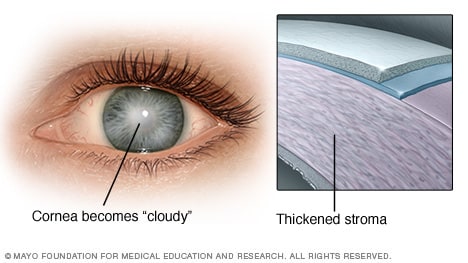
In Fuchs dystrophy, the corneal body (stroma) begins to thicken and the cornea becomes cloudy.
With Fuchs' dystrophy, fluid collects in the clear layer (cornea) at the front of your eye, causing your cornea to swell and thicken. This can cause glare, blurred or cloudy vision, and eye discomfort.
Fuchs' dystrophy usually affects both eyes and can cause your vision to gradually worsen over the years. Typically the disease begins in the 30s and 40s, but many people with Fuchs dystrophy do not develop symptoms until they reach their 50s or 60s.
Some medications and self-care measures can help relieve the signs and symptoms of your Fuchs' dystrophy. But if the disorder has progressed and your vision is affecting your ability to function, the best way to restore vision is a corneal transplant.
Symptoms
As the disease progresses, symptoms of Fuchs' dystrophy, which usually affect both eyes, may include:
- Verschwommenes oder trübes Sehen, manchmal beschrieben als allgemeiner Mangel an klarer Sicht.
- Schwankendes Sehvermögen, mit schlimmeren Symptomen morgens nach dem Aufwachen und allmählicher Besserung im Laufe des Tages. Mit fortschreitender Krankheit kann es entweder länger dauern, bis sich das verschwommene Sehen bessert, oder es bessert sich nicht.
- Blendung, die Ihre Sicht bei schwachem und hellem Licht beeinträchtigen kann.
- Halos um Lichter sehen.
- Schmerzen oder Körnigkeit durch kleine Bläschen auf der Oberfläche Ihrer Hornhaut.
When to go to the doctor?
If you have some of these symptoms, and especially if they worsen over time, see an ophthalmologist who may then refer you to a cornea specialist. If symptoms suddenly develop, call for an urgent appointment. Other eye diseases that cause the same symptoms as Fuchs' dystrophy also require immediate treatment.
Causes
Normally, the cells that line the inside of the cornea (endothelial cells) help maintain a healthy balance of fluid in the cornea and prevent the cornea from swelling. But in Fuchs dystrophy, the endothelial cells gradually die or stop functioning well, leading to a buildup of fluid (edema) in the cornea. This leads to corneal thickening and blurred vision.
Fuchs' dystrophy is usually inherited. The genetic basis of the disease is complex - family members may be affected to varying degrees or not at all.
Risk factors
Factors that increase your risk of developing Fuchs' dystrophy include:
- Sex. Die Fuchs-Dystrophie tritt häufiger bei Frauen als bei Männern auf.
- Genetik. Eine Familiengeschichte von Fuchs-Dystrophie erhöht Ihr Risiko.
- Das Alter. Obwohl es eine seltene früh einsetzende Form der Fuchs-Dystrophie gibt, die in der Kindheit beginnt, beginnt die Krankheit typischerweise in den 30er und 40er Jahren, wobei sich die Symptome danach entwickeln.
Fuchs’ dystrophy care
Sources:
- Lachs JF. Hornhaut. In: Kanski’s Clinical Ophthalmology: A Systematic Approach. 9. Aufl. Elsevier; 2020. https://www.clinicalkey.com. Abgerufen am 1. Mai 2020.
- Yanoff M. et al., Hrsg. Erkrankungen des Hornhautendothels. In: Augenheilkunde. 5. Aufl. Elsevier; 2019. https://www.clinicalkey.com. Abgerufen am 1. Mai 2020.
- Was ist die Fuchs-Dystrophie? Amerikanische Akademie für Augenheilkunde. https://www.aao.org/eye-health/diseases/what-is-fuchs-dystrophy. Abgerufen am 1. Mai 2020.
- Hornhautdystrophien. Nationales Augeninstitut. https://www.nei.nih.gov/learn-about-eye-health/eye-conditions-and-diseases/corneal-conditions/corneal-dystrophies. Abgerufen am 1. Mai 2020.
- Braun AY. Allscripts EPSi. Mayo-Klinik. 12. März 2020.
- Patel SV (Gutachten). Mayo-Klinik. 2. Mai 2020.
- Wieben ED, et al. Eine gemeinsame Trinukleotid-Repeat-Expansion innerhalb des Transkriptionsfaktor-4-Gens (tcf4, e2-2) sagt eine Fuchs-Hornhautdystrophie voraus. Plus eins. 2012;doi:10.1371/journal.pone.0049083.
- Patel SV, et al. Vorhersage der Prognose der Endothelialen Hornhautdystrophie nach Fuchs mittels Scheimpflug-Tomographie. Augenheilkunde 2020; doi:10.1016/j.ophtha.2019.09.033.