

 Suche
Suche
 Mein Konto
Frozen shoulder
Frozen shoulder
overview
Frozen shoulder
Frozen shoulder
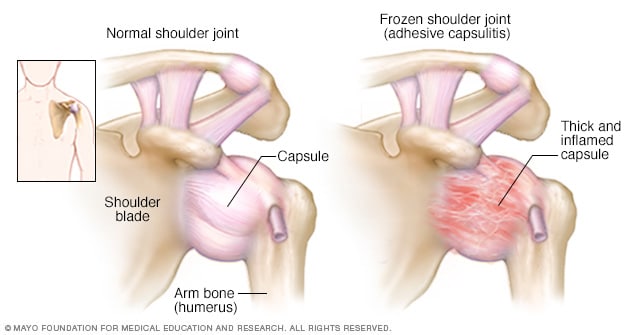
Frozen shoulder occurs when the connective tissue surrounding the joint thickens and becomes tight.
Frozen shoulder, also known as adhesive capsulitis, is a condition characterized by stiffness and pain in your shoulder joint. Signs and symptoms typically begin gradually, worsen over time, and then usually resolve within one to three years.
Your risk of developing frozen shoulder increases if you are recovering from a condition or procedure that prevents you from moving your arm - such as: B. a stroke or a mastectomy.
Treatment for frozen shoulder includes range of motion exercises and sometimes corticosteroids and numbing medications injected into the joint capsule. In a small percentage of cases, arthroscopic surgery may be indicated to loosen the joint capsule so it can move more freely.
It is uncommon for frozen shoulder to reoccur in the same shoulder, but some people may develop it in the opposite shoulder.
Symptoms
Frozen shoulder typically develops slowly and in three stages. Each phase can last several months.
- Gefrierphase. Jede Bewegung Ihrer Schulter verursacht Schmerzen und der Bewegungsbereich Ihrer Schulter beginnt eingeschränkt zu werden.
- Gefrorene Bühne. Der Schmerz kann in dieser Phase nachlassen. Ihre Schulter wird jedoch steifer und die Verwendung wird schwieriger.
- Auftauphase. Der Bewegungsbereich in Ihrer Schulter beginnt sich zu verbessern.
For some people, the pain worsens at night and sometimes disrupts sleep.
Causes
The bones, ligaments and tendons that make up your shoulder joint are covered by a capsule of connective tissue. Frozen shoulder occurs when this capsule around the shoulder joint thickens and tightens, limiting its movement.
Doctors aren't sure why this happens in some people, although it's more likely to occur in people with diabetes or those who have recently had to immobilize their shoulder for a long period of time, such as during surgery. B. after an operation or a broken arm.
Risk factors
Certain factors can increase the risk of frozen shoulder.
Age and gender
People over 40, especially women, are more likely to have frozen shoulders.
Immobility or limited mobility
People with prolonged immobility or limited shoulder mobility are at higher risk of developing frozen shoulder. Immobility can be the result of many factors including:
- Verletzung der Rotatorenmanschette
- Gebrochener Arm
- Streicheln
- Erholung von der Operation
Systemic diseases
People with certain medical conditions appear to be more likely to develop frozen shoulder. Medical conditions that could increase the risk include:
- Diabetes
- Schilddrüsenüberfunktion (Hyperthyreose)
- Unterfunktion der Schilddrüse (Hypothyreose)
- Herzkreislauferkrankung
- Tuberkulose
- Parkinson-Krankheit
prevention
One of the most common causes of frozen shoulder is immobility, which can occur during recovery from a shoulder injury, broken arm, or stroke. If you have had an injury that makes it difficult to move your shoulder, talk to your doctor about exercises you can do to maintain range of motion in your shoulder joint.
Sources:
- Skinner HB. Aktuelle Diagnose & Behandlung in der Orthopädie. 5. Aufl. New York, NY: Die McGraw-Hill-Unternehmen; 2014. http://accessmedicine.mhmedical.com/book.aspx?bookid=675. Abgerufen am 22. Januar 2015.
- Gefrorene Schulter. Amerikanische Akademie der orthopädischen Chirurgen. http://orthoinfo.aaos.org/topic.cfm?topic=a00071. Abgerufen am 22. Januar 2015.
- Prestgard TA. Schultersteife (adhäsive Kapsulitis). http://www.uptodate.com/home. Abgerufen am 22. Januar 2015.
- Akupunktur. National Medicines Comprehensive Database. http://www.naturaldatabase.com. Abgerufen am 22. Januar 2015.
- DeSantana JM, et al. Wirksamkeit der transkutanen elektrischen Nervenstimulation zur Behandlung von Hyperalgesie und Schmerzen. Aktuelle Rheumatologie-Berichte. 2008;10:492.