

 Suche
Suche
 Mein Konto
Genital warts
Genital warts
overview
Genital warts are one of the most common types of sexually transmitted infections. Nearly all sexually active people will become infected with at least one type of human papillomavirus (HPV), the virus that causes genital warts, at some point in their lives.
Genital warts affect the moist tissue of the genital area. They may look like small, flesh-colored bumps or have a cauliflower-like appearance. In many cases, the warts are too small to be visible.
Some genital HPV strains can cause genital warts, while others can cause cancer. Vaccines can help protect against certain genital strains of HPV.
Symptoms
Female genital warts
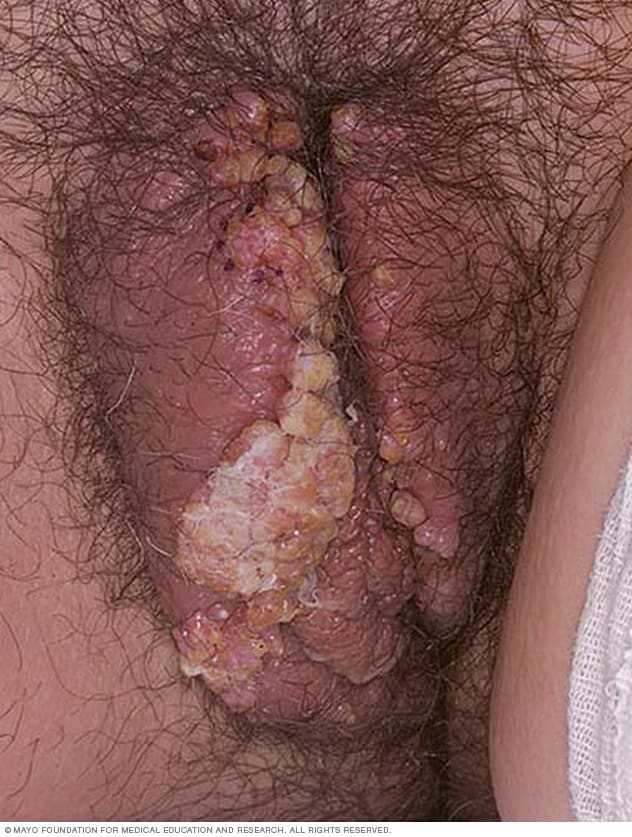
Female genital warts
Genital warts are a common sexually transmitted infection. They can occur on the genitals, pubic area, or anal canal. In women, genital warts can also grow in the vagina.
Male genital warts
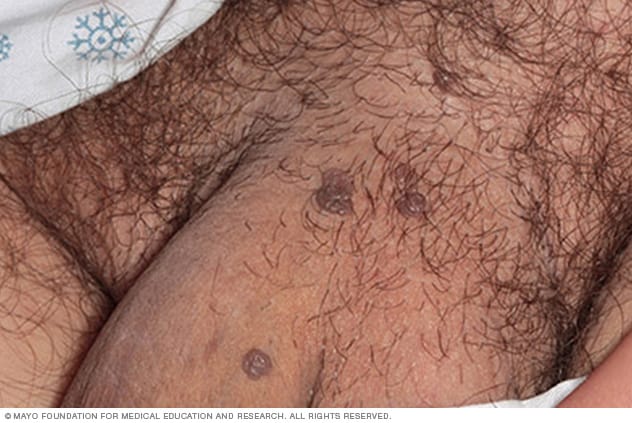
Male genital warts
Genital warts are a common sexually transmitted infection. They can occur on the genitals, pubic area, or anal canal.
In women, genital warts can grow on the vulva, vaginal walls, the area between the external genitals and the anus, the anal canal, and the cervix. In men, they can occur on the tip or shaft of the penis, the scrotum, or the anus.
Genital warts can also develop in the mouth or throat of a person who has had oral sexual contact with an infected person.
Signs and symptoms of genital warts include:
- Kleine, fleischfarbene, braune oder rosafarbene Schwellungen im Genitalbereich
- Eine blumenkohlähnliche Form, die durch mehrere eng beieinander liegende Warzen verursacht wird
- Juckreiz oder Unbehagen im Genitalbereich
- Blutungen beim Geschlechtsverkehr
Genital warts can be so small and flat that they are invisible. However, in rare cases, genital warts can grow into large clusters in someone with a suppressed immune system.
When to go to the doctor?
See a doctor if you or your partner develops bumps or warts in the genital area.
Causes
The human papillomavirus (HPV) causes warts. There are more than 40 strains of HPV that affect the genital area.
Genital warts are almost always transmitted through sexual contact. Your warts do not have to be visible for you to pass the infection to your sexual partner.
Risk factors
Most people who are sexually active will become infected with genital HPV at some point. Factors that may increase your risk of infection include:
- Ungeschützten Sex mit mehreren Partnern haben
- Eine andere sexuell übertragbare Infektion gehabt haben
- Sex mit einem Partner haben, dessen Sexualgeschichte Sie nicht kennen
- In jungen Jahren sexuell aktiv werden
- Ein geschwächtes Immunsystem haben, z. B. durch HIV oder Medikamente durch eine Organtransplantation
Complications
Complications of an HPV infection can include:
-
Cancer.Cervical cancer has been closely linked to genital HPV infection. Certain types of HPV are also associated with vulvar, anus, penile, mouth and throat cancers.
HPV infection does not always lead to cancer, but it is important for women to have regular Pap tests, especially those who have been infected with higher-risk HPV types.
-
Problems during pregnancy.In rare cases, warts can enlarge during pregnancy and make urination difficult. Warts on the vaginal wall can inhibit the stretching of vaginal tissue during childbirth. Large warts on the vulva or in the vagina may bleed if they are stretched during childbirth.
Extremely rarely, a baby born to a mother with genital warts will develop warts in the throat. The baby may need surgery to prevent the airway from becoming blocked.
prevention
Limiting the number of sexual partners you have and getting vaccinated can help prevent you from getting genital warts. Using a condom every time you have sex is a good idea, but it doesn't necessarily protect you from genital warts.
Vaccination
The Centers for Disease Control and Prevention (CDC) recommends routine HPV vaccination for girls and boys ages 11 and 12, although it can be given as early as age 9.
It is ideal for girls and boys to receive the vaccine before having sexual contact.
Side effects of the vaccines are usually mild and include pain at the injection site, headache, mild fever or flu-like symptoms.
The CDC now recommends that all 11- and 12-year-olds receive two doses of the HPV vaccine at least six months apart, instead of the previously recommended three-dose schedule. Younger adolescents aged 9 and 10 and teenagers aged 13 and 14 can also be vaccinated using the updated two-dose vaccination schedule. Research has shown that the two-dose regimen is effective for children under 15 years of age.
Adolescents and young adults who start the vaccination series later, aged 15 to 26, should continue to receive three doses of the vaccine.
The CDC now recommends catch-up HPV vaccinations for anyone up to age 26 who is not adequately vaccinated.
The U.S. Food and Drug Administration recently approved the use of Gardasil 9 for men and women ages 9 to 45. If you are between 27 and 45 years old, discuss with your doctor whether he or she recommends the HPV vaccination.
Sources:
- Cohen J., et al., Hrsg. Papillomaviren. In: Infektionskrankheiten. 4. Aufl. Elsevier; 2017. https://www.clinicalkey.com. Abgerufen am 17. Oktober 2019.
- Fragen Sie MayoExpert. Anogenitale Warzen. Mayo-Klinik; 2019.
- Scheinfeld N. Condylomata acuminata (Anogenitalwarzen) bei Erwachsenen: Epidemiologie, Pathogenese, klinische Merkmale und Diagnose. https://www.uptodate.com/contents/search. Abgerufen am 17. Oktober 2019.
- Genitalwarzen: Ein Merkblatt des Amtes für Frauengesundheit. US-Gesundheitsministerium. https://www.womenshealth.gov/az-topics/genital-warts. Abgerufen am 17. Oktober 2019.
- Grennan D. Genitalwarzen. JAMA-Patientenseite. JAMA. 2019; doi:10.1001/jama.2018.20181.
- Planung und Dosierung von HPV-Impfstoffen. Zentren für die Kontrolle und Prävention von Krankheiten. https://www.cdc.gov/hpv/hcp/schedules-recommendations.html. Abgerufen am 21. Oktober 2019.
- Die FDA genehmigt die erweiterte Verwendung von Gardasil 9 für Personen im Alter von 27 bis 45 Jahren. US Food and Drug Administration. https://www.fda.gov/news-events/press-announcements/fda-approves-expanded-use-gardasil-9-include-individuals-27-through-45-years-old. Abgerufen am 21. Oktober 2019.
- Genitalwarzen. US-Gesundheitsministerium. https://www.womenshealth.gov/az-topics/genital-warts. Abgerufen am 21. Oktober 2019.
- Infektion mit dem humanen Papillomavirus (HPV). Merck Manual Professional-Version. https://www.merckmanuals.com/professional/infectious-diseases/sexually-transmitted-diseases-stds/human-papillomavirus-hpv-infection. Abgerufen am 17. Oktober 2019.
- Pap- und HPV-Tests. US-Gesundheitsministerium. https://www.womenshealth.gov/az-topics/pap-hpv-tests. Abgerufen am 21. Oktober 2019.
- Humanes Papillomavirus (HPV). Wann sollte mein Kind HPV-Impfung bekommen? Zentren für die Kontrolle und Prävention von Krankheiten. https://www.cdc.gov/hpv/parents/vaccine.html. Abgerufen am 11. August 2021.