

 Suche
Suche
 Mein Konto
glaucoma
glaucoma
overview
Open-angle glaucoma
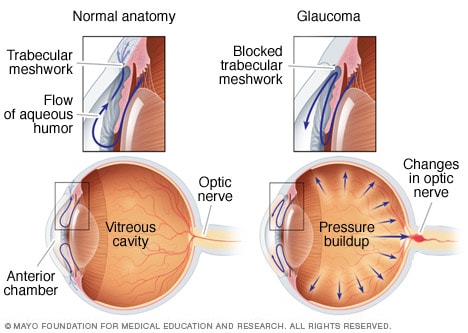
Open-angle glaucoma
Normally, fluid (aqueous humor) in the eye flows freely through the anterior chamber and exits through the drainage system (trabecular meshwork). When this system is blocked or malfunctioning, pressure inside the eye (intraocular pressure) builds, which in turn damages the optic nerve. The most common type of glaucoma causes gradual loss of vision.
Glaucoma is a group of eye diseases that damage the optic nerve, the health of which is critical to good vision. This damage is often caused by abnormally high intraocular pressure.
Glaucoma is a leading cause of blindness in people over 60 years old. It can occur at any age but is more common in older adults.
Many forms of glaucoma have no warning signs. The effect is so gradual that you may not notice a change in vision until it is in an advanced stage.
Because vision loss due to glaucoma cannot be restored, it is important to have regular eye exams that include measurements of eye pressure so that a diagnosis can be made at an early stage and treated appropriately. If glaucoma is detected early, vision loss can be slowed or prevented. If you have the disease, you will generally need treatment for the rest of your life.
Symptoms
The signs and symptoms of glaucoma vary depending on the type and stage of your disease. For example:
Open-angle glaucoma
- Fleckige blinde Flecken in Ihrer seitlichen (peripheren) oder zentralen Sicht, häufig in beiden Augen
- Tunnelblick im fortgeschrittenen Stadium
Acute angle-closure glaucoma
- Starke Kopfschmerzen
- Augenschmerzen
- Übelkeit und Erbrechen
- Verschwommene Sicht
- Halos um Lichter
- Augenrötung
If left untreated, glaucoma eventually leads to blindness. Even with treatment, about 15 percent of people with glaucoma become blind in at least one eye within 20 years.
When to go to the doctor?
Go to an emergency room or ophthalmologist's office immediately if you experience some of the symptoms of acute angle closure glaucoma, such as: B. severe headaches, eye pain and blurred vision.
Causes
Glaucoma is the result of damage to the optic nerve. As this nerve gradually deteriorates, blind spots develop in your visual field. For reasons that doctors don't fully understand, this nerve damage is usually linked to increased intraocular pressure.
Increased eye pressure is due to a buildup of fluid (aqueous humor) flowing through the inside of your eye. This internal fluid normally drains through a tissue called the trabecular meshwork at the angle where the iris and cornea meet. If too much fluid is produced or the drainage system is not functioning properly, the fluid cannot drain at its normal rate and eye pressure increases.
Glaucoma tends to run in families. In some people, scientists have identified genes linked to high eye pressure and optic nerve damage.
Types of glaucoma include:
Open-angle glaucoma
Open-angle glaucoma is the most common form of the disease. The drainage angle formed by the cornea and iris remains open, but the trabecular meshwork is partially blocked. This causes the intraocular pressure to gradually increase. This pressure damages the optic nerve. It happens so slowly that you may lose vision before you are even aware of a problem.
Angle-closure glaucoma
Angle-closure glaucoma, also called angle-closure glaucoma, occurs when the iris bulges forward to narrow or block the drainage angle formed by the cornea and iris. This means the fluid cannot circulate through the eye and the pressure increases. Some people have narrow drainage angles, which puts them at increased risk of angle-closure glaucoma.
Angle-closure glaucoma can occur suddenly (acute angle-closure glaucoma) or gradually (chronic angle-closure glaucoma). Acute angle-closure glaucoma is a medical emergency.
Normal tension glaucoma
In normal-tension glaucoma, your optic nerve is damaged even though your eye pressure is within the normal range. Nobody knows the exact reason for this. You may have a sensitive optic nerve or your optic nerve may have less blood flow. This restricted blood flow can be caused by atherosclerosis – the buildup of fatty deposits (plaque) in the arteries – or other diseases that affect blood flow.
Glaucoma in children
It is possible for infants and children to have glaucoma. It can be present from birth or develop in the first few years of life. Damage to the optic nerve can be caused by drainage blockages or an underlying medical condition.
Pigmentary glaucoma
In pigmentary glaucoma, pigment granules from your iris build up in the drainage canals and slow or block the flow of fluid from your eye. Activities such as jogging sometimes stir up the pigment granules, depositing them on the trabecular meshwork and causing intermittent increases in pressure.
Risk factors
Because chronic forms of glaucoma can destroy vision before signs or symptoms are apparent, you should be aware of these risk factors:
- Hoher Augeninnendruck (Augeninnendruck)
- Über 60 Jahre alt sein
- Schwarz, asiatisch oder spanisch sein
- Eine Familiengeschichte von Glaukom haben
- Bestimmte Erkrankungen wie Diabetes, Herzkrankheiten, Bluthochdruck und Sichelzellenanämie haben
- In der Mitte dünne Hornhäute haben
- Extrem kurzsichtig oder weitsichtig sein
- Nach einer Augenverletzung oder bestimmten Arten von Augenoperationen
- Einnahme von Kortikosteroid-Medikamenten, insbesondere Augentropfen, über einen längeren Zeitraum
prevention
These self-help steps can help you detect glaucoma in its early stages, which is important for preventing vision loss or slowing its progression.
- Lassen Sie sich regelmäßig mit erweiterten Augen untersuchen. Regelmäßige umfassende Augenuntersuchungen können helfen, ein Glaukom in seinen frühen Stadien zu erkennen, bevor größere Schäden auftreten. Als allgemeine Regel empfiehlt die American Academy of Ophthalmology, alle fünf bis zehn Jahre eine umfassende Augenuntersuchung durchführen zu lassen, wenn Sie unter 40 Jahre alt sind; alle zwei bis vier Jahre, wenn Sie 40 bis 54 Jahre alt sind; alle ein bis drei Jahre, wenn Sie 55 bis 64 Jahre alt sind; und alle ein bis zwei Jahre, wenn Sie älter als 65 Jahre sind. Wenn Sie ein Glaukomrisiko haben, müssen Sie häufiger untersucht werden. Bitten Sie Ihren Arzt, Ihnen den richtigen Screening-Zeitplan zu empfehlen.
- Kennen Sie die Augengesundheitsgeschichte Ihrer Familie. Das Glaukom tritt familiär gehäuft auf. Wenn Sie ein erhöhtes Risiko haben, müssen Sie möglicherweise häufiger untersucht werden.
- Sicher trainieren. Regelmäßige, moderate Bewegung kann helfen, einem Glaukom vorzubeugen, indem der Augendruck gesenkt wird. Sprechen Sie mit Ihrem Arzt über ein geeignetes Trainingsprogramm.
- Nehmen Sie regelmäßig die verschriebenen Augentropfen ein. Glaukom-Augentropfen können das Risiko, dass hoher Augendruck zu einem Glaukom fortschreitet, erheblich verringern. Um wirksam zu sein, müssen die von Ihrem Arzt verschriebenen Augentropfen regelmäßig angewendet werden, auch wenn Sie keine Symptome haben.
- Augenschutz tragen. Schwere Augenverletzungen können zu Glaukom führen. Tragen Sie einen Augenschutz, wenn Sie Elektrowerkzeuge verwenden oder Hochgeschwindigkeits-Schlägersportarten auf geschlossenen Plätzen spielen.
Sources:
- Was ist Glaukom? Amerikanische Akademie für Augenheilkunde. https://www.aao.org/eye-health/diseases/what-is-glaucoma. Abgerufen am 16. September 2020.
- Fakten über Glaukom. Nationales Augeninstitut. https://www.nei.nih.gov/learn-about-eye-health/eye-conditions-and-diseases/glaucoma. Abgerufen am 16. September 2020.
- Was ist Glaukom? Glaucoma Research Foundation. https://www.glaucoma.org/glaucoma/. Abgerufen am 16. September 2020.
- Glaukom. Amerikanische Optometrische Vereinigung. https://www.aoa.org/healthy-eyes/eye-and-vision-conditions/glaucoma?sso=y. Abgerufen am 16. September 2020.
- Übersicht Glaukom. Merck Manual Professional-Version. https://www.merckmanuals.com/professional/eye-disorders/glaucoma/overview-of-glaucoma. Abgerufen am 16. September 2020.
- Ferri FF. Glaukom, offener Winkel. In: Ferri’s Clinical Advisor 2020. Elsevier; 2020. https://www.clinicalkey.com. Abgerufen am 16. September 2020.
- Fragen Sie MayoExpert. Glaukom (Erwachsener). Mayo-Klinik; 2019.
- Alternative Medizin. Glaucoma Research Foundation. https://www.glaucoma.org/treatment/alternative-medicine.php. Abgerufen am 16. September 2020.
- Hilft Marihuana bei der Behandlung von Glaukom oder anderen Augenerkrankungen? Amerikanische Akademie für Augenheilkunde. https://www.aao.org/eye-health/tips-prevention/medical-marijuana-glaucoma-treament. Abgerufen am 16. September 2020.
- Umfassende medizinische Augenbewertung für Erwachsene – 2015. American Academy of Ophthalmology. https://www.aao.org/preferred-practice-pattern/comprehensive-adult-medical-eye-evaluation-2015. Abgerufen am 16. September 2020.
- Yamada T (Expertenmeinung). Mayo Clinic, Rochester, Minnesota, 27. Oktober 2018.