

 Suche
Suche
 Mein Konto
Glioma
Glioma
overview
Glioma
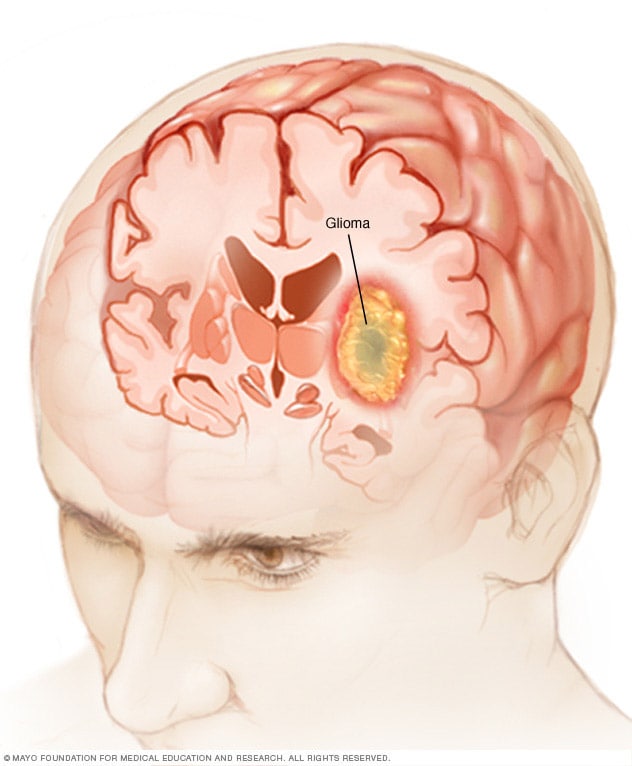
Glioma
Gliomas begin in the sticky supporting cells (glial cells) that surround nerve cells in the brain.
Malignant glioma cells
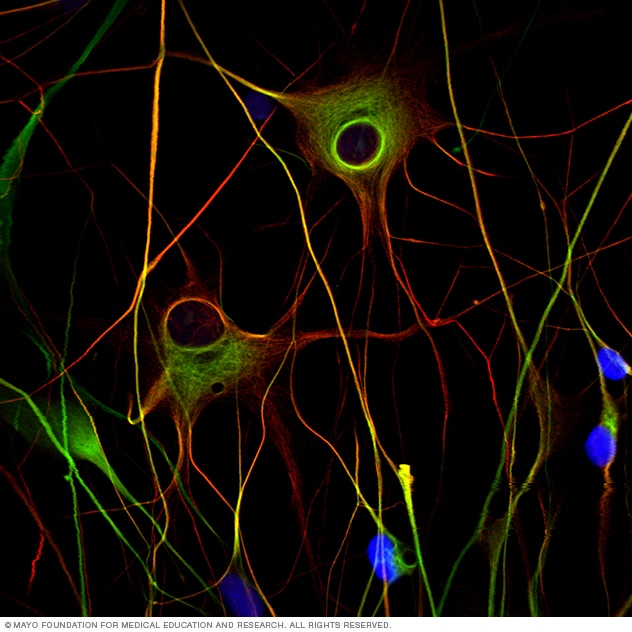
Malignant glioma cells
Glioblastoma multiforme (malignant brain tumor) cells. The cells have irregular shapes with fingers that can spread into the brain.
Glioma is a type of tumor that occurs in the brain and spinal cord. Gliomas begin in the sticky supporting cells (glial cells) that surround nerve cells and help them function.
Three types of glial cells can produce tumors. Gliomas are classified according to the type of glial cells involved in the tumor, as well as the genetic characteristics of the tumor, which can help predict how the tumor will behave over time and which treatments are most likely to work.
Types of glioma include:
- Astrozytome, einschließlich Astrozytom, anaplastisches Astrozytom und Glioblastom
- Ependymome, einschließlich anaplastisches Ependymom, myxopapilläres Ependymom und Subependymom
- Oligodendrogliome, einschließlich Oligodendrogliom, anaplastisches Oligodendrogliom und anaplastisches Oligoastrozytom
A glioma can affect your brain function and, depending on its location and rate of growth, can be life-threatening.
Gliomas are one of the most common types of primary brain tumors.
The type of glioma you have helps determine your treatment and prognosis. In general, treatment options for glioma include surgery, radiation therapy, chemotherapy, targeted therapies, and experimental clinical trials.
Types
-
Astrocytoma
-
Ependymoma
-
Glioblastoma
-
Oligodendroglioma
Symptoms
The symptoms of a glioma vary depending on the type of tumor as well as the size, location and growth rate of the tumor.
Common signs and symptoms of gliomas include:
- Kopfschmerzen
- Übelkeit oder Erbrechen
- Verwirrung oder eine Abnahme der Gehirnfunktion
- Gedächtnisverlust
- Persönlichkeitsveränderungen oder Reizbarkeit
- Schwierigkeiten mit dem Gleichgewicht
- Harninkontinenz
- Sehprobleme wie verschwommenes Sehen, Doppeltsehen oder Verlust des peripheren Sehens
- Sprachschwierigkeiten
- Krampfanfälle, besonders bei jemandem ohne Krampfanfälle in der Vorgeschichte
When to go to the doctor?
Make an appointment with your doctor if you have signs and symptoms typical of glioma.
Causes
As with most primary brain tumors, the exact cause of gliomas is not known. But there are some factors that can increase your risk of a brain tumor.
Risk factors
As with most primary brain tumors, the exact cause of gliomas is not known. But there are some factors that can increase your risk of a brain tumor. Risk factors include:
- Ihr Alter. Ihr Risiko für einen Hirntumor steigt mit zunehmendem Alter. Gliome treten am häufigsten bei Erwachsenen im Alter zwischen 45 und 65 Jahren auf. Ein Hirntumor kann jedoch in jedem Alter auftreten. Bestimmte Arten von Gliomen, wie Ependymome und pilozytische Astrozytome, treten häufiger bei Kindern und jungen Erwachsenen auf.
-
Radiation exposure.People who have been exposed to a type of radiation called ionizing radiation are at increased risk of a brain tumor. Examples of ionizing radiation include radiation therapy used to treat cancer and radiation exposure caused by atomic bombs.
More common forms of radiation, such as electromagnetic fields from power lines and radiofrequency radiation from microwave ovens, do not increase the risk of glioma.
It is not clear whether cell phone use increases the risk of brain tumors. Some studies have found a possible link between cell phone use and a type of brain tumor called acoustic neuroma. Many other studies have found no connection. Because cell phones are a relatively new factor, more long-term research is needed to understand the potential impact on cancer risk. For now, if you're concerned about the possible link between cell phones and cancer, experts recommend limiting your exposure by using a speaker or speakerphone that keeps the cell phone itself away from your head.
- Familiengeschichte von Gliom. Es ist selten, dass Gliom in Familien auftritt. Aber eine Familienanamnese mit Gliom kann das Risiko, es zu entwickeln, verdoppeln. Einige Gene wurden schwach mit Gliomen in Verbindung gebracht, aber es sind weitere Studien erforderlich, um eine Verbindung zwischen diesen genetischen Variationen und Hirntumoren zu bestätigen.
Glioma care
Sources:
- Gewinnen Sie RH. Radiologische Merkmale von Tumoren des zentralen Nervensystems. In: Youmans und Winn Neurologische Chirurgie. 7. Aufl. Philadelphia, Pennsylvania: Elsevier; 2017. https://www.clinicalkey.com.
- Wong ET, et al. Überblick über die klinischen Merkmale und Diagnose von Hirntumoren bei Erwachsenen. https://www.uptodate.com/contents/search. Abgerufen am 12. März 2018.
- Gliome. Merck Manual Professional-Version. http://www.merckmanuals.com/professional/neurological-disorders/intracranial-and-spinal-tumors/gliomas. Abgerufen am 12. März 2018.
- Goldman L. et al., Hrsg. Gliom. In: Goldman-Cecil Medicine. 25. Aufl. Philadelphia, Pennsylvania: Saunders Elsevier; 2016. https://www.clinicalkey.com. Abgerufen am 12. März 2018.
- Gewinnen Sie RH. Geringgradige Gliome: Astrozytome, Oligodendrogliome und gemischte Gliome. In: Youmans und Winn Neurologische Chirurgie. 7. Aufl. Philadelphia, Pennsylvania: Elsevier; 2017. https://www.clinicalkey.com.
- Überblick über intrakranielle Tumoren. Merck Manual Professional-Version. https://www.merckmanuals.com/professional/neurological-disorders/intracranial-and-spinal-tumors/overview-of-intracranial-tumors. Abgerufen am 12. März 2018.
- Michauid D. et al. Risikofaktoren für Hirntumoren. https://www.uptodate.com/contents/search. Abgerufen am 12. März 2018.
- Louis DN, et al. Klassifikation und pathologische Diagnose von Gliomen. https://www.uptodate.com/contents/search. Abgerufen am 12. März 2018.
- Gliom. American Brain Tumor Association. http://www.abta.org/secure/glioblastoma-brochure.pdf. Abgerufen am 27. Mai 2018.
- Physiotherapie. American Brain Tumor Association. http://www.abta.org/brain-tumor-treatment/continuum-of-care/rehabilitation-options/physical-therapy.html. Abgerufen am 12. März 2018.
- Krebserkrankungen des zentralen Nervensystems. Fort Washington, Pa.: Nationales umfassendes Krebsnetzwerk. http://www.nccn.org/professionals/physician_gls/f_guidelines.asp. Abgerufen am 12. März 2018.
- Risikofaktoren für Hirn- und Rückenmarkstumoren. Amerikanische Krebs Gesellschaft. https://www.cancer.org/cancer/brain-spinal-cord-tumors-adults/causes-risks-prevention/risk-factors.html. Abgerufen am 12. März 2018.
- Mikrowellen, Radiowellen und andere Arten von Hochfrequenzstrahlung. Amerikanische Krebs Gesellschaft. https://www.cancer.org/cancer/cancer-causes/radiation-exposure/radiofrequency-radiation.html. Abgerufen am 12. März 2018.
- Strahlentherapie bei erwachsenen Hirn- und Rückenmarkstumoren. Amerikanische Krebs Gesellschaft. https://www.cancer.org/cancer/brain-spinal-cord-tumors-adults/treating/radiation-therapy.html. Abgerufen am 12. März 2018.
- Louis DN, et al. Die Klassifikation der Tumoren des zentralen Nervensystems 2016 der Weltgesundheitsorganisation: Eine Zusammenfassung. Acta Neuropathol. 2016;131:803.
- Novocure. US Food & Drug Administration. https://www.accessdata.fda.gov/cdrh_docs/pdf10/P100034S013d.pdf. Abgerufen am 12. März 2018.
- Riggin EA. Allscripts EPSi. Mayo Clinic, Rochester, Minnesota, 12. März 2018.
- Chen CC, et al. Stereotaktische kraniale Radiochirurgie. https://www.uptodate.com/contents/search. Abgerufen am 12. März 2018.
- Porter AB (Gutachten). Mayo Clinic, Rochester, Minnesota, 7. Mai 2018.
- Mayo-Klinik. US News & World Report. http://health.usnews.com/best-hospitals/area/mn/mayo-clinic-6610451/pulmonology. Abgerufen am 12. März 2018.
- Sporen im Gehirn. Nationales Krebs Institut. https://trp.cancer.gov/spores/brain.htm. Abgerufen am 20. Mai 2018.
- Stupp R. et al. Hochgradiges malignes Gliom: ESMO-Leitlinien für die klinische Praxis für Diagnose, Behandlung und Nachsorge. Annalen der Onkologie. 2010;21:v190. http://annonc.oxfordjournals.org/content/21/suppl_5/v190.full.pdf+html. Abgerufen am 4. November 2014.
- Taylor L. Diagnose, Behandlung und Prognose von Gliom: Fünf neue Dinge. Neurologie: Klinische Praxis. 2010:S28. http://www.neurology.org/content/75/18_Supplement_1/S28.full. Abgerufen am 4. November 2014.
- Omuro A. et al. Glioblastom und andere bösartige Gliome: Eine klinische Überprüfung. Zeitschrift der American Medical Association. 2013;310:1842. http://jama.jamanetwork.com/article.aspx?articleid=1764056. Abgerufen am 4. November 2014.
- Was Sie über Hirntumore wissen müssen. Nationales Krebs Institut. http://www.cancer.gov/cancertopics/wyntk/brain.pdf. Abgerufen am 6. November 2014.
- Armstrong TS, et al. Anwendung komplementärer und alternativmedizinischer Therapien bei Patienten mit primären Hirntumoren. Aktuelle neurologische und neurowissenschaftliche Berichte. 2008;8:264.
-
Astrocytoma
-
Ependymoma
-
Glioblastoma
-
Oligodendroglioma