

 Suche
Suche
 Mein Konto
Hairy cell leukemia
Hairy cell leukemia
overview
Hairy cell leukemia
Hairy cell leukemia
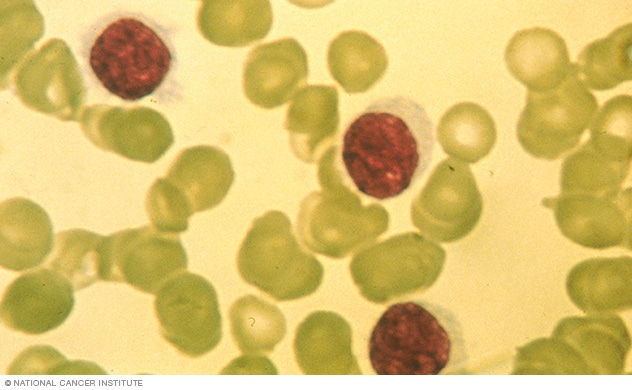
Hairy cell leukemia cells, which appear as darker cells in this photo, are surrounded by a halo of fine projections (villi). To diagnose hairy cell leukemia, your doctor may take a sample of bone marrow from your body and examine it under a microscope for hair cells.
Hairy cell leukemia is a rare, slow-growing blood cancer in which your bone marrow produces too many B cells (lymphocytes), a type of white blood cell that fights infections.
These excess B cells are abnormal and appear “hairy” under the microscope. As the number of leukemia cells increases, fewer healthy white blood cells, red blood cells, and platelets are produced.
Hairy cell leukemia affects more men than women and is most common in middle-aged or older adults.
Hairy cell leukemia is considered a chronic disease because it may never completely go away, although treatment can result in years of remission.
Symptoms
Some people have no signs or symptoms of hairy cell leukemia, but a blood test for another disease or condition may accidentally reveal hairy cell leukemia.
In other cases, people with hairy cell leukemia experience signs and symptoms typical of a number of diseases and conditions, such as:
- Ein Völlegefühl in Ihrem Bauch, das es unangenehm machen kann, mehr als ein bisschen auf einmal zu essen
- Ermüdung
- Leichte Blutergüsse
- Wiederkehrende Infektionen
- Die Schwäche
- Gewichtsverlust
When to go to the doctor?
Make an appointment with your doctor if you have persistent signs and symptoms that worry you.
Causes
It's not clear what causes hairy cell leukemia.
Doctors know that cancer occurs when cells develop errors (mutations) in their DNA. In the case of hairy cell leukemia, mutations in the DNA cause your bone marrow stem cells to make too many white blood cells that don't function properly. Doctors don't know what causes the DNA mutations that lead to hairy cell leukemia.
Risk factors
Certain factors may increase your risk of developing hairy cell leukemia. Not all research studies agree on which factors increase your risk of disease.
Some research suggests that your risk of hairy cell leukemia may be due to your:
- Strahlenbelastung. Personen, die Strahlung ausgesetzt sind, wie z. B. Personen, die in der Nähe von Röntgengeräten arbeiten und keine angemessene Schutzausrüstung tragen, oder Personen, die eine Strahlenbehandlung gegen Krebs erhalten haben, haben möglicherweise ein höheres Risiko, an Haarzellenleukämie zu erkranken, aber die Beweise sind nicht schlüssig.
- Exposition gegenüber Chemikalien. Es gibt widersprüchliche Studien zur Rolle von Industrie- und Agrarchemikalien bei der Entstehung von Haarzellenleukämie.
Complications
Hairy cell leukemia progresses very slowly and sometimes remains stable for many years. For this reason, there are few complications of the disease.
Untreated hairy cell leukemia that progresses can crowd out healthy blood cells in the bone marrow, leading to serious complications such as:
- Infektionen. Eine verringerte Anzahl gesunder weißer Blutkörperchen setzt Sie dem Risiko von Infektionen aus, die Ihr Körper ansonsten abwehren könnte.
- Blutung. Niedrige Blutplättchenzahlen machen es Ihrem Körper schwer, Blutungen zu stoppen, wenn sie einmal begonnen haben. Wenn Sie eine leicht niedrige Blutplättchenzahl haben, werden Sie möglicherweise feststellen, dass Sie leichter blaue Flecken bekommen. Sehr niedrige Blutplättchenzahlen können zu spontanen Nasen- oder Zahnfleischbluten führen.
- Anämie. Eine niedrige Anzahl roter Blutkörperchen bedeutet, dass weniger Zellen verfügbar sind, um Sauerstoff durch Ihren Körper zu transportieren. Dies wird als Anämie bezeichnet. Anämie verursacht Müdigkeit.
Increased risk of second cancer
Some studies have found that people with hairy cell leukemia may have an increased risk of developing a second type of cancer. It is not clear whether this risk is due to the effect of hairy cell leukemia on the body or whether the risk comes from the medications used to treat hairy cell leukemia.
Second cancers found in people treated for hairy cell leukemia include non-Hodgkin's lymphoma.
Sources:
- Kaushansky K., et al., Hrsg. Haarzell-Leukämie. In: Williams Hämatologie. 9. Aufl. New York, NY: McGraw-Hill-Bildung; 2016. http://accessmedicine.mhmedical.com. Abgerufen am 18. Februar 2018.
- Grever MR, et al. Konsensrichtlinien für die Diagnose und Behandlung von Menschen mit klassischer Haarzell-Leukämie. Blut. 2017;129:553.
- Quest GR, et al. Klinische Merkmale und Diagnose der Haarzell-Leukämie. Best Practice & Research Klinische Hämatologie. 2015;28:180.
- Tallman MS, et al. Klinische Merkmale und Diagnose der Haarzell-Leukämie. http://www.uptodate.com/contents/search. Abgerufen am 18. Februar 2018.
- Hoffmann R. et al. Haarzell-Leukämie. In: Hämatologie: Grundlagen und Praxis. 7. Aufl. Philadelphia, Pennsylvania: Elsevier; 2018. https://www.clinicalkey.com. Abgerufen am 25. September 2017.
- Behandlung von Haarzellenleukämie (PDQ): Version für medizinische Fachkräfte. Nationales Krebs Institut. https://www.cancer.gov/types/leukemia/hp/hairy-cell-treatment-pdq#section/all. Abgerufen am 26. September 2017.
- Talmann MS. Behandlung der Haarzellenleukämie. https://www.uptodate.com/contents/search. Abgerufen am 18. Februar 2018.
- Notfallmanagement. Fort Washington, Pa.: Nationales umfassendes Krebsnetzwerk. http://www.nccn.org/professionals/physician_gls/f_guidelines.asp. Abgerufen am 28. September 2017.
- Haarzell-Leukämie. Fort Washington, Pa.: Nationales umfassendes Krebsnetzwerk. http://www.nccn.org/professionals/physician_gls/f_guidelines.asp. Abgerufen am 28. September 2017.
- Fragen Sie MayoExpert. Haarzell-Leukämie (HCL): Diagnose bis Erstbehandlung, Krankheitsrückfall (Erwachsener). Rochester, Minnesota: Mayo Foundation for Medical Education and Research; 2017.