

 Suche
Suche
 Mein Konto
Heat rash
Heat rash
overview
Heat rash
Heat rash
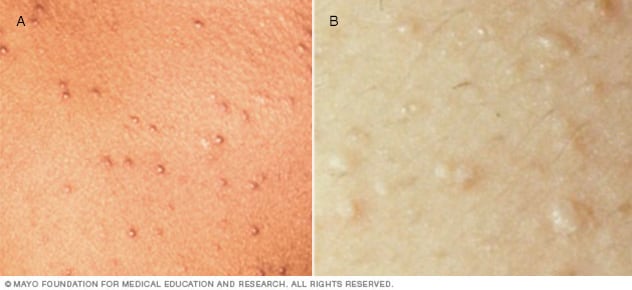
Miliaria rubra (A), a type of heat rash, appears as a cluster of small, inflamed, blister-like bumps that can cause severe itching. Miliaria crystallina (B), another type of heat rash, appears as clear, fluid-filled bumps that do not hurt or itch.
Heat rash – also known as prickly heat and miliaria – isn't just for babies. It also affects adults, especially in hot, humid conditions.
Heat rash occurs when sweat is trapped in the skin. Symptoms can range from small blisters to deep, inflamed lumps. Some forms of heat rash are very itchy.
Heat rash usually goes away once the skin cools. Severe forms of the condition may require treatment from a healthcare provider.
Symptoms
Sweat glands
Sweat glands
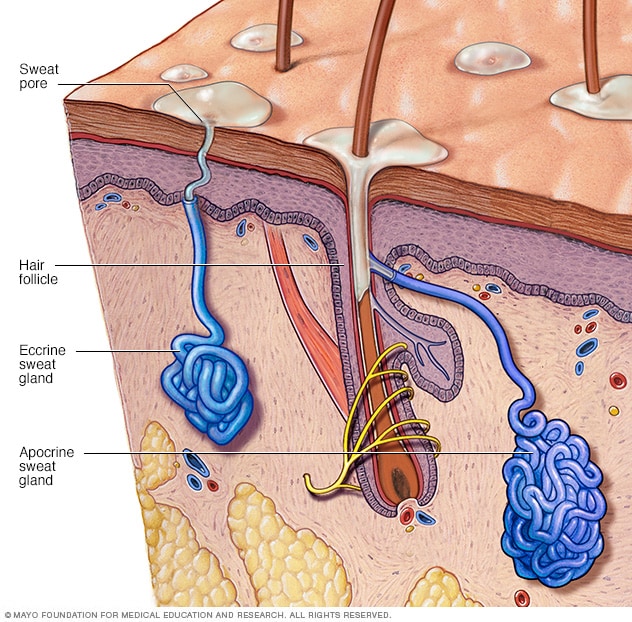
Your skin has two types of sweat glands: eccrine and apocrine. Eccrine glands occur throughout most of your body and open directly on the surface of the skin. Apocrine glands open into the hair follicle and lead to the surface of the skin. Apocrine glands develop in areas rich in hair follicles, such as: B. on the scalp, armpits and groin area.
Adults usually develop a heat rash in skin folds and where clothing rubs against the skin. In infants, the rash occurs primarily on the neck, shoulders, and chest. It can also show up in the armpits, elbow creases, and groin.
Types of heat rash
The types of heat rash are classified based on how deeply the sweat is trapped in the skin. Signs and symptoms for each type vary.
- Die mildeste Form von Hitzeausschlag wird Miliaria crystallina genannt. Sie tritt auf, wenn die Öffnung des Schweißkanals auf der Hautoberfläche (Schweißpore) verstopft ist. Diese Form ist durch winzige, klare, mit Flüssigkeit gefüllte Beulen gekennzeichnet, die leicht brechen.
- Eine Art, die tiefer in der Haut vorkommt, heißt Miliaria rubra. Es wird manchmal als stachelige Hitze bezeichnet. Anzeichen und Symptome sind kleine, entzündete, blasenartige Beulen und Juckreiz oder Kribbeln im betroffenen Bereich.
- Gelegentlich füllen sich die entzündeten Beulen von Miliaria rubra mit Eiter. Diese Form wird Miliaria pustulosa genannt.
- Eine weniger häufige Form von Hitzeausschlag wird als Miliaria profunda bezeichnet. Es betrifft die tiefste Hautschicht (Dermis). Es verursacht feste, schmerzhafte oder juckende entzündete Beulen, die wie Gänsehaut aussehen und aufbrechen können.
When to go to the doctor?
Heat rash usually heals by cooling the skin and avoiding exposure to the heat that caused it. Contact your doctor if you or your child have symptoms that last more than a few days or the rash seems to get worse.
Causes
Heat rash occurs when a duct leading from a sweat gland to the surface of the skin becomes blocked or inflamed. This then blocks the opening of the sweat duct on the skin surface (sweat pore). Instead of evaporating, sweat gets trapped under the skin, causing irritation and bumps on the skin.
Risk factors
Factors that increase the risk of heat rash include:
- Ein Neugeborenes sein, da Neugeborene unreife Schweißkanäle haben
- Leben in einem heißen, feuchten Klima
- Körperlich aktiv sein
- Lange Bettruhe und Fieber
Complications
Heat rash usually heals without scarring. People with brown or black skin are at risk of skin patches becoming lighter or darker in response to inflammatory skin conditions (post-inflammatory hypo- or hyperpigmentation). These changes usually disappear within weeks or months.
A common complication is bacterial infection, which causes inflamed and itchy pustules.
prevention
How to protect yourself or your child from heat rash:
- Ziehen Sie sich bei heißem Wetter lockere, leichte Kleidung an, die Feuchtigkeit von der Haut ableitet. Wickeln Sie Neugeborene nicht in zu viele Schichten.
- Begrenzen Sie bei heißem Wetter die körperliche Aktivität. Bleiben Sie im Schatten oder in einem klimatisierten Gebäude. Oder verwenden Sie einen Ventilator, um die Luft zirkulieren zu lassen.
- Halten Sie Ihren Schlafbereich kühl und gut belüftet.
- Vermeiden Sie Cremes und Salben, die die Poren verstopfen können.
- Vermeiden Sie Medikamente, die Schwitzen verursachen, wie Clonidin, Betablocker und Opioide.
Sources:
- Fragen Sie MayoExpert. Miliaria (Kind). Mayo-Klinik; 2021.
- Miliaria. American Osteopathic College of Dermatology. https://www.aocd.org/skin/dermatologic_diseases/miliaria.html. Abgerufen am 19. Januar 2022.
- Kelly AP, et al., Hrsg. Pädiatrie. In: Taylor und Kelly’s Dermatology for Skin of Color. 2. Aufl. McGraw-Hügel; 2016.
- Miliaria. Merck Manual Professional-Version. https://www.merck.com/mmpe/print/sec10/ch118/ch118e.html. Abgerufen am 19. Januar 2022.
- Tintinalli JE, et al., Hrsg. Hitze Notfälle. In: Tintinalli’s Emergency Medicine: A Comprehensive Study Guide. 9. Aufl. McGraw-Hügel; 2020. https://accessmedicine.mhmedical.com. Abgerufen am 19. Januar 2022.
- Gauer R. et al. Hitzebedingte Erkrankungen. Amerikanischer Hausarzt. 2019;99:482.
- James WD, et al. Dermatosen aufgrund physikalischer Faktoren. In: Andrews‘ Diseases of the Skin: Clinical Dermatology. 13. Aufl. Elsevier; 2020. https://www.clinicalkey.com. Abgerufen am 19. Januar 2022.
- Ishimine P. Hitzekrankheit (außer Hitzschlag) bei Kindern. https://www.uptodate.com/contents/search. Abgerufen am 20. Januar 2022.
- Smith CC, et al. Primäre fokale Hyperhidrose. https://www.uptodate.com/contents/search. Abgerufen am 2. März 2022.