

 Suche
Suche
 Mein Konto
Hypopituitarism
Hypopituitarism
overview
Pituitary gland and hypothalamus
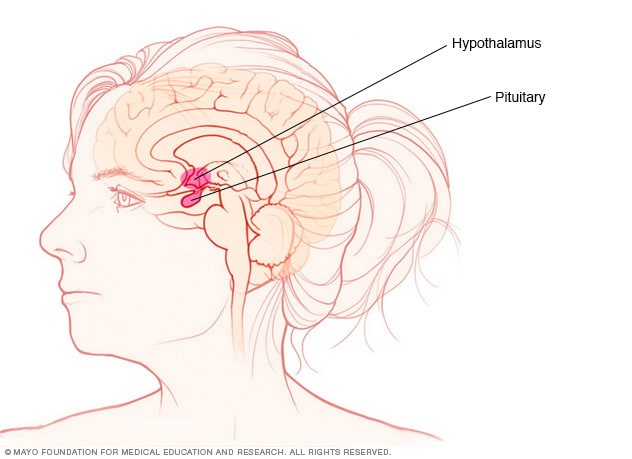
Pituitary gland and hypothalamus
The pituitary gland and hypothalamus are located in the brain and control hormone production.
Endocrine system
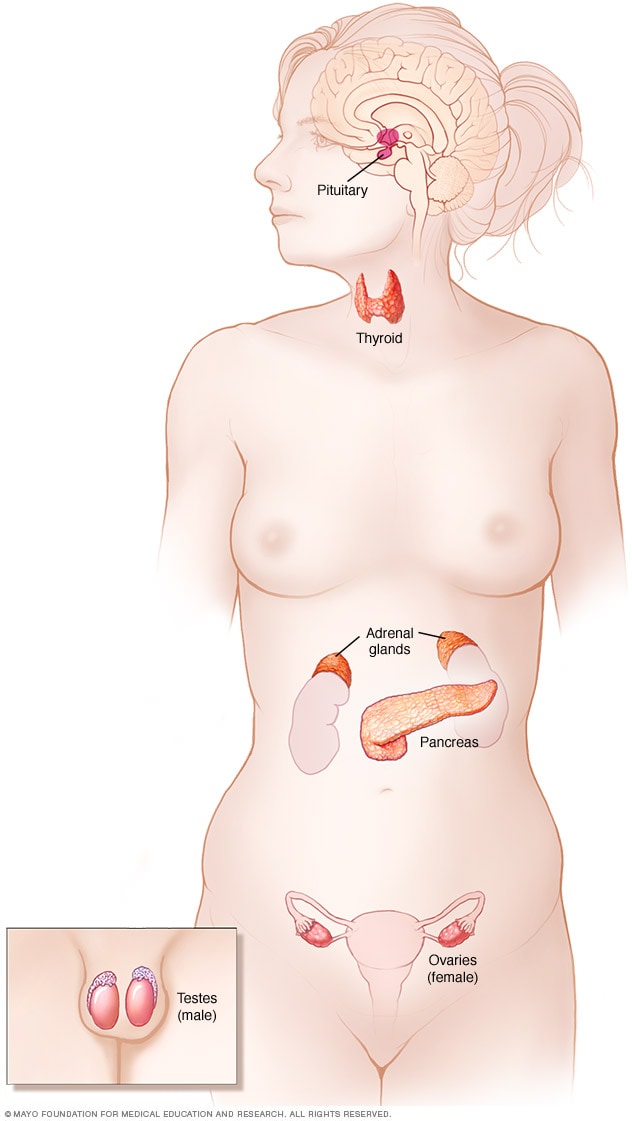
Endocrine system
The endocrine system includes the pituitary gland, thyroid, parathyroid glands, adrenal glands, pancreas, ovaries, and testes.
Hypopituitarism is a rare condition in which your pituitary gland doesn't produce one or more hormones or doesn't produce enough of them.
The pituitary gland is a kidney bean-sized gland located at the base of your brain. It is part of your body's endocrine system, which is made up of all the glands that produce and regulate hormones. Despite its small size, the pituitary gland produces and releases a variety of hormones that affect almost every part of your body.
Hypopituitarism is when you have an undersupply (deficiency) of one or more of the pituitary hormones. These hormone deficiencies can affect a number of your body's routine functions, such as: B. Growth, blood pressure or reproduction. Symptoms typically vary depending on which hormone or hormones you are deficient in.
If you have hypopituitarism, you will likely need to take medication for the rest of your life. Medications help replace the missing hormones, which helps control your symptoms.
Symptoms
The signs and symptoms of hypopituitarism usually develop gradually and get worse over time. They are sometimes subtle and can be overlooked for months or even years. But some people develop signs and symptoms suddenly.
Signs and symptoms of hypopituitarism vary from person to person depending on which pituitary hormones are affected and to what extent. In people with more than one pituitary hormone deficiency, the second deficiency can increase or, in some cases, mask the symptoms of the first deficiency.
Growth hormone (GH) deficiency.
In children, GH deficiency can lead to growth problems and short stature. Most adults with GH deficiency have no symptoms, but some adults may experience:
- Ermüdung
- Muskelschwäche
- Veränderungen in der Körperfettzusammensetzung
- Mangel an Ehrgeiz
- Soziale Isolation
Deficiency of luteinizing hormone (LH) and follicle stimulating hormone (FSH).
A deficiency of these hormones called gonadotropins affects the reproductive system. In women, the deficiency reduces egg and estrogen production by the ovaries. In men, the deficiency reduces sperm and testosterone production by the testicles. Women and men may experience lower sex drive, infertility, or fatigue. In children and adolescents, delayed puberty is usually the only symptom.
Women may also have symptoms such as:
- Hitzewallungen
- Unregelmäßige oder keine Periode
- Verlust der Schambehaarung
- Eine Unfähigkeit, Milch zum Stillen zu produzieren
Men may also experience symptoms such as:
- Erektile Dysfunktion
- Weniger Gesichts- oder Körperbehaarung
- Stimmungsschwankungen
Thyroid stimulating hormone (TSH) deficiency
This hormone controls the thyroid. A TSH deficiency leads to low levels of thyroid hormones (hypothyroidism). This causes symptoms such as:
- Ermüdung
- Gewichtszunahme
- Trockene Haut
- Verstopfung
- Kälteempfindlichkeit oder Schwierigkeiten, warm zu bleiben
Adrenocorticotropic hormone (ACTH) deficiency
This hormone helps your adrenal glands work properly and helps your body respond to stress. Symptoms of ACTH deficiency include:
- Starke Müdigkeit
- Niedriger Blutdruck, der zu Ohnmacht führen kann
- Häufige und anhaltende Infektionen
- Übelkeit, Erbrechen oder Bauchschmerzen
- Verwirrtheit
Deficiency of antidiuretic hormone (ADH).
This hormone, also called vasopressin, helps your body balance its fluid levels. ADH deficiency can cause a condition called diabetes insipidus, which can cause:
- Übermäßiges Wasserlassen
- Extremer Durst
- Elektrolytstörungen
Prolactin deficiency
Prolactin is the hormone that tells the body when to start producing breast milk. Low prolactin levels can cause women to have trouble making milk for breastfeeding.
When to go to the doctor?
See your doctor ifYou develop any of the signs and symptoms associated with hypopituitarism.
Contact your doctor immediately ifSigns or symptoms of hypopituitarism occur suddenly or are associated with severe headache, vision problems, confusion, or drop in blood pressure. These may be signs and symptoms of sudden destruction of pituitary gland tissue (pituitary apoplexy), often caused by bleeding into the pituitary gland. Pituitary apoplexy is a medical emergency and requires immediate medical attention.
Causes
Hypopituitarism has a number of causes. In many cases, hypopituitarism is caused by a tumor of the pituitary gland. As a pituitary tumor increases in size, it can compress and damage pituitary tissue, affecting hormone production. A tumor can also compress the optic nerves and cause vision problems.
In addition to tumors, certain diseases or events that damage the pituitary gland can also trigger hypopituitarism. Examples include:
- Kopfverletzungen
- Gehirnoperation
- Bestrahlung von Kopf oder Hals
- Mangelnde Durchblutung des Gehirns oder der Hypophyse (Schlaganfall) oder Blutung (Hämorrhagie) in das Gehirn oder die Hypophyse
- Bestimmte Medikamente wie Betäubungsmittel, hochdosierte Kortikosteroide oder bestimmte Krebsmedikamente, sogenannte Checkpoint-Inhibitoren
- Entzündung der Hirnanhangsdrüse, verursacht durch eine abnormale Reaktion des Immunsystems (Hypophysitis)
- Infektionen des Gehirns, wie Meningitis, oder Infektionen, die sich auf das Gehirn ausbreiten können, wie Tuberkulose oder Syphilis
- Infiltrative Erkrankungen, die mehrere Körperteile betreffen, einschließlich Sarkoidose, einer entzündlichen Erkrankung, die in verschiedenen Organen auftritt; Langerhans-Zell-Histiozytose, bei der abnorme Zellen in zahlreichen Teilen des Körpers Narben verursachen; und Hämochromatose, die übermäßige Eisenablagerungen in der Leber und anderen Geweben verursacht
- Schwerer Blutverlust während der Geburt, der zu einer Schädigung des vorderen Teils der Hypophyse führen kann (Sheehan-Syndrom oder postpartale Hypophysennekrose)
In some cases, hypopituitarism is caused by a genetic mutation (inherited). These mutations affect the pituitary gland's ability to produce one or more of its hormones, often beginning at birth or in early childhood.
Tumors or diseases of the hypothalamus, a part of the brain located directly above the pituitary gland, can also cause hypopituitarism. The hypothalamus produces its own hormones that directly influence the activity of the pituitary gland.
In some cases, the cause of hypopituitarism is unknown.
Sources:
- Fragen Sie MayoExpert. Hypopituitarismus. Rochester, Minnesota: Mayo Foundation for Medical Education and Research; 2018.
- Higham CE, et al. Hypopituitarismus. Die Lanzette. 2016;388:2403.
- Generalisierter Hypopituitarismus. Merck Manual Professional-Version. https://www.merckmanuals.com/professional/endocrine-and-metabolic-disorders/pituitary-disorders/generalized-hypopituitarism. Abgerufen am 4. April 2019.
- Jameson JL, et al., Hrsg. Hypopituitarismus. In: Harrisons Prinzipien der Inneren Medizin. 20. Aufl. New York, NY: Die McGraw-Hill-Unternehmen; 2018. https://accessmedicine.mhmedical.com. Abgerufen am 4. April 2019.
- Kellermann RD, et al. Hypopituitarismus. In: Conn’s Current Therapy 2019. Philadelphia, Pa.: Elsevier; 2019. https://www.clinicalkey.com. Abgerufen am 4. April 2019.
- Nippoldt, TB (Gutachten). Mayo Clinic, Rochester, Minnesota, 19. April 2019.