

 Suche
Suche
 Mein Konto
croup
croup
overview
Normal respiratory system
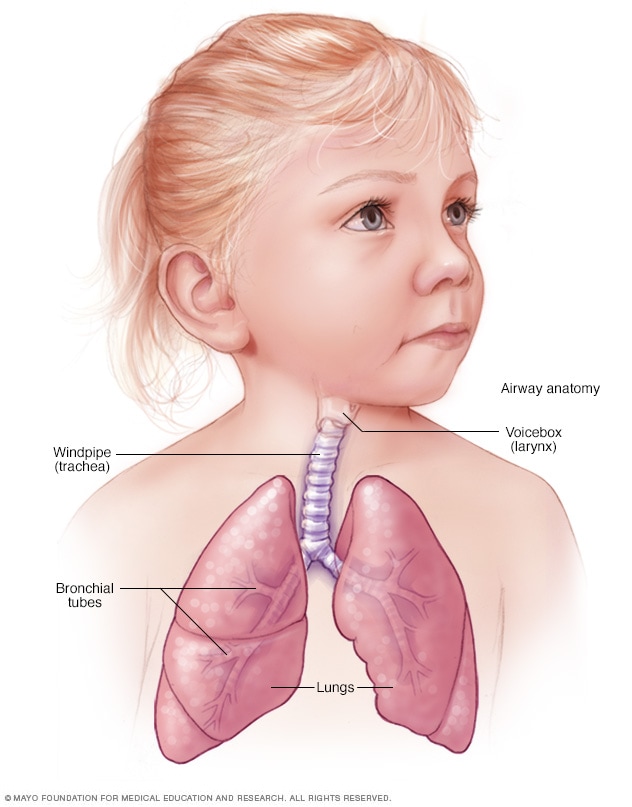
Normal respiratory system
This shows the normal anatomy of a child's airway.
croup

croup
When the upper respiratory tract is infected with the virus that causes croup, the tissue around the voice box (larynx) and windpipe (trachea) swells. When a cough forces air through this narrowed passage, it can sound like the bark of a seal.
Croup refers to an upper respiratory tract infection that obstructs breathing and causes a characteristic barking cough.
The cough and other signs and symptoms of croup are the result of swelling around the voice box (larynx), windpipe (trachea), and bronchi (bronchi). When a cough forces air through this narrowed passage, the swollen vocal cords produce a sound similar to a seal barking. A high-pitched whistling sound (stridor) often occurs when inhaling.
Croup typically occurs in younger children. Croup is usually not serious and most children can be treated at home.
Symptoms
Croup often starts as a typical cold. If there is enough inflammation and coughing, a child will develop:
- Lauter bellender Husten, der durch Weinen und Husten weiter verschlimmert wird, sowie Angst und Unruhe, wodurch ein Zyklus sich verschlechternder Anzeichen und Symptome entsteht
- Fieber
- Heisere Stimme
- Atmung, die laut oder angestrengt sein kann
Symptoms of croup are usually worse at night and usually last three to five days.
When to go to the doctor?
If your child's symptoms are severe, worsen or last longer than three to five days, or do not respond to home treatment, contact your child's doctor.
Seek immediate medical attention if your child:
- Macht laute, schrille Atemgeräusche sowohl beim Einatmen als auch beim Ausatmen
- Macht hohe Atemgeräusche, wenn es nicht weint oder aufgeregt ist
- Beginnt zu sabbern oder hat Schluckbeschwerden
- Wirkt ängstlich und aufgeregt oder müde und lustlos
- Atmet schneller als gewöhnlich
- Atembeschwerden
- Entwickelt blaue oder gräuliche Haut um Nase, Mund oder Fingernägel (Zyanose)
Causes
Croup is usually caused by a viral infection, most often a parainfluenza virus.
Your child can become infected with a virus by inhaling infected respiratory droplets that are coughed or sneezed into the air. Virus particles in these droplets can also survive on toys and other surfaces. If your child touches a contaminated surface and then touches their eyes, nose, or mouth, infection may follow.
Risk factors
Children between 6 months and 3 years of age are most at risk of developing croup. Because children have small airways, they are most susceptible to more croup symptoms.
Complications
Most cases of croup are mild. In a small percentage of children, the airways become so swollen that they interfere with breathing. Rarely, a secondary bacterial infection of the trachea may occur, causing difficulty breathing and requiring emergency medical care.
Only a small number of children seen in the emergency room for croup require hospitalization.
prevention
To prevent croup, take the same steps you use to prevent colds and flu.
- Häufiges Händewaschen ist das Wichtigste.
- Halten Sie Ihr Kind von erkrankten Personen fern.
- Ermutigen Sie Ihr Kind, in seine Armbeuge zu husten oder zu niesen.
To ward off more serious infections, keep your child's vaccinations up to date. The diphtheria and Haemophilus influenza type b (Hib) vaccines provide protection against some of the rarest - but most dangerous - upper respiratory tract infections. There is still no vaccine that protects against parainfluenza viruses.
Sources:
- Fragen Sie MayoExpert. Kruppe (Kind). Rochester, Minnesota: Mayo Foundation for Medical Education and Research; 2018.
- Björnson CL, et al. Kruppe bei Kindern. Zeitschrift der Kanadischen Ärztevereinigung. 2013;185:1317.
- Johnson DW. Kruppe. BMJ Klinischer Nachweis. 2014;2014:0321. https://www.ncbi.nlm.nih.gov/pmc/articles/PMC4178284/. Abgerufen am 7. Januar 2019.
- Krupp (Laryngotracheobronchitis). Merck Manual Professional-Version. https://www.merckmanuals.com/professional/pediatrics/respiratory-disorders-in-young-children/croup. Abgerufen am 7. Januar 2019.
- Gates A, et al. Glukokortikoide für Krupp bei Kindern. Cochrane-Datenbank systematischer Reviews. https://www.cochranelibrary.com. Abgerufen am 7. Januar 2019.
- Über humane Parainfluenzaviren (HPIVs). Zentren für die Kontrolle und Prävention von Krankheiten. https://www.cdc.gov/parainfluenza/about/index.html. Abgerufen am 7. Januar 2019.
- Kimberlin DW, et al. Parainfluenza-Virusinfektionen. In: Rotes Buch Online. 31. Aufl. Elk Grove Village, Illinois: American Academy of Pediatrics; 2018. https://redbook.solutions.aap.org. Abgerufen am 7. Januar 2019.
- Petrocheilou A, et al. Virale Kruppe: Diagnose und ein Behandlungsalgorithmus. Pädiatrische Pneumologie. 2014;49:421.
- Ali S, et al. Präklinische Dexamethason-Verabreichung bei Kindern mit Krupp: Eine Überprüfung der Krankenakte. Notfallmedizin. 2018;10:141.
- Ortiz-Alvarez O, et al. Akute Behandlung der Kruppe in der Notaufnahme. Pädiatrie und Kindergesundheit. 2017;22:166.
- Smith DK, et al. Kruppe: Diagnose und Behandlung. Amerikanischer Hausarzt. 2018;97:575.
- Bagwell T. et al. Management von Krupp in der Notaufnahme: Die Rolle von vernebeltem Epinephrin in mehreren Dosen. Pädiatrische Notfallversorgung. Im Druck. Abgerufen am 7. Januar 2019.
- Seien Sie vorsichtig, wenn Sie Kindern Husten- und Erkältungsprodukte geben. US Food and Drug Administration. https://www.fda.gov/drugs/resourcesforyou/specialfeatures/ucm263948.htm. Abgerufen am 7. Januar 2019.
- Diphtherie und der Impfstoff (Schuss), um es zu verhindern. Zentren für die Kontrolle und Prävention von Krankheiten. https://www.cdc.gov/diphtheria/materials.html. Abgerufen am 7. Januar 2019.
- Schützen Sie Ihr Kind vor der Hib-Krankheit. Zentren für die Kontrolle und Prävention von Krankheiten. https://www.cdc.gov/features/hibdisease/. Abgerufen am 7. Januar 2019.
- Baughn JM (Expertenmeinung). Mayo Clinic, Rochester, Minnesota, 23. Januar 2019.
- Bakterielle Tracheitis. Merck Manual Professional-Version. https://www.merckmanuals.com/professional/pediatrics/respiratory-disorders-in-young-children/bacterial-tracheitis. Abgerufen am 23. Januar 2019.