

 Suche
Suche
 Mein Konto
Lichen sclerosus
Lichen sclerosus
overview
Lichen sclerosus (LIE-kun skluh-ROW-sus) is a rare disorder that produces patchy, white skin that appears thinner than normal. It usually affects the genital and anal areas.
Anyone can get lichen sclerosus, but postmenopausal women are at higher risk.
Your doctor may suggest treatment with creams or ointments to help restore your skin to a more normal appearance and reduce the tendency for scarring. The condition tends to recur, so long-term follow-up care may be required. Rarely, lichen sclerosus improves without treatment.
Symptoms
Lichen sclerosus
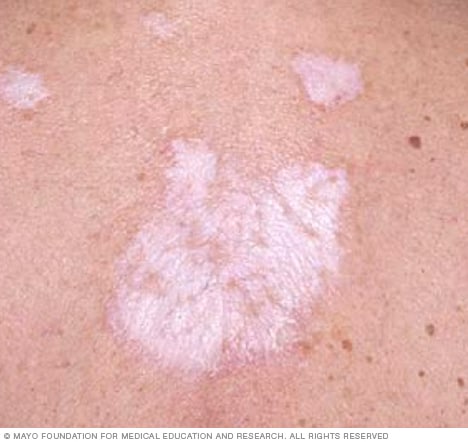
Lichen sclerosus
Lichen sclerosus is a rare skin disease characterized by white, mottled patches of skin.
Lichen sclerosus in the genital area
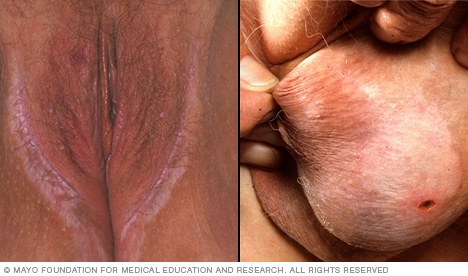
Lichen sclerosus in the genital area
Lichen sclerosus can affect the skin on any part of your body, but most commonly affects the skin of the vulva, the foreskin of the penis, or the skin in the anal area.
People with mild lichen sclerosus may not have any signs or symptoms.
Signs and symptoms usually affect the skin in the genital and anal areas, but can also affect the skin of the torso, upper arms, and breasts. These can include:
- Rötung
- Juckreiz (Pruritus), der schwerwiegend sein kann
- Unbehagen oder Schmerzen
- Glätten Sie weiße Flecken auf Ihrer Haut
- Fleckige, faltige Stellen
- Reißen oder Bluten
- In schweren Fällen Blutungen, Blasenbildung oder ulzerierte Wunden
- Schmerzhafter Sex
When to go to the doctor?
See your doctor if you have signs and symptoms typical of lichen sclerosus.
If you have already been diagnosed with lichen sclerosus, see your doctor every six to 12 months to be checked for skin changes or side effects from treatment.
Causes
The cause of lichen sclerosus is unknown. An overactive immune system or hormone imbalance may play a role. Previous skin damage to a specific area of your skin may increase the likelihood of lichen sclerosus in that area.
Lichen sclerosus is not contagious and cannot be transmitted through sexual intercourse.
Lichen sclerosus often occurs in postmenopausal women, but also in men and children. In women, lichen sclerosus usually affects the vulva. Among boys and men, uncircumcised men are most at risk because the condition generally affects the foreskin.
In children, signs and symptoms may improve during puberty, but they still need to be monitored for disease activity.
Risk factors
The risk of lichen sclerosus is higher in postmenopausal women, although it can occur in men and children. Men who are uncircumcised are at higher risk because the condition often affects the foreskin.
Complications
Complications of lichen sclerosus include painful sex, urinary retention, constipation, and inability to retract the foreskin. People with lichen sclerosus also have an increased risk of squamous cell carcinoma of the affected area.
Sources:
- Ferri FF, et al., Hrsg. Krankheiten und Störungen. In: Ferri’s Fast Facts in Dermatology: A Practical Guide to Skin Diseases and Disorders. 2. Aufl. Philadelphia, Pennsylvania: Elsevier; 2019. https://www.clinicalkey.com. Abgerufen am 24. August 2018.
- Fistarol SK, et al. Diagnose und Behandlung des Lichen sclerosus. Amerikanisches Journal für klinische Dermatologie. 2013;14:27.
- Was ist Lichen sclerosus? National Institute of Arthritis and Musculoskeletal and Skin Diseases. https://www.niams.nih.gov/health-topics/lichen-sclerosus. Abgerufen am 24. August 2018.
- Schlosser BJ, et al. Lichen sclerosus und Lichen planus bei Frauen und Mädchen. Klinische Geburtshilfe und Gynäkologie. 2015;58:125.
- Fragen Sie MayoExpert. Lichen sclerosus (balanitis xerotica obliterans). Rochester, Minnesota: Mayo Foundation for Medical Education and Research; 2018.