

 Suche
Suche
 Mein Konto
Cradle cap
Cradle cap
overview
Cradle cap on fair skin
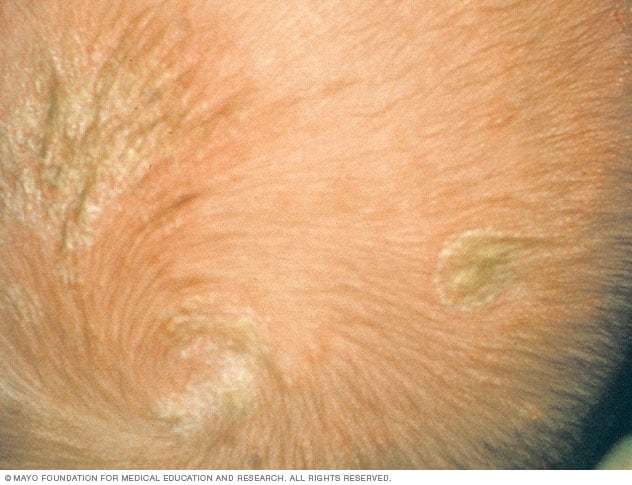
Cradle cap on fair skin
Cradle cap is characterized by scaly patches on a baby's scalp. You may notice thick, yellow patches of skin. The spots may be crusty or greasy.
Cradle cap on dark skin
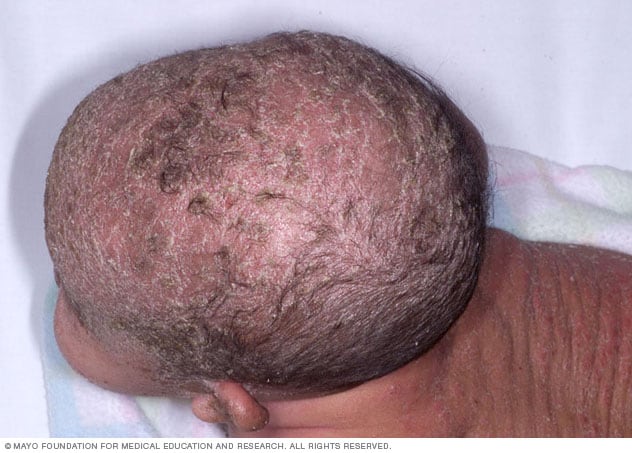
Cradle cap on dark skin
Cradle cap appears as patchy scales or thick crusts on the scalp and oily skin covered with flaky white or yellow scales. Cradle cap usually does not bother the infant.
Cradle cap causes crusty or oily scaly patches on a baby's scalp. The condition is not painful or itchy. But it can cause thick white or yellow scales that are not easy to remove.
Cradle cap usually clears up on its own in weeks or a few months. Home care measures include washing your baby's scalp daily with a mild shampoo. This can help you loosen and remove the scales. Do not scratch cradle cap.
If cradle cap persists or appears severe, your doctor may suggest a medicated shampoo, lotion, or other treatment.
Symptoms
Common signs of cradle cap include:
- Fleckige Schuppenbildung oder dicke Krusten auf der Kopfhaut
- Fettige oder trockene Haut, die mit schuppigen weißen oder gelben Schuppen bedeckt ist
- Hautschuppen
- Möglicherweise leichte Rötung
Similar scales may also be present on the ears, eyelids, nose, and groin.
Cradle cap is common in newborns. It usually doesn't itch.
Cradle cap is the common term for infantile seborrheic dermatitis. It is sometimes confused with another skin condition, atopic dermatitis. A key difference between these conditions is that atopic dermatitis usually causes significant itching.
When to go to the doctor?
See your baby's doctor if:
- Sie haben erfolglos versucht, es zu Hause zu behandeln
- Die Patches verteilen sich auf Gesicht oder Körper Ihres Babys
Causes
The cause of cradle cap is not known. One contributing factor may be hormones that are passed from mother to baby before birth. These hormones can lead to excessive sebum production in the sebaceous glands and hair follicles.
Another factor may be a yeast called Malassezia (mal-uh-SEE-zhuh), which grows in the sebum along with bacteria. Antifungal treatments such as ketoconazole are often effective and support the idea that yeast is a contributing factor.
Cradle cap is not contagious and is not caused by poor hygiene.
prevention
Shampoo your baby's hair every few days to prevent cradle cap. Stick with a mild baby shampoo unless your baby's doctor recommends something stronger.
Sources:
- Fragen Sie MayoExpert. Seborrhoische Dermatitis. Rochester, Minnesota: Mayo Foundation for Medical Education and Research; 2018.
- Barbara Woodward Lips Patientenschulungszentrum. Pflege Ihres Neugeborenen. Rochester, Minnesota: Mayo Foundation for Medical Education and Research; 2014.
- Sasseville D. Milchschorf und seborrhoische Dermatitis bei Säuglingen. https://www.uptodate.com/contents/search. Abgerufen am 1. Oktober 2018.