

 Suche
Suche
 Mein Konto
Graves' disease
Graves' disease
overview
thyroid
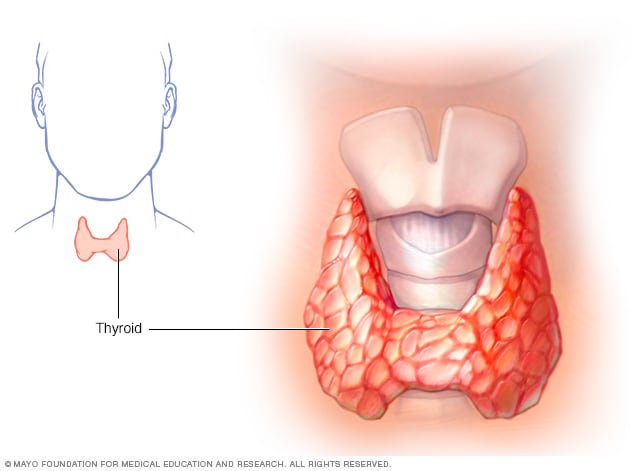
thyroid
Your thyroid is located at the base of your neck, just below the Adam's apple.
Graves' disease is a disease of the immune system that leads to overproduction of thyroid hormones (hyperthyroidism). Although a number of medical conditions can lead to hyperthyroidism, Graves' disease is a common cause.
Thyroid hormones affect many body systems, so the signs and symptoms of Graves' disease can vary widely. Although Graves' disease can affect anyone, it is more common in women and people under 40.
The primary goals of treatment are to reduce the amount of thyroid hormones the body produces and reduce the severity of symptoms.
Symptoms
Enlarged thyroid

Enlarged thyroid
Widespread enlargement of the thyroid can expand the gland far beyond its typical size (left) and cause a noticeable bulge in the neck (right).
Common signs and symptoms of Graves' disease include:
- Angst und Reizbarkeit
- Ein feines Zittern der Hände oder Finger
- Hitzeempfindlichkeit und vermehrtes Schwitzen oder warme, feuchte Haut
- Gewichtsverlust trotz normaler Essgewohnheiten
- Vergrößerung der Schilddrüse (Kropf)
- Veränderung der Menstruationszyklen
- Erektile Dysfunktion oder verminderte Libido
- Häufiger Stuhlgang
- Hervortretende Augen (Graves-Ophthalmopathie)
- Ermüdung
- Dicke, rote Haut, normalerweise an den Schienbeinen oder Fußspitzen (Graves-Dermopathie)
- Schneller oder unregelmäßiger Herzschlag (Palpitationen)
- Schlafstörung
Graves ophthalmopathy
Graves ophthalmopathy

Graves ophthalmopathy
Signs and symptoms of Graves' ophthalmopathy include bulging eyes, redness, and retracting eyelids.
About 30% of people with Graves' disease experience some signs and symptoms of Graves' ophthalmopathy. In Graves' ophthalmopathy, inflammation and other immune system events affect the muscles and other tissues around the eyes. Signs and symptoms can include:
- Glubschaugen
- Gritty Gefühl in den Augen
- Druck oder Schmerzen in den Augen
- Geschwollene oder eingezogene Augenlider
- Gerötete oder entzündete Augen
- Lichtempfindlichkeit
- Doppeltsehen
- Sehkraftverlust
Graves dermopathy
Graves dermopathy

Graves dermopathy
In rare cases, people with Graves' disease develop a reddish thickening of the skin that resembles the texture of an orange peel (Graves dermopathy). This results from a buildup of proteins in the skin. It often occurs on the shins and the tops of the feet.
An unusual manifestation of Graves' disease, called Graves' dermopathy, is the redness and thickening of the skin, most commonly on the shins or the tops of the feet.
When to go to the doctor?
A number of medical conditions can cause the signs and symptoms associated with Graves' disease. See your doctor if you have any potential problems related to Graves' disease for a quick and accurate diagnosis.
Seek emergency care if you have heart-related signs and symptoms, such as: B. a fast or irregular heartbeat, or if you develop vision loss.
Causes
Graves' disease is caused by a malfunction of the body's disease-fighting immune system. It is unknown why this happens.
The immune system normally produces antibodies that target a specific virus, bacteria, or other foreign substance. In Graves' disease, for reasons that are not entirely clear, the immune system produces an antibody against some of the cells in the hormone-producing gland in the neck (thyroid).
Normally, thyroid function is regulated by a hormone released by a tiny gland at the base of the brain (pituitary gland). The antibody associated with Graves' disease - thyrotropin receptor antibody (TRAb) - acts like the regulatory pituitary hormone. This means that TRAb overrides the normal regulation of the thyroid and causes overproduction of thyroid hormones (hyperthyroidism).
Cause of Graves ophthalmopathy
Graves' ophthalmopathy results from a buildup of certain carbohydrates in the muscles and tissues behind the eyes - the cause of which is also unknown. It appears that the same antibody that can cause thyroid dysfunction can also exert an “attractive force” on the tissue surrounding the eyes.
Graves' ophthalmopathy often occurs simultaneously with hyperthyroidism or several months later. But signs and symptoms of ophthalmopathy can appear years before or after the onset of hyperthyroidism. Graves' ophthalmopathy can occur even in the absence of hyperthyroidism.
Risk factors
Although anyone can develop Graves' disease, many factors can increase the risk of the disease, including:
- Familiengeschichte. Da Morbus Basedow in der Familie ein bekannter Risikofaktor ist, gibt es wahrscheinlich ein Gen oder Gene, die eine Person anfälliger für die Erkrankung machen können.
- Sex. Frauen entwickeln viel häufiger Morbus Basedow als Männer.
- Das Alter. Die Basedow-Krankheit entwickelt sich normalerweise bei Menschen vor dem 40.
- Andere Autoimmunerkrankungen. Menschen mit anderen Erkrankungen des Immunsystems, wie Typ-1-Diabetes oder rheumatoider Arthritis, haben ein erhöhtes Risiko.
- Emotionaler oder körperlicher Stress. Belastende Lebensereignisse oder Krankheiten können als Auslöser für das Auftreten von Morbus Basedow bei Menschen mit Genen dienen, die ihr Risiko erhöhen.
- Schwangerschaft. Schwangerschaft oder kürzliche Geburt können das Erkrankungsrisiko erhöhen, insbesondere bei Frauen, die über Gene verfügen, die ihr Risiko erhöhen.
- Rauchen. Zigarettenrauchen, das das Immunsystem beeinträchtigen kann, erhöht das Morbus Basedow-Risiko. Raucher mit Basedow-Krankheit haben auch ein erhöhtes Risiko, eine Graves-Ophthalmopathie zu entwickeln.
Complications
Complications of Graves' disease can include:
- Schwangerschaftsprobleme. Mögliche Komplikationen der Basedow-Krankheit während der Schwangerschaft sind Fehlgeburten, Frühgeburten, fetale Schilddrüsenfunktionsstörungen, schlechtes fetales Wachstum, mütterliche Herzinsuffizienz und Präeklampsie. Präeklampsie ist eine mütterliche Erkrankung, die zu Bluthochdruck und anderen schwerwiegenden Anzeichen und Symptomen führt.
- Herzerkrankungen. Unbehandelt kann die Basedow-Krankheit zu Herzrhythmusstörungen, Veränderungen in der Struktur und Funktion der Herzmuskulatur und der Unfähigkeit des Herzens führen, genügend Blut durch den Körper zu pumpen (Herzinsuffizienz).
-
Thyroid storm.A rare but life-threatening complication of Graves' disease is thyroid storm, also known as accelerated hyperthyroidism or thyrotoxic crisis. It is more likely if severe hyperthyroidism is untreated or inadequately treated.
The sudden and dramatic increase in thyroid hormones can cause many effects, including fever, sweating, vomiting, diarrhea, delirium, severe weakness, seizures, irregular heartbeat, yellow skin and eyes (jaundice), severely low blood pressure, and coma. A thyroid storm requires immediate emergency care.
- Brüchige Knochen. Auch eine unbehandelte Schilddrüsenüberfunktion kann zu schwachen, brüchigen Knochen führen (Osteoporose). Die Stärke Ihrer Knochen hängt zum Teil von der Menge an Kalzium und anderen Mineralien ab, die sie enthalten. Zu viel Schilddrüsenhormon beeinträchtigt die Fähigkeit Ihres Körpers, Kalzium in Ihre Knochen einzubauen.
Treatment of Graves' disease
Sources:
- Fragen Sie MayoExpert. Hyperthyreose. Mayo-Klinik; 2019.
- Morbus Basedow. Nationales Institut für Diabetes und Verdauungs- und Nierenerkrankungen. https://www.niddk.nih.gov/health-information/endocrine-diseases/graves-disease. Abgerufen am 9. April 2020.
- Jameson JL, et al., Hrsg. Hyperthyreose. In: Harrisons Prinzipien der Inneren Medizin. 20. Aufl. Die McGraw-Hill-Unternehmen; 2018. https://accessmedicine.mhmedical.com. Abgerufen am 5. Juni 2020.
- Papadakis MA, et al., Hrsg. Endokrine Störungen. In: Aktuelle medizinische Diagnose & Behandlung 2020. 59. Aufl. McGraw-Hill-Bildung; 2020. https://www.accessmedicine.mhmedical.com. Abgerufen am 9. April 2020.
- Davies TF. Pathogenese der Morbus Basedow. https://www.uptodate.com/contents/search. Abgerufen am 9. April 2020.
- Kahaly GJ, et al. 2018 European Thyroid Association Guideline for the Management of Graves‘ Hyperthyroidism. Europäisches Schilddrüsenjournal. 2018; doi:10.1159/000490384.
- Ross DS, et al. Richtlinien der American Thyroid Association von 2016 zur Diagnose und Behandlung von Hyperthyreose und anderen Ursachen von Thyreotoxikose. Schilddrüse. 2016; doi:10.1089/thy.2016.0229.
- Bobanga JD, et al. Behandlung von Patienten mit Morbus Basedow und das angemessene Ausmaß der Thyreoidektomie. Best Practice & Research Klinische Endokrinologie & Stoffwechsel. 2019; doi:10.1016/j.beem.2019.101319.
- Braswell-Pickering BA. Allscripts EPSi. Mayo-Klinik. 6. Januar 2022.
- Nguyen CT, et al. Graves-Hyperthyreose in der Schwangerschaft. Aktuelle Meinung in Endokrinologie, Diabetes und Fettleibigkeit. 2019; doi:10.1097/MED.0000000000000492.
- Davies TF, et al. Behandlung Graves-Orbitopathie (Ophthalmopathie). https://www.uptodate.com/contents/search. Abgerufen am 27. Mai 2020.
- Nippoldt TN (Gutachten). Mayo-Klinik. 5. Juni 2020.