

 Suche
Suche
 Mein Konto
MRSA infection
MRSA infection
overview
Methicillin-resistant Staphylococcus aureus (MRSA) infection is caused by a type of staph that has become resistant to many of the antibiotics used to treat common staph infections.
Most MRSA infections occur in people who have been in hospitals or other health care facilities such as nursing homes and dialysis centers. When it occurs in these settings, it is called healthcare-associated MRSA (HA-MRSA). HA-MRSA infections are usually associated with invasive procedures or devices such as surgery, intravenous tubes, or artificial joints. HA-MRSA can spread through healthcare workers touching people with unclean hands or people touching unclean surfaces.
A different type of MRSA infection has emerged in the broader community - in healthy people. This form, community-associated MRSA (CA-MRSA), often begins as a painful skin ulcer. It is usually transmitted through skin-to-skin contact. Vulnerable populations include groups such as high school wrestlers, child care workers and people living in crowded conditions.
Symptoms
Staphylococcal infection
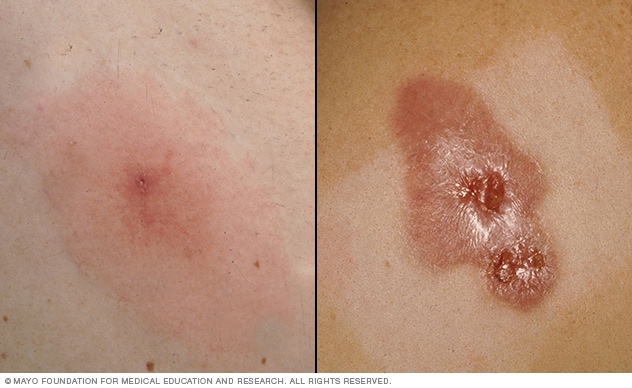
Staphylococcal infection
MRSA infections start as small red bumps that can quickly turn into deep, painful abscesses.
Staph skin infections, including MRSA, generally begin as swollen, painful red bumps that may look like pimples or spider bites. The affected area may be:
- Fühlt sich warm an
- Voll mit Eiter oder anderem Ausfluss
- Begleitet von Fieber
These red bumps can quickly turn into deep, painful boils (abscesses) that require surgical drainage. Sometimes the bacteria remain confined to the skin. But they can also burrow deep into the body, causing potentially life-threatening infections in bones, joints, surgical wounds, bloodstream, heart valves and lungs.
When to go to the doctor?
Watch out for minor skin problems – pimples, insect bites, cuts and scrapes – especially in children. If sores appear infected or are accompanied by fever, see your doctor.
Causes
There are several types of Staphylococcus aureus bacteria, commonly referred to as “staphylococci.” Staphylococci are usually found on the skin or in the nose of about a third of the population. The bacteria are generally harmless unless they enter the body through a cut or other wound, and even then they usually cause only minor skin problems in healthy people.
According to the Centers for Disease Control and Prevention, about 5% of the population chronically carries the type of staph bacteria known as MRSA.
Antibiotic resistance
MRSA is the result of decades of often unnecessary use of antibiotics. Antibiotics have been prescribed for years for colds, flu, and other viral infections that do not respond to these medications. Even when used appropriately, antibiotics contribute to the emergence of drug-resistant bacteria because they do not destroy every germ they target. Bacteria live on an evolutionary fast track, so germs that survive treatment with one antibiotic soon learn to resist others.
Risk factors
Because MRSA strains occur in different settings in the hospital and in the community in general, the risk factors for the two strains differ.
Risk factors for HA-MRSA
- Krankenhausaufenthalt. MRSA bleibt in Krankenhäusern ein Problem, wo es die am stärksten gefährdeten Personen angreifen kann – ältere Erwachsene und Menschen mit geschwächtem Immunsystem.
- Mit einem invasiven medizinischen Gerät. Medizinische Schläuche – wie intravenöse Zugänge oder Blasenkatheter – können einen Weg für MRSA darstellen, um in Ihren Körper zu gelangen.
- Aufenthalt in einer Langzeitpflegeeinrichtung. MRSA ist in Pflegeheimen weit verbreitet. Träger von MRSA haben die Fähigkeit, es zu verbreiten, auch wenn sie selbst nicht krank sind.
Risk factors for CA-MRSA
- Teilnahme an Kontaktsportarten. MRSA kann sich leicht durch Schnitte und Kratzer sowie Haut-zu-Haut-Kontakt ausbreiten.
- Leben in überfüllten oder unhygienischen Bedingungen. MRSA-Ausbrüche sind in Militärausbildungslagern, Kindertagesstätten und Gefängnissen aufgetreten.
- Männer haben Sex mit Männern. Männer, die Sex mit Männern haben, haben ein höheres Risiko, an MRSA-Infektionen zu erkranken.
- HIV-Infektion haben. Menschen mit HIV haben ein höheres Risiko, eine MRSA-Infektion zu entwickeln.
- Verwendung illegal injizierter Drogen. Menschen, die illegal injizierte Drogen konsumieren, haben ein höheres Risiko für MRSA-Infektionen.
Complications
MRSA infections can resist the effects of many common antibiotics, making them more difficult to treat. This can cause infections to spread and sometimes become life-threatening.
MRSA infections can have the following effects:
- Blutkreislauf
- Lunge
- Herz
- Knochen
- Gelenke
prevention
Prevention of HA-MRSA
In the hospital, people infected or colonized with MRSA are often placed in isolation to prevent the spread of MRSA. Visitors and medical staff caring for people in isolation may be required to wear protective clothing.
You must also follow strict hand hygiene procedures. For example, healthcare workers can help prevent HA-MRSA by washing their hands with soap and water or using hand sanitizer before and after each clinical appointment.
Hospital rooms, surfaces and equipment, and laundry items must be properly disinfected and cleaned on a regular basis.
Prevention of CA-MRSA
- Wasche deine Hände. Sorgfältiges Händewaschen bleibt Ihre beste Abwehr gegen Keime. Schrubben Sie die Hände mindestens 20 Sekunden lang kräftig. Tragen Sie eine kleine Flasche Händedesinfektionsmittel mit mindestens 60 % Alkohol für Zeiten, in denen Sie keinen Zugang zu Wasser und Seife haben.
- Wunden bedeckt halten. Halten Sie Schnitte und Kratzer sauber und bedecken Sie sie mit sauberen, trockenen Verbänden, bis sie verheilt sind. Der Eiter von infizierten Wunden kann MRSA enthalten, und das Abdecken von Wunden kann helfen, die Ausbreitung der Bakterien zu verhindern.
- Halten Sie persönliche Gegenstände persönlich. Vermeiden Sie es, persönliche Gegenstände wie Handtücher, Bettwäsche, Rasierer, Kleidung und Sportgeräte zu teilen. MRSA verbreitet sich sowohl auf infizierten Gegenständen als auch durch direkten Kontakt.
- Duschen Sie nach sportlichen Spielen oder Übungen. Duschen Sie sofort nach jedem Spiel oder Training. Verwenden Sie Seife und Wasser. Teilen Sie keine Handtücher.
- Bettwäsche desinfizieren. Wenn Sie einen Schnitt oder eine wunde Stelle haben, waschen Sie Handtücher und Bettwäsche in einer Waschmaschine, die auf die heißeste Wassereinstellung eingestellt ist (wenn möglich mit zugesetztem Bleichmittel), und trocknen Sie sie in einem heißen Trockner. Waschen Sie Sport- und Sportkleidung nach jedem Tragen.
Sources:
- Methicillin-resistenter Staphylococcus aureus (MRSA). Zentren für die Kontrolle und Prävention von Krankheiten. https://www.cdc.gov/mrsa/community/index.html. Abgerufen am 2. November 2020.
- Methicillin-resistenter Staphylococcus aureus (MRSA) bei Erwachsenen: Epidemiologie. https://www.uptodate.com/contents/search. Abgerufen am 2. November 2020.
- Methicillin-resistenter Staphylococcus aureus (MRSA) bei Erwachsenen: Behandlung. https://www.uptodate.com/contents/search. Abgerufen am 2. November 2020.
- Fragen Sie MayoExpert. Methicillin-resistenter Staphylococcus aureus (MRSA). Mayo-Klinik; 2020.
- Methicillin-resistente Staphylococcus-Infektionen (MRSA und MRSE). Elsevier Point of Care. Elsevier; 2020. https://www.clinicalkey.com. Abgerufen am 2. November 2020.
- Ferri FF. Methicillin-resistenter Staphylococcus aureus (MRSA). In: Ferri’s Clinical Advisor 2021. Elsevier; 2021. https://www.clinicalkey.com. Abgerufen am 2. November 2020.
- Harris A. Methicillin-resistenter Staphylococcus aureus (MRSA) bei Erwachsenen: Prävention und Kontrolle. https://www.uptodate.com/contents/search. Abgerufen am 2. November 2020.