

 Suche
Suche
 Mein Konto
Nasal polyps
Nasal polyps
overview
Nasal polyps
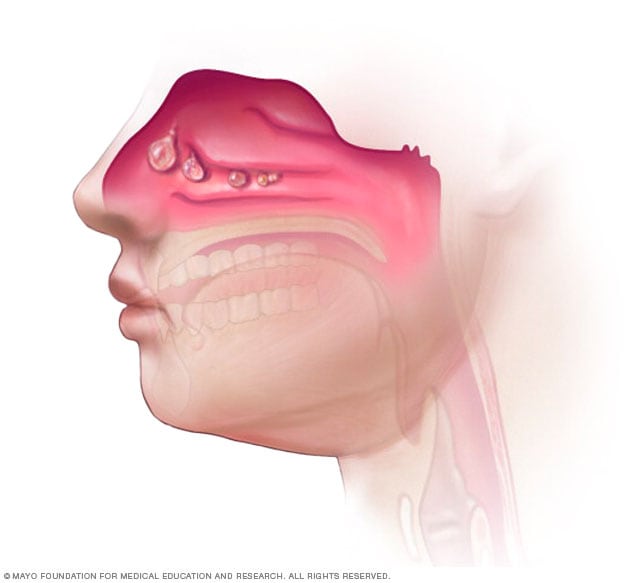
Nasal polyps
Nasal polyps are soft, benign growths on the nasal lining or sinuses. They often appear in groups, like bunches of grapes on a stem.
Nasal polyps are soft, painless, benign growths on the lining of your nasal passages or sinuses. They hang down like tears or grapes. They result from chronic inflammation and are associated with asthma, recurrent infections, allergies, drug sensitivity or certain immune disorders.
Small nasal polyps may not cause any symptoms. Larger growths or groups of nasal polyps can block your nasal passages or cause breathing problems, a lost sense of smell, and frequent infections.
Nasal polyps can affect anyone, but they are more common in adults. Medication can often shrink or eliminate nasal polyps, but surgery is sometimes required to remove them. Even after successful treatment, nasal polyps often return.
Symptoms
Nasal polyps are associated with irritation and swelling (inflammation) of the lining of your nasal passages and sinuses that lasts longer than 12 weeks (chronic sinusitis).
However, it is possible to have chronic sinusitis without nasal polyps.
Nasal polyps themselves are soft and numb. So if they are small, you may not know you have them. Multiple growths or a large polyp can block your nasal passages and sinuses.
Common signs and symptoms of chronic sinusitis with nasal polyps include:
- Eine laufende Nase
- Anhaltende Verstopfung
- Postnasaler Tropf
- Verminderter oder fehlender Geruchssinn
- Verlust des Geschmackssinns
- Gesichtsschmerzen oder Kopfschmerzen
- Schmerzen in den oberen Zähnen
- Ein Druckgefühl auf Stirn und Gesicht
- Schnarchen
- Häufiges Nasenbluten
When to go to the doctor?
See your doctorif your symptoms last longer than 10 days. The symptoms of chronic sinusitis and nasal polyps are similar to those of many other diseases, including the common cold.
Seek immediate medical attention or call 911or your local emergency number if you experience:
- Schwere Atembeschwerden
- Plötzliche Verschlechterung Ihrer Symptome
- Doppeltsehen, eingeschränktes Sehvermögen oder eingeschränkte Fähigkeit, Ihre Augen zu bewegen
- Starke Schwellung um die Augen
- Zunehmend starke Kopfschmerzen, begleitet von hohem Fieber oder der Unfähigkeit, den Kopf nach vorne zu neigen
Causes
Scientists do not yet fully understand what causes nasal polyps, why some people develop long-term inflammation, or why irritation and swelling (inflammation) cause polyps to form in some people and not others. The swelling occurs in the fluid-producing lining (mucous membrane) of your nose and sinuses.
There is evidence that people who develop polyps have different immune system responses and different chemical markers in their mucous membranes than those who do not develop polyps.
Nasal polyps can form at any age, but they are most common in young and middle-aged adults.
Nasal polyps can form anywhere in your sinuses or nasal passages, but they most commonly appear in an area where sinuses near your eyes, nose, and cheekbones drain through winding passages into your nose.
Risk factors
Any condition that causes long-term irritation and swelling (inflammation) in your nasal passages or sinuses, such as infections or allergies, can increase your risk of developing nasal polyps.
Conditions commonly associated with nasal polyps include:
- Asthma, eine Krankheit, bei der die Atemwege anschwellen (entzünden) und sich verengen
- Aspirin-Empfindlichkeit
- Allergische Pilz-Sinusitis, eine Allergie gegen luftübertragene Pilze
- Mukoviszidose, eine genetische Störung, die zu ungewöhnlich dicken, klebrigen Flüssigkeiten im Körper führt, einschließlich dickem Schleim aus Nasen- und Nebenhöhlenschleimhaut
- Churg-Strauss-Syndrom (eosinophile Granulomatose mit Polyangiitis), eine seltene Krankheit, die eine Entzündung der Blutgefäße verursacht
- Mangel an Vitamin D, was auftritt, wenn Ihr Körper nicht genug Vitamin D hat
Your family history can also play a role. There is some evidence that certain genetic variations linked to immune system function make you more likely to develop nasal polyps.
Complications
Nasal polyps can cause complications because they block normal airflow and fluid drainage and also because of the long-term irritation and swelling (inflammation) that underlies their development.
Possible complications are:
- Obstruktive Schlafapnoe. Dies ist eine potenziell schwerwiegende Erkrankung, bei der Sie während des Schlafs häufig aufhören und anfangen zu atmen.
- Asthma-Schübe. Chronische Sinusitis kann Asthma verschlimmern.
- Nebenhöhleninfektion. Nasenpolypen können Sie anfälliger für häufig wiederkehrende Infektionen der Nasennebenhöhlen machen.
prevention
The following strategies can help reduce your chances of developing nasal polyps or nasal polyps recurrence after treatment:
- Umgang mit Allergien und Asthma. Befolgen Sie die Behandlungsempfehlungen Ihres Arztes. Wenn Ihre Symptome nicht gut unter Kontrolle sind, sprechen Sie mit Ihrem Arzt über eine Änderung Ihres Behandlungsplans.
- Vermeiden Sie nasale Reizstoffe. Vermeiden Sie so weit wie möglich das Einatmen von Substanzen in der Luft, die wahrscheinlich zu Schwellungen oder Reizungen in Nase und Nebenhöhlen beitragen, wie z. B. Allergene, Tabakrauch, chemische Dämpfe sowie Staub und feine Ablagerungen.
- Praktiziere gute Hygiene. Waschen Sie sich regelmäßig und gründlich die Hände. Dies ist eine der besten Möglichkeiten, sich vor bakteriellen und viralen Infektionen zu schützen, die eine Entzündung der Nasenwege und Nebenhöhlen verursachen können.
- Befeuchten Sie Ihr Zuhause. Die Verwendung eines Luftbefeuchters kann helfen, Ihre Atemwege zu befeuchten, den Schleimfluss aus Ihren Nebenhöhlen zu verbessern und Verstopfungen und Entzündungen vorzubeugen. Reinigen Sie den Luftbefeuchter täglich, um das Wachstum von Bakterien zu verhindern.
-
Use nasal irrigation.Use a salt water spray (saline solution) or nasal rinse to flush your nasal passages. This can improve mucus flow and remove allergens and other irritants.
You can purchase over-the-counter saline sprays or nasal irrigation kits with devices such as a neti pot or squeeze bottle to administer a rinse.
To prepare the rinse solution, use distilled, sterile water that has been boiled and cooled for one minute or filtered with a filter with an absolute pore size of 1 micron or less. After each use, rinse the irrigation device with distilled, sterile, previously boiled or filtered water and allow it to air dry openly.
Sources:
- Zitelli BJ, et al., Hrsg. HNO-Heilkunde. In: Atlas of Pediatric Physical Diagnosis von Zitelli und Davis. 7. Aufl. Philadelphia, Pennsylvania: Elsevier; 2018. https://www.clinicalkey.com. Abgerufen am 27. Februar 2019.
- Mason RJ, et al. Erkrankungen der oberen Atemwege. In: Murray und Nadels Textbook of Respiratory Medicine. 6. Aufl. Philadelphia, Pennsylvania: Saunders Elsevier; 2016. https://www.clinicalkey.com. Abgerufen am 27. Februar 2019.
- Goldman L. et al., Hrsg. Umgang mit Patienten mit Erkrankungen der Nase, Nebenhöhlen und Ohren. In: Goldman-Cecil Medicine. 25. Aufl. Philadelphia, Pennsylvania: Saunders Elsevier; 2016. https://www.clinicalkey.com. Abgerufen am 27. Februar 2019.
- Nasenpolypen. Amerikanische Akademie für Allergie, Asthma und Immunologie. https://www.aaaai.org/conditions-and-treatments/library/allergy-library/nasal-polyps. Abgerufen am 27. Februar 2019.
- Lou H., et al. Höhepunkte der eosinophilen chronischen Rhinosinusitis mit Nasenpolypen in Definition, Prognose und Verlauf. Internationales Forum für Allergie & Rhinologie. 2018;8:1218.
- Bhattacharyya N. Klinische Präsentation, Diagnose und Behandlung von nasaler Obstruktion. https://www.uptodate.com/contents/search. Abgerufen am 27. Februar 2019.
- Hamilos DL. Chronische Rhinosinusitis: Management. https://www.uptodate.com/contents/search. Abgerufen am 27. Februar 2019.
- Jankowski R. et al. Nasenpolyposis (oder chronische olfaktorische Rhinitis). European Annals of Otorhinolaryngology, Head and Neck Diseases. 2018;135:191.
- Sedaghat AR. Chronische Rhinosinusitis. Amerikanischer Hausarzt. 2017;96:500.
- Nasennebenhöhlenentzündung (Sinusitis). Zentren für die Kontrolle und Prävention von Krankheiten. https://www.cdc.gov/antibiotic-use/community/for-patients/common-illnesses/sinus-infection.html. Abgerufen am 4. März 2019.
- König TE. Klinische Merkmale und Diagnose einer eosinophilen Granulomatose mit Polyangiitis (Churg-Strauss). https://www.uptodate.com/contents/search. Abgerufen am 6. März 2019.
- Sichere rituelle Nasenspülung. Zentren für die Kontrolle und Prävention von Krankheiten. https://www.cdc.gov/parasites/naegleria/ritual-ablution.html. Abgerufen am 6. März 2019.
- Lavigne P. et al. Immunmodulatoren bei chronischer Rhinosinusitis. World Journal of Otorhinolaryngology-Head and Neck Surgery. 2018;4:186.
- Bachert C, et al. Biotherapeutika bei chronischer Rhinosinusitis mit und ohne Nasenpolypen. Zeitschrift für Allergie und klinische Immunologie: In der Praxis. 2017;5:1512.
- Hamilos DL, et al. Chronische Rhinosinusitis: Klinische Manifestationen, Pathophysiologie und Diagnose. https://www.uptodate.com/contents/search. Abgerufen am 11. März 2019.
- Schweißtest. Mukoviszidose-Stiftung. https://www.cff.org/What-is-CF/Testing/Sweat-Test/. Abgerufen am 11. März 2019.
- Fragen Sie MayoExpert. Chronische Rhinosinusitis. Rochester, Minnesota: Mayo Foundation for Medical Education and Research; 2018.
- Stokes PJ, et al. Die Beziehung zwischen Serum-Vitamin D und chronischer Rhinosinusitis: Eine systematische Überprüfung. Amerikanisches Journal für Rhinologie und Allergie. 2016;30:23.
- Aspirin-exazerbierte Atemwegserkrankung (AERD). Amerikanische Akademie für Allergie, Asthma und Immunologie. https://www.aaaai.org/conditions-and-treatments/library/asthma-library/aspirin-exacerbated-respiratory-disease. Abgerufen am 18. März 2019.
- FDA genehmigt erste Behandlung für chronische Rhinosinusitis mit Nasenpolypen. US Food and Drug Administration. https://www.fda.gov/news-events/press-announcements/fda-approves-first-treatment-chronic-rhinosinusitis-nasal-polyps. Abgerufen am 3. Juli 2019.