

 Suche
Suche
 Mein Konto
Nasopharyngeal carcinoma
Nasopharyngeal carcinoma
overview
Parts of the throat (pharynx)
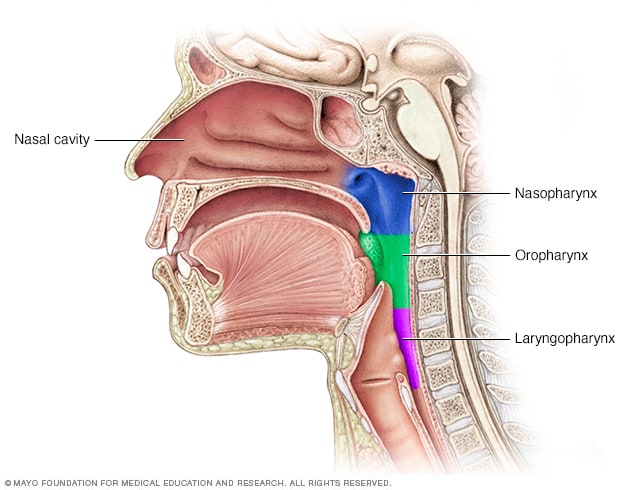
Parts of the throat (pharynx)
The throat (pharynx) is a muscular tube that runs from the bridge of the nose to the throat. It consists of three sections: nasopharynx, oropharynx and laryngopharynx, which is also called the hypopharynx.
Nasopharyngeal cancer (nay-zoh-fuh-RIN-jee-ul) is cancer that occurs in the nasopharynx, which is located behind your nose and above your throat.
Nasopharyngeal carcinoma is rare in the United States. It is much more common in other parts of the world – particularly Southeast Asia.
Nasopharyngeal carcinoma is difficult to detect early. This is likely because the nasopharynx is not easy to examine and the symptoms of nasopharyngeal cancer mimic those of other, more common diseases.
Treatment for nasopharyngeal cancer usually includes radiation therapy, chemotherapy, or a combination of both. You can work with your doctor to determine the exact approach depending on your specific situation.
Symptoms
In its early stages, nasopharyngeal carcinoma may not cause any symptoms. Possible noticeable symptoms of nasopharyngeal carcinoma include:
- Ein Knoten im Nacken, der durch einen geschwollenen Lymphknoten verursacht wird
- Blut im Speichel
- Blutiger Ausfluss aus der Nase
- Verstopfte Nase oder Klingeln in den Ohren
- Schwerhörigkeit
- Häufige Ohrinfektionen
- Halsschmerzen
- Kopfschmerzen
When to go to the doctor?
Early symptoms of nasopharyngeal cancer may not always prompt you to see your doctor. However, if you notice unusual and persistent changes in your body that don't seem right, such as: If you have an unusually stuffy nose, see your doctor.
Causes
Cancer begins when one or more genetic mutations cause normal cells to grow uncontrollably, invade surrounding structures, and ultimately spread to other parts of the body (metastasize). In nasopharyngeal carcinomas, this process begins in the squamous epithelial cells that line the surface of the nasopharynx.
What exactly causes the gene mutations that lead to nasopharyngeal carcinoma is not known, although factors such as Epstein-Barr virus have been identified that increase the risk of this cancer. However, it is not clear why some people with all risk factors never develop cancer while others without obvious risk factors do.
Risk factors
Researchers have identified some factors that appear to increase the risk of developing nasopharyngeal carcinoma, including:
- Sex. Das Nasopharynxkarzinom tritt bei Männern häufiger auf als bei Frauen.
- Wettrennen. Diese Art von Krebs betrifft häufiger Menschen in Teilen Chinas, Südostasiens und Nordafrikas. In den Vereinigten Staaten haben asiatische Einwanderer ein höheres Risiko für diese Art von Krebs als in Amerika geborene Asiaten. Inuit in Alaska haben auch ein erhöhtes Risiko für Nasen-Rachen-Krebs.
- Das Alter. Nasopharynxkrebs kann in jedem Alter auftreten, wird aber am häufigsten bei Erwachsenen im Alter zwischen 30 und 50 Jahren diagnostiziert.
- Gesalzene Lebensmittel. Chemikalien, die beim Kochen von gepökelten Lebensmitteln wie Fisch und konserviertem Gemüse im Dampf freigesetzt werden, können in die Nasenhöhle gelangen und das Risiko eines Nasopharynxkarzinoms erhöhen. Die Exposition gegenüber diesen Chemikalien in einem frühen Alter kann das Risiko noch weiter erhöhen.
- Epstein Barr Virus. Dieses häufige Virus verursacht normalerweise leichte Anzeichen und Symptome, wie z. B. die einer Erkältung. Manchmal kann es zu einer infektiösen Mononukleose kommen. Das Epstein-Barr-Virus wird auch mit mehreren seltenen Krebsarten, einschließlich Nasopharynxkarzinom, in Verbindung gebracht.
- Familiengeschichte. Ein Familienmitglied mit Nasopharynxkarzinom erhöht das Erkrankungsrisiko.
- Alkohol und Tabak. Starker Alkoholkonsum und Tabakkonsum können das Risiko für die Entwicklung eines Nasopharynxkarzinoms erhöhen.
Complications
Complications of nasopharyngeal carcinoma may include:
- Krebs, der wächst, um in nahe gelegene Strukturen einzudringen. Fortgeschrittenes Nasopharynxkarzinom kann Komplikationen verursachen, wenn es groß genug wird, um in benachbarte Strukturen wie Rachen, Knochen und Gehirn einzudringen.
-
Cancer that spreads to other areas of the body.Nasopharyngeal carcinoma often spreads (metastasizes) beyond the nasopharynx.
Most people with nasopharyngeal cancer have regional metastases. This means that cancer cells have migrated from the original tumor to nearby areas, such as: B. Lymph nodes in the neck.
Cancer cells that spread to other areas of the body (distant metastases) most often migrate to the bones, lungs, and liver.
prevention
There is no sure way to prevent nasopharyngeal carcinoma. However, if you are concerned about your risk of nasopharyngeal cancer, you may consider avoiding habits that have been linked to the disease. For example, you may choose to reduce the amount of salted foods you eat or avoid these foods altogether.
Tests to screen for nasopharyngeal cancer
Routine screening for nasopharyngeal carcinoma is not performed in the United States and other areas where the disease is rare.
But in areas of the world where nasopharyngeal cancer is much more common - for example, some areas of China - doctors may offer screenings to people thought to be at high risk for the disease. Screening may include blood tests to detect Epstein-Barr virus.
Sources:
- Flint PW, et al. Gutartige und bösartige Tumoren des Nasopharynx. In: Cummings HNO-Heilkunde: Kopf- und Halschirurgie. 6. Aufl. Philadelphia, Pennsylvania: Saunders Elsevier; 2015. https://www.clinicalkey.com. Abgerufen am 8. Juli 2018.
- Kopf-Hals-Krebs. Fort Washington, Pa.: Nationales umfassendes Krebsnetzwerk. http://www.nccn.org/professionals/physician_gls/f_guidelines.asp. Abgerufen am 2. April 2018.
- Nasen-Rachen-Krebs-Behandlung (PDQ). Nationales Krebs Institut. https://www.cancer.gov/types/head-and-neck/hp/adult/nasopharyngeal-treatment-pdq. Abgerufen am 8. Juli 2018.
- Nasen-Rachen-Krebs: Behandlungsmöglichkeiten. Krebs.Net. https://www.cancer.net/cancer-types/nasopharyngeal-cancer/treatment-options. Abgerufen am 8. Juli 2018.
- Hui EP, et al. Epidemiologie, Ätiologie und Diagnose des Nasopharynxkarzinoms. https://www.uptodate.com/contents/search. Abgerufen am 8. Juli 2018.
- Fragen Sie MayoExpert. Nasopharynxkarzinom, Typ I bis III: Diagnose bis Erstbehandlung (Erwachsener). Rochester, Minnesota: Mayo Foundation for Medical Education and Research; 2017.
- Hui EP, et al. Therapie des frühen lokoregional fortgeschrittenen Nasopharynxkarzinoms. https://www.uptodate.com/contents/search. Abgerufen am 8. Juli 2018.
- Mundtrockenheit oder Xerostomie. Krebs.Net. https://www.cancer.net/navigating-cancer-care/side-effects/dry-mouth-or-xerostomia. Abgerufen am 8. Juli 2018.