

 Suche
Suche
 Mein Konto
Kidney cysts
Kidney cysts
overview
Kidney cyst
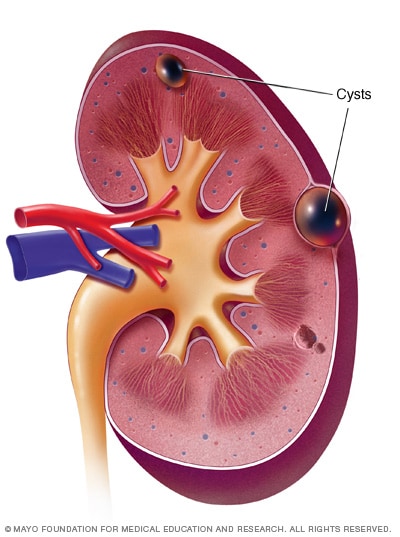
Kidney cyst
A kidney cyst is a round or oval fluid-filled sac with a well-defined outline. Kidney cysts typically grow on the surface of a kidney. Some may develop in the kidney.
Kidney cysts are round bags of fluid that form on or in the kidneys. Kidney cysts can occur in conditions that can affect kidney function. But more commonly, kidney cysts are a type called simple kidney cysts. Simple kidney cysts are not cancer and rarely cause problems.
It's not clear what causes simple kidney cysts. Often a cyst appears on the surface of a kidney. But more than one cyst can occur on one or both kidneys. Simple kidney cysts are not the same as cysts that form in polycystic kidney disease. Simple cysts are also different from complex cysts. Complex cysts need to be monitored for changes that could be cancerous.
Simple kidney cysts are often found during an imaging test for another condition. Treatment is usually not necessary unless simple cysts cause symptoms.
Symptoms
Simple kidney cysts usually cause no symptoms. But if a simple kidney cyst becomes large enough, symptoms can include:
- Dumpfer Schmerz im Rücken oder in der Seite
- Fieber
- Oberbauchschmerzen
When to go to the doctor?
Make an appointment with your doctor if you have symptoms of a kidney cyst.
Causes
It's not clear what causes simple kidney cysts. One theory is that kidney cysts develop when the surface layer of the kidney weakens and forms a pouch. The sac then fills with fluid, sloughs off, and develops into a cyst.
Risk factors
The risk of having simple kidney cysts increases with age. But they can occur at any age. Simple kidney cysts are more common in men.
Complications
Kidney cysts can sometimes lead to complications including:
- Eine infizierte Zyste. Eine Nierenzyste kann sich infizieren und Fieber und Schmerzen verursachen.
- Eine geplatzte Zyste. Eine platzende Nierenzyste verursacht starke Rücken- oder Seitenschmerzen. Manchmal kann eine geplatzte Zyste Blut im Urin verursachen.
- Blockierter Urinfluss. Eine Nierenzyste, die den typischen Urinfluss blockiert, kann zu einer Nierenschwellung führen.
Sources:
- Kruskal JB, et al. Einfache und komplexe Nierenzysten bei Erwachsenen. https://www.uptodate.com/contents/search. Abgerufen am 7. April 2022.
- Partin AW, et al., Hrsg. Gutartige Nierentumore. In: Campbell-Walsh-Wein-Urologie. 12. Aufl. Elsevier; 2021. https://www.clinicalkey.com. Abgerufen am 7. April 2022.
- Einfache Nierenzysten. Nationales Institut für Diabetes und Verdauungs- und Nierenerkrankungen. https://www.niddk.nih.gov/health-information/kidney-disease/simple-kidney-cysts. Abgerufen am 7. April 2022.
- Maugeri A, et al. Vergleich der Aspiration mit Sklerotherapie und laparoskopischer Deroofing zur Behandlung von symptomatischen einfachen Nierenzysten: Eine systematische Überprüfung und Meta-Analyse. Updates in der Chirurgie. 2021; doi:10.1007/s13304-021-01042-2.
- Fragen Sie MayoExpert. Nierenzysten (Erwachsener). Mayo-Klinik; 2021.
- Einfache Nierenzysten. Nationale Nierenstiftung. https://www.kidney.org/atoz/content/Simple-Kidney-Cysts. Abgerufen am 7. April 2022.
- Kellermann RD, et al. Bösartige Tumoren des Urogenitaltraktes. In: Conn’s Current Therapy 2022. Elsevier; 2022. https://www.clinicalkey.com. Abgerufen am 7. April 2022.
- Feehally J, et al., Hrsg. Andere zystische Nierenerkrankungen. In: Umfassende klinische Nephrologie. 6. Aufl. Elsevier; 2019. https://www.clinicalkey.com. Abgerufen am 12. April 2022.