

 Suche
Suche
 Mein Konto
Pheochromocytoma
Pheochromocytoma
overview
Pheochromocytoma and irregular blood pressure
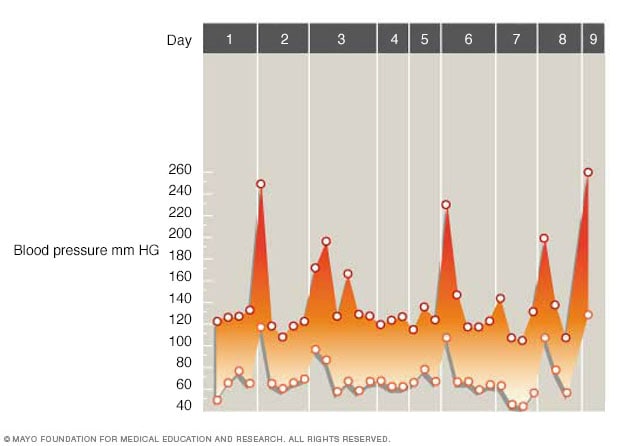
Pheochromocytoma and irregular blood pressure
A pheochromocytoma can cause wild blood pressure fluctuations between attacks when blood pressure is normal. This can make the condition difficult to recognize. The graph shows a nine-day period of short, irregular spikes in blood pressure due to pheochromocytoma. The bottom dots represent the bottom number of the reading (diastolic pressure). The higher points show the highest number of the reading (systolic pressure). For example, the first increase in blood pressure is observed on the second day with a reading of 250/110 millimeters of mercury.
A pheochromocytoma (fee-o-kroe-moe-sy-TOE-muh) is a rare, usually benign (benign) tumor that develops in an adrenal gland. You have two adrenal glands – one is located at the top of each kidney. The adrenal glands are part of the body's hormone-producing (endocrine) system. The endocrine system also includes the pituitary gland, thyroid, parathyroid glands, pancreas, ovaries (in women), and testes (in men).
A pheochromocytoma usually only develops in one adrenal gland. But tumors can develop in both.
If you have a pheochromocytoma, the tumor releases hormones that can cause high blood pressure, headaches, sweating, and panic attack symptoms. If pheochromocytoma is not treated, serious or life-threatening damage to other body systems can result.
Surgery to remove a pheochromocytoma usually results in normalization of blood pressure.
Symptoms
Signs and symptoms of pheochromocytomas often include:
- Hoher Blutdruck
- Kopfschmerzen
- Starkes Schwitzen
- Schneller Herzschlag
- Zittern
- Blässe
- Kurzatmigkeit
- Panikattackenartige Symptome
Less common signs or symptoms may include:
- Angst oder Untergangsgefühl
- Verschwommenes Sehen
- Verstopfung
- Gewichtsverlust
Symptomatic spells
Symptoms of pheochromocytoma may be constant or may occur occasionally or become more severe. These spells can occur due to activities or conditions, foods high in a substance that affects blood pressure (tyramine), and medications.
Certain Activities or Conditionscan worsen symptoms such as:
- Körperliche Schwerstarbeit
- Angst oder Stress
- Veränderungen der Körperhaltung, wie z. B. Wechsel vom Sitzen oder Liegen zum Stehen
- Arbeit und Lieferung
- Operation und ein Medikament, das Sie während der Operation in einen schlafähnlichen Zustand versetzt (Anästhesie)
foods high in tyramine,a substance that affects blood pressure can also worsen symptoms. Tyramine is often found in foods that are fermented, aged, pickled, cured, overripe, or spoiled. These foods include:
- Einige Käse
- Einige Biere und Weine
- Schokolade
- Getrocknetes oder geräuchertes Fleisch
Certain medicationsSymptoms that may make symptoms worse include:
- Monoaminoxidase-Hemmer (MAO-Hemmer) wie Phenelzine (Nardil), Tranylcypromine (Parnate) und Isocarboxazid (Marplan)
- Stimulanzien wie Amphetamine oder Kokain
When to go to the doctor?
Although high blood pressure is a primary sign of pheochromocytoma, most people with high blood pressure do not have an adrenal tumor. Talk to your doctor if any of these apply to you:
- Schwierigkeiten bei der Kontrolle des Bluthochdrucks mit der derzeitigen Behandlung
- Zauber von Verschlechterung des Bluthochdrucks
- Eine Familiengeschichte des Phäochromozytoms
- Eine Familiengeschichte einer verwandten genetischen Störung: Multiple endokrine Neoplasie, Typ 2 (MEN 2), von Hippel-Lindau-Krankheit, hereditäre Paragangliom-Syndrome oder Neurofibromatose 1
Causes
Endocrine system
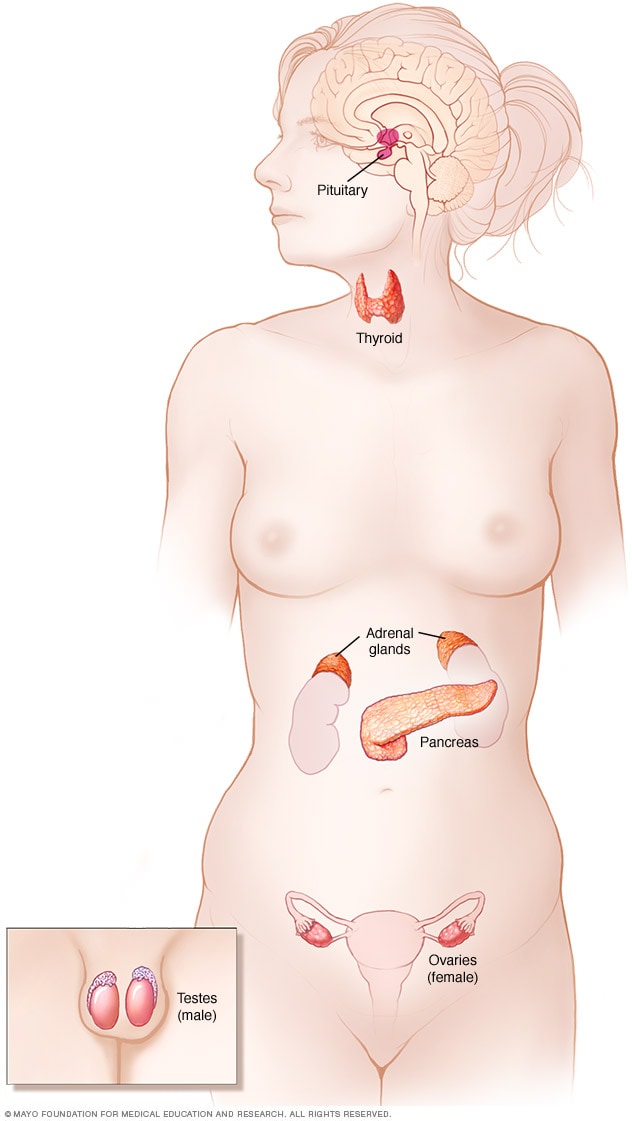
Endocrine system
The endocrine system includes the pituitary gland, thyroid, parathyroid glands, adrenal glands, pancreas, ovaries, and testes.
Researchers don't know exactly what causes pheochromocytoma. The tumor develops in specialized cells called chromaffin cells, which are located in the center of an adrenal gland. These cells release certain hormones, especially adrenaline (epinephrine) and noradrenaline (norepinephrine). These hormones help control many body functions such as heart rate, blood pressure and blood sugar.
Adrenaline and norepinephrine trigger the body's fight-or-flight response to a perceived threat. The hormones cause blood pressure to rise and the heart to beat faster. You prepare other body systems that allow you to respond quickly. A pheochromocytoma causes more of these hormones to be released, and it causes them to be released when you are not in a threatening situation.
Most chromaffin cells are located in the adrenal glands. But there are also small accumulations of these cells in the heart, head, neck, bladder, back wall of the stomach (abdomen) and along the spine. Chromaffin cell tumors outside the adrenal glands are called paragangliomas. They can have the same effects on the body as a pheochromocytoma.
Risk factors
Multiple endocrine neoplasia, type 2B (MEN 2B)
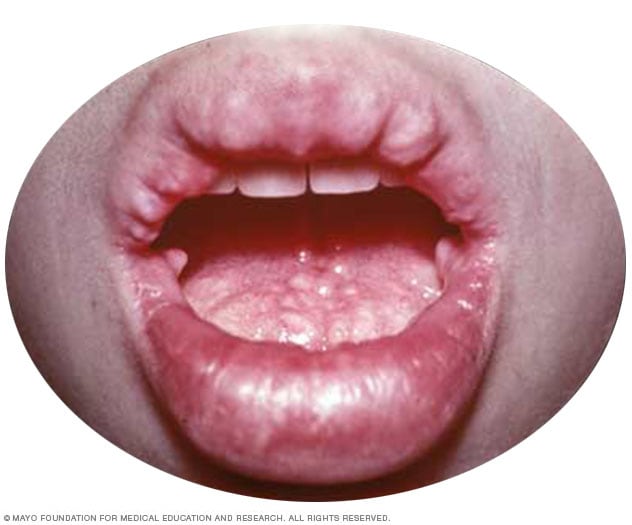
Multiple endocrine neoplasia, type 2B (MEN 2B)
Pheochromocytoma can occur in the inherited syndrome multiple endocrine neoplasia, type 2B (MEN 2B). In addition to pheochromocytoma, people with MEN 2B suffer from medullary thyroid cancer and tumors of the nerves in the lips, mouth, eyes, and digestive tract.
Most pheochromocytomas are discovered in people between the ages of 20 and 50. However, the tumor can develop at any age.
People with certain rare inherited diseases are at increased risk of pheochromocytoma or paraganglioma. Tumors associated with these disorders are more likely to be cancerous. Tumors are also more likely to occur in both adrenal glands. These genetic conditions include:
- Multiple endokrine Neoplasie, Typ 2 (MEN 2) ist eine Erkrankung, die zu Tumoren in mehr als einem Teil des endokrinen Systems führt. Es gibt zwei Arten von MEN, Typ 2A und Typ 2B, die beide Phäochromozytome beinhalten. Andere mit dieser Erkrankung verbundene Tumore können an anderen Körperteilen auftreten, einschließlich der Schilddrüse, der Nebenschilddrüse, der Lippen, der Zunge und des Verdauungssystems.
- Von-Hippel-Lindau-Krankheit kann Tumore an vielen Stellen verursachen, einschließlich des zentralen Nervensystems, des endokrinen Systems, der Bauchspeicheldrüse und der Nieren.
- Neurofibromatose 1 verursacht viele Tumore in der Haut (Neurofibrome), pigmentierte Hautflecken und Tumoren des Sehnervs.
- Hereditäre Paragangliom-Syndrome sind Erbkrankheiten, die entweder zu Phäochromozytomen oder Paragangliomen führen.
Complications
High blood pressure can damage organs, especially tissues of the heart and blood vessel system (cardiovascular system), brain and kidneys. This damage can cause several critical conditions including:
- Herzkrankheit
- Streicheln
- Nierenversagen
- Probleme mit den Augennerven
Cancerous tumors
Rarely, pheochromocytoma is cancerous and the cancer cells spread to other parts of the body. Cancer cells from a pheochromocytoma or paraganglioma most often migrate to the lymphatic system, bones, liver, or lungs.
Sources:
- Phäochromozytom. Merck Manual Professional-Version. https://www.merckmanuals.com/professional/endocrine-and-metabolic-disorders/adrenal-disorders/pheochromocytoma. Abgerufen am 15. Dezember 2021.
- Hansen JT. Abdomen. In: Netter’s Clinical Anatomy. 4. Aufl. Elsevier; 2019. https://www.clinicalkey.com. Abgerufen am 12. Januar 2020.
- El-Doueihi RZ, et al. Bilaterales biochemisch stilles Phäochromozytom, doch nicht still. Urologische Fallberichte. 2019; doi:10.1016/j.eucr.2019.100876.
- Junge WF. Klinisches Bild und Diagnose des Phäochromozytoms. https://www.uptodate.com/contents/search. Abgerufen am 15. Dezember 2021.
- Sbardella E. et al. Phäochromozytom: Ein Ansatz zur Diagnose. Best Practice & Research Klinische Endokrinologie & Stoffwechsel. 2019; doi:10.1016/j.beem.2019.101346.
- Neumann HPH, et al. Phäochromozytom und Paragangliom. New England Journal of Medicine. 2019; doi:10.1056/NEJMra1806651.
- Andersen G. et al. Nahrungsquellen und biomolekulare Ziele von Tyramin. Ernährungsbewertungen. 2018; doi:10.1093/nutrit/nuy036.
- Überblick über die Nebennierenfunktion. Merck Manual Professional-Version. https://www.merckmanuals.com/professional/endocrine-and-metabolic-disorders/adrenal-disorders/overview-of-adrenal-function. Abgerufen am 15. Dezember 2021.
- Kreditgeber JWM, et al. Phäochromozytom und Paragangliom: Eine Richtlinie für die klinische Praxis der Endocrine Society. Zeitschrift für klinische Endokrinologie und Stoffwechsel. 2014; doi:10.1210/jc.2014-1498.
- Crawford MH, Hrsg. Systemische Hypertonie. In: Aktuelle Diagnose & Behandlung: Kardiologie. 5. Aufl. McGraw-Hill-Bildung; 2017. https://accessmedicine.mhmedical.com. Abgerufen am 12. Januar 2020.
- Fragen Sie MayoExpert. Phäochromozytom. Mayo-Klinik; 2020.
- Young WF, et al. Behandlung des Phäochromozytoms bei Erwachsenen. https://www.uptodate.com/contents/search. Abgerufen am 15. Dezember 2021.
- Fragen Sie MayoExpert. Neuroendokrine (karzinoide) Tumore (Erwachsene). Mayo-Klinik; 2020.
- Phäochromozytom. Nationales Krebsinstitut Zentrum für Krebsforschung. https://www.cancer.gov/pediatric-adult-rare-tumor/rare-tumors/rare-endocrine-tumor/pheochromocytoma. Abgerufen am 15. Dezember 2021.
- Fragen Sie MayoExpert. Multiple endokrine Neoplasie Typ 2. Mayo Clinic; 2021.
- Arten von Blutdruckmedikamenten. American Heart Association. https://www.heart.org/en/health-topics/high-blood-pressure/changes-you-can-make-to-manage-high-blood-pressure/types-of-blood-pressure-medications. Abgerufen am 16. Dezember 2021.
- Kearns AE (Gutachten). Mayo-Klinik. 20. Dezember 2021.