

 Suche
Suche
 Mein Konto
Prostate cancer
Prostate cancer
overview
Prostate cancer
Prostate cancer
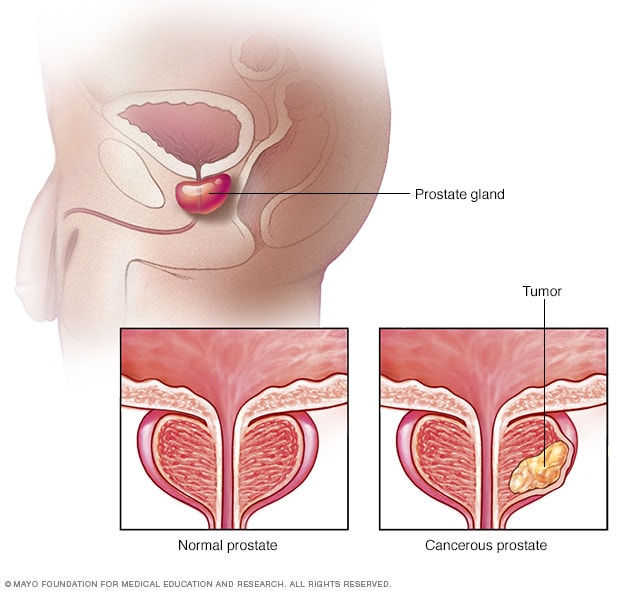
Prostate cancer occurs in the prostate gland, which in men is located just below the bladder and surrounds the upper part of the tube that drains urine from the bladder (urethra). This illustration shows a normal prostate and a prostate with a tumor.
Prostate cancer is cancer that occurs in the prostate. The prostate is a small walnut-shaped gland in men that produces seminal fluid, nourishes and transports sperm.
Prostate cancer is one of the most common types of cancer. Many prostate cancers grow slowly and are confined to the prostate gland, where they may not cause serious damage. However, while some types of prostate cancer grow slowly and require minimal or no treatment, other types are aggressive and can spread quickly.
Prostate cancer that is detected early - when it is still confined to the prostate gland - has the best chance of successful treatment.
Symptoms
Prostate cancer may not cause any signs or symptoms in its early stages.
Prostate cancer that is more advanced may cause signs and symptoms such as:
- Probleme beim Wasserlassen
- Verringerte Kraft im Urinstrahl
- Blut im Urin
- Blut im Sperma
- Knochenschmerzen
- Abnehmen ohne es zu versuchen
- Erektile Dysfunktion
When to go to the doctor?
Make an appointment with your doctor if you have persistent signs or symptoms that worry you.
Causes
prostate gland
prostate gland
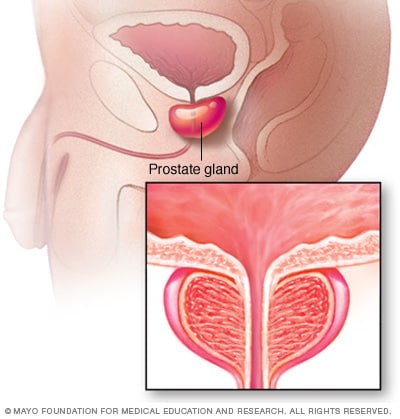
The prostate is located just below the bladder in men and surrounds the upper part of the tube that drains urine from the bladder (urethra). The primary function of the prostate is to produce the fluid that nourishes and transports sperm (seminal fluid).
It's not clear what causes prostate cancer.
Doctors know that prostate cancer begins when cells in the prostate develop changes in their DNA. A cell's DNA contains the instructions that tell a cell what to do. The changes tell the cells to grow and divide faster than normal cells. The abnormal cells continue to live when other cells would die.
The abnormal cells that accumulate form a tumor that can grow to invade nearby tissue. Over time, some abnormal cells may break off and spread (metastasize) to other parts of the body.
Risk factors
Factors that may increase your risk of prostate cancer include:
- Älteres Alter. Ihr Risiko für Prostatakrebs steigt mit zunehmendem Alter. Es ist am häufigsten nach dem 50.
- Wettrennen. Aus noch nicht geklärten Gründen haben Schwarze ein höheres Prostatakrebsrisiko als Menschen anderer Rassen. Bei Menschen mit schwarzer Hautfarbe ist Prostatakrebs auch eher aggressiv oder fortgeschritten.
- Familiengeschichte. Wenn bei einem Blutsverwandten, wie einem Elternteil, Geschwister oder Kind, Prostatakrebs diagnostiziert wurde, kann Ihr Risiko erhöht sein. Auch wenn Sie eine Familienanamnese mit Genen haben, die das Brustkrebsrisiko erhöhen (BRCA1 oder BRCA2) oder eine sehr starke Familienanamnese mit Brustkrebs, kann Ihr Prostatakrebsrisiko höher sein.
- Fettleibigkeit. Übergewichtige Menschen haben möglicherweise ein höheres Prostatakrebsrisiko als Menschen mit gesundem Gewicht, obwohl Studien zu gemischten Ergebnissen geführt haben. Bei fettleibigen Menschen ist der Krebs mit größerer Wahrscheinlichkeit aggressiver und kehrt nach der Erstbehandlung mit größerer Wahrscheinlichkeit zurück.
Complications
Complications of prostate cancer and its treatments include:
- Krebs, der sich ausbreitet (metastasiert). Prostatakrebs kann sich auf nahegelegene Organe wie Ihre Blase ausbreiten oder durch Ihren Blutkreislauf oder Ihr Lymphsystem zu Ihren Knochen oder anderen Organen wandern. Prostatakrebs, der sich auf die Knochen ausbreitet, kann Schmerzen und Knochenbrüche verursachen. Sobald sich Prostatakrebs auf andere Bereiche des Körpers ausgebreitet hat, kann er immer noch auf die Behandlung ansprechen und kontrolliert werden, aber es ist unwahrscheinlich, dass er geheilt wird.
- Inkontinenz. Sowohl Prostatakrebs als auch seine Behandlung können Harninkontinenz verursachen. Die Behandlung der Inkontinenz hängt von der Art ab, die Sie haben, wie schwer sie ist und wie wahrscheinlich es ist, dass sie sich im Laufe der Zeit bessert. Behandlungsoptionen können Medikamente, Katheter und Operationen umfassen.
- Erektile Dysfunktion. Erektile Dysfunktion kann aus Prostatakrebs oder seiner Behandlung resultieren, einschließlich Operationen, Bestrahlung oder Hormonbehandlungen. Zur Behandlung der erektilen Dysfunktion stehen Medikamente, Vakuumgeräte zur Unterstützung der Erektion und Operationen zur Verfügung.
prevention
You can reduce your risk of prostate cancer if you:
-
Choose a healthy diet full of fruits and vegetables.Eat a variety of fruits, vegetables and whole grains. Fruits and vegetables contain many vitamins and nutrients that can contribute to your health.
It has not yet been conclusively proven whether prostate cancer can be prevented through diet. But eating a healthy diet with a variety of fruits and vegetables can improve your overall health.
- Wählen Sie gesunde Lebensmittel gegenüber Nahrungsergänzungsmitteln. Keine Studien haben gezeigt, dass Nahrungsergänzungsmittel eine Rolle bei der Verringerung Ihres Prostatakrebsrisikos spielen. Wählen Sie stattdessen Lebensmittel, die reich an Vitaminen und Mineralstoffen sind, damit Sie einen gesunden Vitaminspiegel in Ihrem Körper aufrechterhalten können.
- Treiben Sie an den meisten Tagen der Woche Sport. Bewegung verbessert Ihre allgemeine Gesundheit, hilft Ihnen, Ihr Gewicht zu halten und verbessert Ihre Stimmung. Versuchen Sie, an den meisten Tagen der Woche Sport zu treiben. Wenn Sie neu im Sport sind, beginnen Sie langsam und arbeiten Sie sich jeden Tag zu mehr Trainingszeit hoch.
- Ein gesundes Gewicht beibehalten. Wenn Ihr aktuelles Gewicht gesund ist, arbeiten Sie daran, es zu halten, indem Sie eine gesunde Ernährung wählen und an den meisten Tagen der Woche Sport treiben. Wenn Sie abnehmen müssen, fügen Sie mehr Bewegung hinzu und reduzieren Sie die Anzahl der Kalorien, die Sie jeden Tag zu sich nehmen. Bitten Sie Ihren Arzt um Hilfe bei der Erstellung eines Plans für eine gesunde Gewichtsabnahme.
-
Talk to your doctor about an increased risk of prostate cancer.If you are at very high risk of prostate cancer, you and your doctor may consider medications or other treatments to reduce your risk. Some studies suggest that taking 5-alpha-reductase inhibitors, including finasteride (Propecia, Proscar) and dutasteride (Avodart), may reduce the overall risk of developing prostate cancer. These medications are used to control prostate enlargement and hair loss.
However, some evidence suggests that people taking these medications have an increased risk of developing a more severe form of prostate cancer (high-grade prostate cancer). If you are concerned about your risk of developing prostate cancer, talk to your doctor.
Prostate cancer treatment
Sources:
- Fragen Sie MayoExpert. Prostatakrebs (Erwachsener). Mayo-Klinik; 2018.
- Niederhuber JE, et al., Hrsg. Prostatakrebs. In: Abeloffs Klinische Onkologie. 6. Aufl. Elsevier; 2020. https://www.clinicalkey.com. Abgerufen am 29. Mai 2020.
- Partin AW, et al., Hrsg. In: Campbell-Walsh-Wein-Urologie. 12. Aufl. Elsevier; 2021. https://www.clinicalkey.com. Abgerufen am 29. Mai 2020.
- Fragen Sie MayoExpert. Prostatabiopsie (Erwachsener). Mayo-Klinik; 2019.
- Prostatakrebs. Nationales umfassendes Krebsnetzwerk. https://www.nccn.org/professionals/physician_gls/default.aspx. Abgerufen am 29. Mai 2020.
- Fragen Sie MayoExpert. Radikale Prostatektomie (Erwachsener). Mayo-Klinik; 2019.
- Rock CL, et al. Leitlinie der American Cancer Society für Ernährung und körperliche Aktivität zur Krebsprävention. CA: Ein Krebsjournal für Kliniker. 2020; doi:10.3322/caac.21591.
- Notfallmanagement. Nationales umfassendes Krebsnetzwerk. https://www.nccn.org/professionals/physician_gls/default.aspx. Abgerufen am 29. Mai 2020.
- Thompson RH, et al. Radikale Prostatektomie bei Achtzigjährigen: Wie alt ist zu alt? Zeitschrift für Urologie. 2006; doi:10.1016/j.urology.2006.05.031.
- Injektion von Cholin C-11 (Verschreibungsinformationen). PET-Radiochemie-Einrichtung der Mayo-Klinik; 2012. https://www.accessdata.fda.gov/scripts/cder/daf/index.cfm?event=overview.process&ApplNo=203155. Abgerufen am 23. Juni 2020.
- Woodrum DA, et al. Gezielte Prostatabiopsie und MR-geführte Therapie bei Prostatakrebs. Bauchradiologie. 2016; doi:10.1007/s00261-016-0681-3.
- Agarwal DK, et al. Erste Erfahrungen mit da Vinci Single-Port Roboter-assistierten radikalen Prostatektomien. Europäische Urologie. 2020; doi:10.1016/j.eururo.2019.04.001.
- Gettman MT, et al. Aktueller Stand der Robotik in der urologischen Laparoskopie. Europäische Urologie. 2003; doi:10.1016/S0302-2838(02)00579-1.
- Krambeck AE, et al. Radikale Prostatektomie bei Prostata-Adenokarzinom: Ein abgestimmter Vergleich von offenen retropubischen und robotergestützten Techniken. BJU International. 2008; doi:10.1111/j.1464-410X.2008.08012.x.
- Warner KJ. Allscripts EPSi. Mayo-Klinik. 4. Februar 2020.